Crude oil trading alert: Oil prices continue to decline; be wary of a break below key support levels.
2026-06-10 09:43:38
WTI crude oil prices remained volatile during Wednesday's Asian trading session, having regained buying support after a significant pullback. The increased risk aversion in the market was primarily due to renewed tensions in the Middle East, prompting investors to reassess potential risks to global oil supply.

Following a brief truce between Israel and Iran, the regional conflict has not shown significant signs of abating. The United States subsequently launched a new round of military strikes against Iranian coastal targets in response to Iran's earlier actions toward military targets near the Strait of Hormuz, a key energy corridor. Meanwhile, Iran stated that it would resume full-scale military confrontation if Israel continued its military operations against Hezbollah in Lebanon. This has increased the uncertainty surrounding the previously fragile temporary ceasefire agreement and heightened risk premiums in global energy markets.
Market concerns about Middle Eastern energy supplies were further fueled by inventory data. The latest data from the American Petroleum Institute (API) showed that U.S. commercial crude oil inventories fell by approximately 9.1 million barrels last week, reaching their lowest level in nearly four months, reflecting that refiners and buyers accelerated the pace of replenishing crude oil reserves amid continued supply risks in the Persian Gulf region.
It is worth noting that although the ongoing regional conflict continues to affect market sentiment, U.S. energy officials have stated that ship traffic and crude oil exports through the Strait of Hormuz have increased, indicating that the global energy transportation system remains relatively resilient. Since the Strait of Hormuz handles approximately 20% of global seaborne crude oil transport, its operational status remains a key factor determining international oil price trends.
From a technical perspective, the WTI crude oil daily chart shows that after a rapid rise, oil prices have entered a high-level consolidation phase. Although the previous trading day saw a drop of over 2.5%, prices remain within the main upward trend channel. In the short term, the area around $87/barrel has become a key support zone. If this level can be held, oil prices are expected to challenge the $90/barrel resistance zone or even higher; conversely, if the support is broken, prices may fall back to around $85/barrel. Daily momentum indicators show that bullish momentum has weakened somewhat, but the overall upward structure has not been completely broken.
From a 4-hour chart perspective, oil prices have undergone a technical correction after a rapid pullback, with short-term moving averages gradually flattening out, indicating a renewed battle between bulls and bears. If the situation in the Middle East escalates further, or if US inventories continue to decline, supply concerns could drive oil prices higher again. However, if ceasefire negotiations make positive progress and shipping in the Strait of Hormuz remains stable, market risk premiums may further decline, thus limiting the upside potential for oil prices.
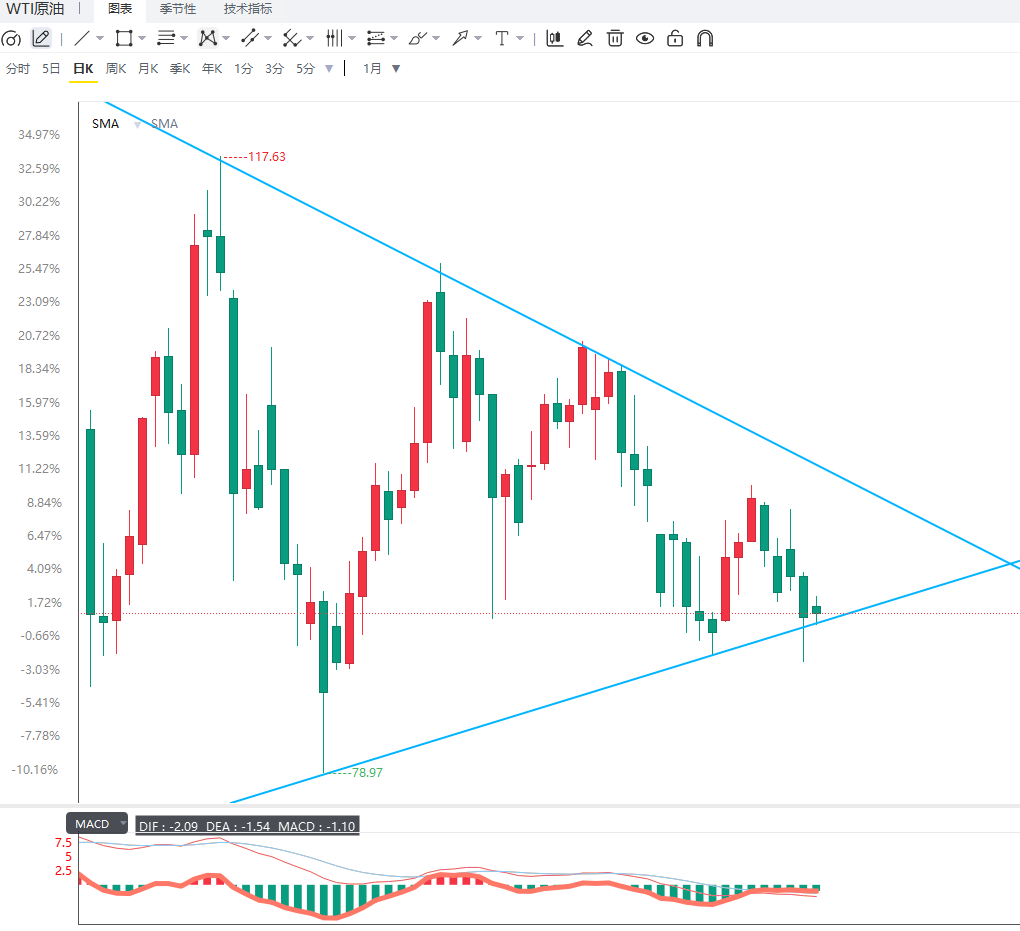
Editor's Summary : Current international oil price trends are still primarily influenced by both geopolitical tensions and actual supply conditions. Recurring conflicts in the Middle East and a significant decline in US inventories have provided substantial support for oil prices; however, the resumption of shipping through the Strait of Hormuz and increased exports have alleviated market concerns about extreme supply disruptions. In the short term, the $87 to $90 per barrel range will be a crucial area for WTI crude oil to choose its direction. Investors need to continuously monitor developments in the Middle East, US inventory data, and global energy transportation conditions, as these factors will determine the future direction of oil prices in the short term.
Following a brief truce between Israel and Iran, the regional conflict has not shown significant signs of abating. The United States subsequently launched a new round of military strikes against Iranian coastal targets in response to Iran's earlier actions toward military targets near the Strait of Hormuz, a key energy corridor. Meanwhile, Iran stated that it would resume full-scale military confrontation if Israel continued its military operations against Hezbollah in Lebanon. This has increased the uncertainty surrounding the previously fragile temporary ceasefire agreement and heightened risk premiums in global energy markets.
Market concerns about Middle Eastern energy supplies were further fueled by inventory data. The latest data from the American Petroleum Institute (API) showed that U.S. commercial crude oil inventories fell by approximately 9.1 million barrels last week, reaching their lowest level in nearly four months, reflecting that refiners and buyers accelerated the pace of replenishing crude oil reserves amid continued supply risks in the Persian Gulf region.
It is worth noting that although the ongoing regional conflict continues to affect market sentiment, U.S. energy officials have stated that ship traffic and crude oil exports through the Strait of Hormuz have increased, indicating that the global energy transportation system remains relatively resilient. Since the Strait of Hormuz handles approximately 20% of global seaborne crude oil transport, its operational status remains a key factor determining international oil price trends.
From a technical perspective, the WTI crude oil daily chart shows that after a rapid rise, oil prices have entered a high-level consolidation phase. Although the previous trading day saw a drop of over 2.5%, prices remain within the main upward trend channel. In the short term, the area around $87/barrel has become a key support zone. If this level can be held, oil prices are expected to challenge the $90/barrel resistance zone or even higher; conversely, if the support is broken, prices may fall back to around $85/barrel. Daily momentum indicators show that bullish momentum has weakened somewhat, but the overall upward structure has not been completely broken.
From a 4-hour chart perspective, oil prices have undergone a technical correction after a rapid pullback, with short-term moving averages gradually flattening out, indicating a renewed battle between bulls and bears. If the situation in the Middle East escalates further, or if US inventories continue to decline, supply concerns could drive oil prices higher again. However, if ceasefire negotiations make positive progress and shipping in the Strait of Hormuz remains stable, market risk premiums may further decline, thus limiting the upside potential for oil prices.
Editor's Summary : Current international oil price trends are still primarily influenced by both geopolitical tensions and actual supply conditions. Recurring conflicts in the Middle East and a significant decline in US inventories have provided substantial support for oil prices; however, the resumption of shipping through the Strait of Hormuz and increased exports have alleviated market concerns about extreme supply disruptions. In the short term, the $87 to $90 per barrel range will be a crucial area for WTI crude oil to choose its direction. Investors need to continuously monitor developments in the Middle East, US inventory data, and global energy transportation conditions, as these factors will determine the future direction of oil prices in the short term.
- Risk Warning and Disclaimer
- The market involves risk, and trading may not be suitable for all investors. This article is for reference only and does not constitute personal investment advice, nor does it take into account certain users’ specific investment objectives, financial situation, or other needs. Any investment decisions made based on this information are at your own risk.