Despite reports of a major breakthrough in uranium enrichment negotiations between the US and Iran, why are gold prices still stagnant?
2026-06-10 16:35:41
On Wednesday (June 10), spot gold continued its decline during the Asian and European sessions, following a sharp drop on Tuesday. It rebounded slightly after hitting a low during the session due to positive news and is currently trading around 4189. The US-Iran peace talks are facing numerous obstacles. The US hopes to reach a respectable agreement and maintain its dominant stance, which requires a response from the US military after Iran destroyed its helicopters. However, a hardline US response could make Iran even less willing to compromise, preventing an agreement from being signed. This vicious cycle makes the prospects for peace talks very bleak.
However, amid the decline in gold prices, good news emerged regarding the US-Iran nuclear negotiations. On the 9th, US media quoted US officials and several diplomats as saying that the negotiations between the US and Iran, mediated by Pakistan, had made "significant progress." Among the issues, the US position on the disposal of Iran's enriched uranium had changed: it no longer demanded that Iran transport its highly enriched uranium stockpile to other countries, but instead cooperated with the International Atomic Energy Agency to dilute it.
According to reports, the likelihood of an agreement between Iran and the US is much higher than previously expected. The two sides are currently bargaining over four demands put forward by the US, including extending the moratorium on uranium enrichment activities; diluting the stockpile of highly enriched uranium; dismantling multiple nuclear facilities; and allowing international nuclear watchdogs to conduct surprise inspections in Iran.
The report also cited Iranian sources as saying that the Iranian leadership believes that sending enriched uranium to other countries would make Iran more vulnerable to attacks from the US and Israel.
However, observing gold prices, after the rebound, they resumed their downward trend, meaning that the 60-day temporary ceasefire no longer aroused market interest. The market turned its attention to the most important nuclear issue, which is also the underlying logic for determining whether the US military's actions were meaningful. If an agreement is reached, the US can reverse the pressure from public opinion, but the continued decline in gold prices indicates that the market is not optimistic about the US-Iran nuclear negotiations.

Early Wednesday morning, a roar over the Strait of Hormuz shattered the fragile illusion of peace in the Middle East. A U.S. AH-64 Apache attack helicopter collided with an Iranian drone and crashed while patrolling off the coast of Oman.
Although the two crew members were successfully rescued unharmed by the unmanned surface vessel, this seemingly accidental incident was quickly characterized by Washington as a deliberate provocation by Iran.
Hours later, the U.S. Central Command launched three rounds of precision airstrikes against air defense facilities, ground command posts, and radar sites around the Iranian port of Bandar Abbas and Qeshm Island, thus beginning a new round of retaliation and counter-retaliation.
Faced with the US's touted "reciprocal retaliation," Iran did not choose to remain silent but instead directly overturned the ceasefire negotiations that had been painstakingly maintained since April. Tehran swiftly launched retaliatory actions, firing a barrage of missiles and drones at Jordan's Muwafak Salti airbase, which houses US F-35 fighter jets, as well as US military targets in Bahrain and Kuwait.
Although Jordan and other countries successfully intercepted some incoming weapons by activating their air defense systems and no large-scale casualties have occurred so far, these rounds of intense shelling have brought the already fragile ceasefire consensus to the brink of complete collapse, and the situation in the Middle East has once again fallen into a dangerous state of tension.
Looking back at this conflict that began on February 28, the US, Iran, and Israel have long been caught in a bizarre vicious cycle of geopolitical maneuvering.
For Israeli Prime Minister Netanyahu, continuing to escalate military operations in southern Lebanon and maintaining a "state of war" is the best bargaining chip for consolidating his domestic rule and prolonging his political life.
Iran, which has long been subject to sanctions, has retaliated against the extreme pressure exerted by the US military's Apache helicopters blocking oil routes with a "barefoot but not afraid of those wearing shoes" attitude—directly creating conflict with drones and pushing the navigation risks in the Strait of Hormuz to the extreme.
For Iran, the situation could not have gotten any worse; this maximum pressure has instead become a bloody bargaining chip to force the United States to make concessions on the issues of lifting sanctions and unfreezing assets.
Caught in the middle, the United States is caught in a dilemma of "sure to lose money." Trump, who has returned to the White House, is facing enormous pressure in the 2026 midterm elections: he needs to show a tough stance in front of voters and hawks and keep raising his demands in negotiations with Iran to demonstrate a "strongman image"; but the more stringent the terms of the agreement, the stronger Iran's resistance will be, and the slimmer the possibility of the negotiations will become.
This vicious cycle leads to the indefinite prolongation of the war, which will ultimately only backfire on America's own strategic interests and economic foundation.
Despite heated rhetoric and constant military actions, both the US and Iran are striving to avoid crossing the irreversible red line of a full-scale war, constrained by US domestic law and the realities of the Middle East.
Whether the situation can ease depends on closely monitoring three key indicators:
First, the boundaries of a second US retaliation: constrained by the 60-day deadline of the War Powers Act and congressional opposition, the White House cannot launch a full-scale war authorized by Congress. If subsequent counterattacks remain limited to the scope of reciprocal self-defense of "hit and run," it indicates that the US is still testing the waters within the legal framework. If it rashly strikes the core of the Iranian Revolutionary Guard or oil ports, it may trigger domestic political backlash due to unconstitutional controversies.
Secondly, the Trump administration's negotiating narrative strategy—Trump's continued "optimism" about negotiations after the plane crash reveals his eagerness to achieve political results before the midterm elections. It remains to be seen whether the White House will use third-party mediation, such as Pakistan, to make implicit concessions like gradually unfreezing assets in exchange for progress in nuclear negotiations, while simultaneously maintaining the narrative that "US military pressure has been effective." After all, a full resolution to the nuclear issue could cover up all the flaws in the entire military operation.
Third, Israel's "proxy role"—if direct fighting between the US and Iran cools down, but Israel intensifies its attacks on Hezbollah in Lebanon, it means that the US may have the upper hand in negotiations, which would be conducive to the signing of an agreement.
Israel's continued bombing of Lebanon may indeed prove that the United States still has a significant negotiating advantage. Trump has also said more than 30 times that an agreement is about to be reached, hoping to achieve a short-term ceasefire agreement. However, if the United States really wants the situation in the Middle East to benefit the midterm elections, then a temporary ceasefire agreement will not prove anything. The United States may turn its attention to the final nuclear issue. Of course, this nuclear agreement is still very difficult, and Iran is unlikely to make concessions.
Technically, spot gold is accelerating its decline within a descending channel, with the market betting that peace talks will not materialize in the short term. The key price level is currently at the 0.618 Fibonacci retracement level of 4066, with strong support around 4066-4150. Gold prices previously saw significant volume in this area. If this zone is breached, it could trigger stop-loss orders from long positions, leading to a rapid break below this key level in the short term. Going forward, watch for support around 4100, near the lower trendline of the descending channel. Specifically, the previous lows of 4090 and 4066 are either unlikely to be breached, or a close approach would almost certainly result in a break below them.
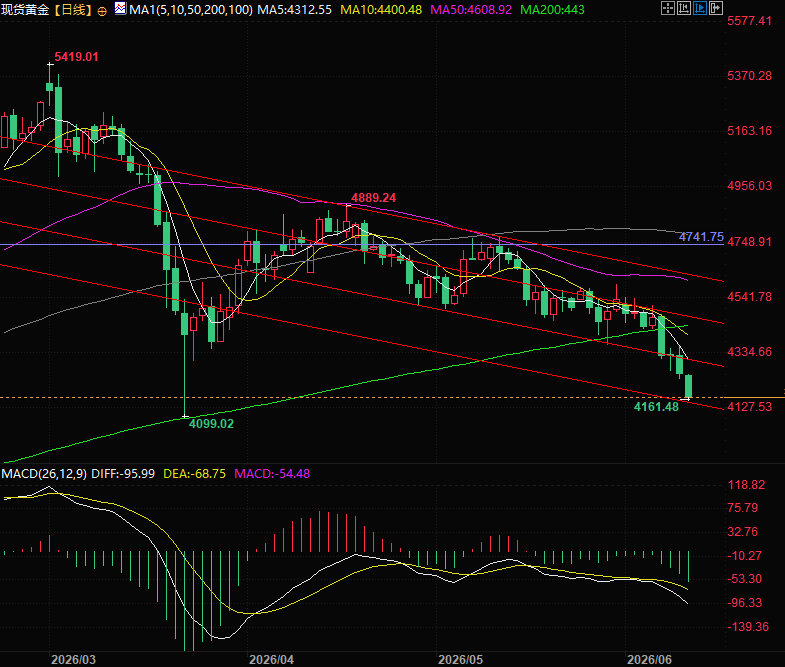
(Spot gold daily chart, source: FX678)
At 16:33 Beijing time, spot gold was trading at $4,168 per ounce.
However, amid the decline in gold prices, good news emerged regarding the US-Iran nuclear negotiations. On the 9th, US media quoted US officials and several diplomats as saying that the negotiations between the US and Iran, mediated by Pakistan, had made "significant progress." Among the issues, the US position on the disposal of Iran's enriched uranium had changed: it no longer demanded that Iran transport its highly enriched uranium stockpile to other countries, but instead cooperated with the International Atomic Energy Agency to dilute it.
According to reports, the likelihood of an agreement between Iran and the US is much higher than previously expected. The two sides are currently bargaining over four demands put forward by the US, including extending the moratorium on uranium enrichment activities; diluting the stockpile of highly enriched uranium; dismantling multiple nuclear facilities; and allowing international nuclear watchdogs to conduct surprise inspections in Iran.
The report also cited Iranian sources as saying that the Iranian leadership believes that sending enriched uranium to other countries would make Iran more vulnerable to attacks from the US and Israel.
However, observing gold prices, after the rebound, they resumed their downward trend, meaning that the 60-day temporary ceasefire no longer aroused market interest. The market turned its attention to the most important nuclear issue, which is also the underlying logic for determining whether the US military's actions were meaningful. If an agreement is reached, the US can reverse the pressure from public opinion, but the continued decline in gold prices indicates that the market is not optimistic about the US-Iran nuclear negotiations.
The plane crash ignited a fuse: the US and Iran quickly fell into a cycle of retaliation.
Early Wednesday morning, a roar over the Strait of Hormuz shattered the fragile illusion of peace in the Middle East. A U.S. AH-64 Apache attack helicopter collided with an Iranian drone and crashed while patrolling off the coast of Oman.
Although the two crew members were successfully rescued unharmed by the unmanned surface vessel, this seemingly accidental incident was quickly characterized by Washington as a deliberate provocation by Iran.
Hours later, the U.S. Central Command launched three rounds of precision airstrikes against air defense facilities, ground command posts, and radar sites around the Iranian port of Bandar Abbas and Qeshm Island, thus beginning a new round of retaliation and counter-retaliation.
Faced with the US's touted "reciprocal retaliation," Iran did not choose to remain silent but instead directly overturned the ceasefire negotiations that had been painstakingly maintained since April. Tehran swiftly launched retaliatory actions, firing a barrage of missiles and drones at Jordan's Muwafak Salti airbase, which houses US F-35 fighter jets, as well as US military targets in Bahrain and Kuwait.
Although Jordan and other countries successfully intercepted some incoming weapons by activating their air defense systems and no large-scale casualties have occurred so far, these rounds of intense shelling have brought the already fragile ceasefire consensus to the brink of complete collapse, and the situation in the Middle East has once again fallen into a dangerous state of tension.
A vicious cycle of tripartite power struggles: a geopolitical predicament where each party has its own agenda.
Looking back at this conflict that began on February 28, the US, Iran, and Israel have long been caught in a bizarre vicious cycle of geopolitical maneuvering.
For Israeli Prime Minister Netanyahu, continuing to escalate military operations in southern Lebanon and maintaining a "state of war" is the best bargaining chip for consolidating his domestic rule and prolonging his political life.
Iran, which has long been subject to sanctions, has retaliated against the extreme pressure exerted by the US military's Apache helicopters blocking oil routes with a "barefoot but not afraid of those wearing shoes" attitude—directly creating conflict with drones and pushing the navigation risks in the Strait of Hormuz to the extreme.
For Iran, the situation could not have gotten any worse; this maximum pressure has instead become a bloody bargaining chip to force the United States to make concessions on the issues of lifting sanctions and unfreezing assets.
Caught in the middle, the United States is caught in a dilemma of "sure to lose money." Trump, who has returned to the White House, is facing enormous pressure in the 2026 midterm elections: he needs to show a tough stance in front of voters and hawks and keep raising his demands in negotiations with Iran to demonstrate a "strongman image"; but the more stringent the terms of the agreement, the stronger Iran's resistance will be, and the slimmer the possibility of the negotiations will become.
This vicious cycle leads to the indefinite prolongation of the war, which will ultimately only backfire on America's own strategic interests and economic foundation.
Three indicators of easing tensions: probing and tacit understanding beneath the red line
Despite heated rhetoric and constant military actions, both the US and Iran are striving to avoid crossing the irreversible red line of a full-scale war, constrained by US domestic law and the realities of the Middle East.
Whether the situation can ease depends on closely monitoring three key indicators:
First, the boundaries of a second US retaliation: constrained by the 60-day deadline of the War Powers Act and congressional opposition, the White House cannot launch a full-scale war authorized by Congress. If subsequent counterattacks remain limited to the scope of reciprocal self-defense of "hit and run," it indicates that the US is still testing the waters within the legal framework. If it rashly strikes the core of the Iranian Revolutionary Guard or oil ports, it may trigger domestic political backlash due to unconstitutional controversies.
Secondly, the Trump administration's negotiating narrative strategy—Trump's continued "optimism" about negotiations after the plane crash reveals his eagerness to achieve political results before the midterm elections. It remains to be seen whether the White House will use third-party mediation, such as Pakistan, to make implicit concessions like gradually unfreezing assets in exchange for progress in nuclear negotiations, while simultaneously maintaining the narrative that "US military pressure has been effective." After all, a full resolution to the nuclear issue could cover up all the flaws in the entire military operation.
Third, Israel's "proxy role"—if direct fighting between the US and Iran cools down, but Israel intensifies its attacks on Hezbollah in Lebanon, it means that the US may have the upper hand in negotiations, which would be conducive to the signing of an agreement.
Summary and Technical Analysis:
Israel's continued bombing of Lebanon may indeed prove that the United States still has a significant negotiating advantage. Trump has also said more than 30 times that an agreement is about to be reached, hoping to achieve a short-term ceasefire agreement. However, if the United States really wants the situation in the Middle East to benefit the midterm elections, then a temporary ceasefire agreement will not prove anything. The United States may turn its attention to the final nuclear issue. Of course, this nuclear agreement is still very difficult, and Iran is unlikely to make concessions.
Technically, spot gold is accelerating its decline within a descending channel, with the market betting that peace talks will not materialize in the short term. The key price level is currently at the 0.618 Fibonacci retracement level of 4066, with strong support around 4066-4150. Gold prices previously saw significant volume in this area. If this zone is breached, it could trigger stop-loss orders from long positions, leading to a rapid break below this key level in the short term. Going forward, watch for support around 4100, near the lower trendline of the descending channel. Specifically, the previous lows of 4090 and 4066 are either unlikely to be breached, or a close approach would almost certainly result in a break below them.
(Spot gold daily chart, source: FX678)
At 16:33 Beijing time, spot gold was trading at $4,168 per ounce.
- Risk Warning and Disclaimer
- The market involves risk, and trading may not be suitable for all investors. This article is for reference only and does not constitute personal investment advice, nor does it take into account certain users’ specific investment objectives, financial situation, or other needs. Any investment decisions made based on this information are at your own risk.