Rising inflation expectations in Europe are fueling anticipation of earlier action, with Amundi predicting consecutive interest rate hikes by the European Central Bank in June and July.
2026-06-10 17:21:51
In a recent research report, Amundi's chief investment officer team stated that the European Central Bank (ECB) may take more aggressive short-term tightening measures in the coming months to address rising inflation expectations. The institution predicts that the ECB will raise interest rates by 25 basis points in both June and July, a more hawkish stance than the market's previous consensus that it might wait until September to act.

Amundi points out that the core factor driving the European Central Bank to raise interest rates ahead of schedule is not the current inflation data itself, but rather the policymakers' concern that inflation expectations may gradually solidify. In particular, recent surveys show that more and more companies are planning to raise the prices of their products and services, which may increase the risk of persistent price pressures in the future.
The European economy is currently facing challenges from volatile energy costs and persistent price pressures, with rising business costs leaving room for further adjustments in end-market prices. For the European Central Bank, controlling long-term inflation expectations among households and businesses is crucial, because if the market believes that high inflation will persist, wage negotiations, consumer behavior, and corporate pricing strategies may all change, making it even more difficult for inflation to fall back down.
However, Amundi also emphasized that the market has not yet seen sufficient evidence to prove that inflation has formed a significant second-round effect, such as continued rapid wage increases further pushing up service sector prices. Therefore, the institution believes that it is more reasonable for the European Central Bank to take two preventative interest rate hikes at present, rather than entering a prolonged period of large-scale tightening.
From a financial market perspective, expectations of an earlier-than-expected interest rate hike by the European Central Bank are likely to continue supporting the euro's performance. Higher interest rates will enhance the attractiveness of euro-denominated assets and narrow the policy gap with other major economies. However, whether the euro can continue to strengthen in the future still depends on the performance of European economic growth, the direction of US monetary policy, and changes in global market risk aversion.
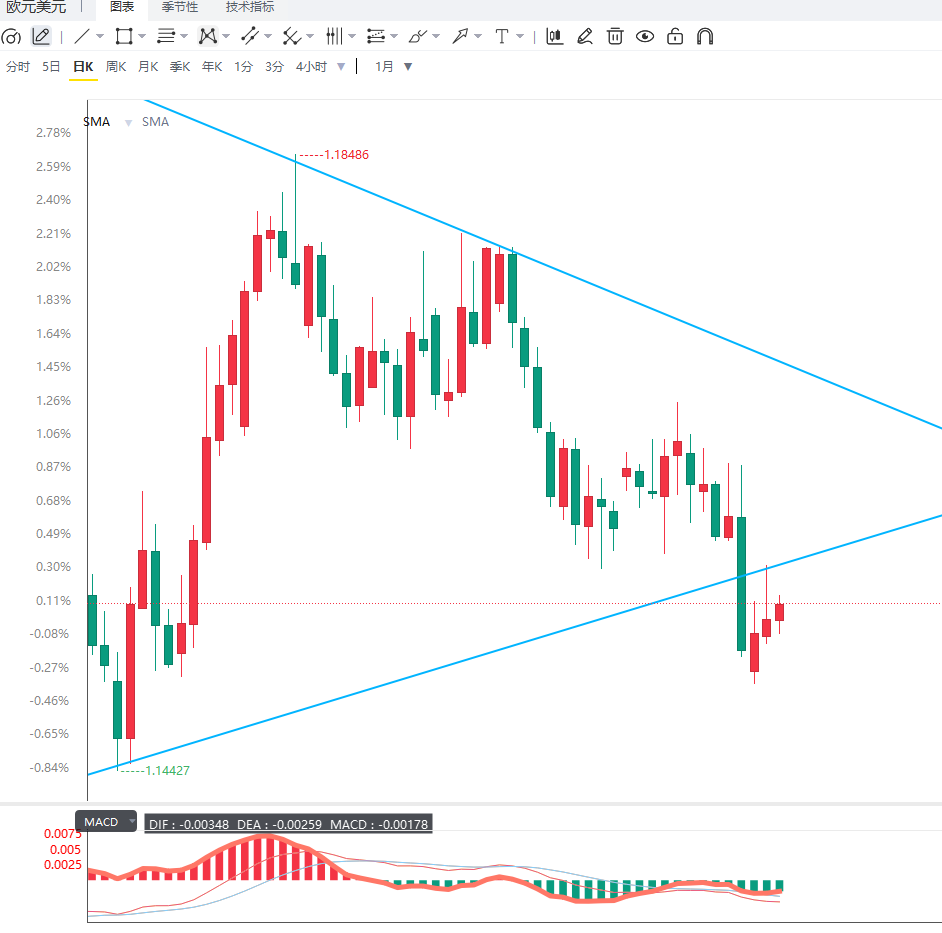
From a technical perspective, the EUR/USD daily chart shows that although the exchange rate has been under pressure recently due to safe-haven demand for the US dollar, it has found significant support around the 1.1500 area . If the European Central Bank releases a stronger hawkish signal and pushes the exchange rate back above the 1.1600 level , the bulls are expected to further challenge the key moving average resistance around 1.1670 , and a break above this level could extend the upward trend towards the 1.1740 area .
From a 4-hour chart perspective, the euro/dollar pair remains in a short-term consolidation phase at lower levels. Technical indicators suggest that downward momentum has weakened, but the bulls have not yet fully taken control of the market. If US inflation data continues to strengthen and reinforces expectations that the Federal Reserve will maintain high interest rates, the dollar may regain buying interest, and the euro/dollar pair may retest the support areas of 1.1500 and 1.1470 . Conversely, if expectations of continued interest rate hikes by the European Central Bank intensify further, the euro may have room for further rebound.
Editor's Summary : Amundi anticipates consecutive interest rate hikes by the European Central Bank (ECB) in June and July, reflecting policymakers' heightened concern about rising inflation expectations. While there are currently no clear signs of a wage and price spiral, proactive policy action could help prevent long-term inflation expectations from spiraling out of control. In the short term, ECB policy signals, US inflation trends, and the strength of the US dollar will remain key factors influencing the euro's exchange rate against the dollar. Investors should pay close attention to whether the euro can hold the key support level of 1.1500 and whether it has the ability to break through the resistance level of 1.1600.
Amundi points out that the core factor driving the European Central Bank to raise interest rates ahead of schedule is not the current inflation data itself, but rather the policymakers' concern that inflation expectations may gradually solidify. In particular, recent surveys show that more and more companies are planning to raise the prices of their products and services, which may increase the risk of persistent price pressures in the future.
The European economy is currently facing challenges from volatile energy costs and persistent price pressures, with rising business costs leaving room for further adjustments in end-market prices. For the European Central Bank, controlling long-term inflation expectations among households and businesses is crucial, because if the market believes that high inflation will persist, wage negotiations, consumer behavior, and corporate pricing strategies may all change, making it even more difficult for inflation to fall back down.
However, Amundi also emphasized that the market has not yet seen sufficient evidence to prove that inflation has formed a significant second-round effect, such as continued rapid wage increases further pushing up service sector prices. Therefore, the institution believes that it is more reasonable for the European Central Bank to take two preventative interest rate hikes at present, rather than entering a prolonged period of large-scale tightening.
From a financial market perspective, expectations of an earlier-than-expected interest rate hike by the European Central Bank are likely to continue supporting the euro's performance. Higher interest rates will enhance the attractiveness of euro-denominated assets and narrow the policy gap with other major economies. However, whether the euro can continue to strengthen in the future still depends on the performance of European economic growth, the direction of US monetary policy, and changes in global market risk aversion.
From a technical perspective, the EUR/USD daily chart shows that although the exchange rate has been under pressure recently due to safe-haven demand for the US dollar, it has found significant support around the 1.1500 area . If the European Central Bank releases a stronger hawkish signal and pushes the exchange rate back above the 1.1600 level , the bulls are expected to further challenge the key moving average resistance around 1.1670 , and a break above this level could extend the upward trend towards the 1.1740 area .
From a 4-hour chart perspective, the euro/dollar pair remains in a short-term consolidation phase at lower levels. Technical indicators suggest that downward momentum has weakened, but the bulls have not yet fully taken control of the market. If US inflation data continues to strengthen and reinforces expectations that the Federal Reserve will maintain high interest rates, the dollar may regain buying interest, and the euro/dollar pair may retest the support areas of 1.1500 and 1.1470 . Conversely, if expectations of continued interest rate hikes by the European Central Bank intensify further, the euro may have room for further rebound.
Editor's Summary : Amundi anticipates consecutive interest rate hikes by the European Central Bank (ECB) in June and July, reflecting policymakers' heightened concern about rising inflation expectations. While there are currently no clear signs of a wage and price spiral, proactive policy action could help prevent long-term inflation expectations from spiraling out of control. In the short term, ECB policy signals, US inflation trends, and the strength of the US dollar will remain key factors influencing the euro's exchange rate against the dollar. Investors should pay close attention to whether the euro can hold the key support level of 1.1500 and whether it has the ability to break through the resistance level of 1.1600.
- Risk Warning and Disclaimer
- The market involves risk, and trading may not be suitable for all investors. This article is for reference only and does not constitute personal investment advice, nor does it take into account certain users’ specific investment objectives, financial situation, or other needs. Any investment decisions made based on this information are at your own risk.