A fresh take on an old topic: Why does gold continue to fall despite ongoing geopolitical conflicts?
2026-06-10 17:33:36
However, in recent years, the global market has frequently witnessed an "abnormal" scene: despite the undercurrents in the Middle East and the constant geopolitical conflicts, with news headlines filled with crises, gold prices have not only failed to experience the expected one-sided surge, but have instead shown a downward trend with fluctuations, and even a short-term accelerated correction.
As the saying goes, "When gunfire erupts, gold soars," which usually refers to a full-scale war, the fall of one's homeland, the devaluation of one's own currency, and the complete paralysis of the financial network. As a natural form of currency, gold naturally sees its price rise. However, most modern "geopolitical conflicts" are localized, proxy-based, and controllable frictions. In such cases, the global financial network remains intact, the US dollar remains strong, and US Treasury bonds continue to pay interest.
The geopolitical turmoil has failed to provide sustained momentum for gold, a phenomenon that has left countless retail investors who blindly chase high prices for hedging purposes bewildered. Has the "safe haven myth" of gold truly failed?
To understand the underlying causes, we need to move beyond the emotional panic of macro narratives and delve into the underlying pricing logic and capital flows of global finance to find the answers.
While geopolitical conflicts can certainly bring short-term emotional premiums, the core of the gold pricing mechanism has never been news hype, but rather real interest rates. People will calmly calculate the costs and benefits using real interest rates and the amount of liquidity.
The real interest rate (nominal government bond yield minus long-term inflation expectations) reflects the real return for investors after deducting purchasing power losses and serves as an anchor for the valuation of all asset classes in the market.
The underlying financial attributes of gold: Gold is a special asset that does not accrue interest or pay dividends. The only reason to hold gold is that other assets cannot provide a satisfactory real return.
When geopolitical conflicts raise concerns about fiscal pressures, inflation, and supply chain disruptions, nominal yields on U.S. Treasuries often rise due to sell-offs.
If the market's long-term inflation expectations remain relatively stable at this time (reflecting the market's continued confidence in the central bank's ability to control inflation), the result will be a passive increase in real interest rates.
When real interest rates rise, the opportunity cost of holding gold increases significantly. In other words, when investors can obtain substantial and certain real returns by depositing money in government bonds, the appeal of gold as a "dead asset" is dealt a devastating blow.
Currently, this structurally high real interest rate has become a "mountain" weighing on gold prices, strongly offsetting and suppressing the safe-haven premium brought about by geopolitical conflicts.
On another level, global tech stocks have attracted yield-oriented funds, and tech infrastructure has attracted long-term institutional money, leading to less money being used to buy US Treasury bonds and invest in gold. The decrease in US Treasury bond purchases has in turn led to higher US Treasury yields, i.e., higher market interest rates, which in turn have passively increased real interest rates and suppressed gold prices.
From the perspective of trading leverage, when geopolitical conflicts evolve into energy crises, they often trigger another counterintuitive chain reaction—a liquidity crunch and a "dollar shortage."
When core commodities such as crude oil experience price spikes or supply constraints due to conflict, the demand for liquidity (especially US dollar cash) in global supply chains and energy-importing countries increases exponentially.
In extreme circumstances, in order to maintain exchange rate stability, pay high energy import bills, or rescue their domestic banking systems from liquidity depletion, some central banks and sovereign institutions around the world will make a mechanical choice: to convert their highly liquid gold assets into US dollar cash.
This kind of liquidity squeeze caused by a "dollar shortage" has occurred at the beginning of several financial crises in history.
At this point, gold is no longer a safe haven, but has become "the only ATM that can be exchanged for cash" in the hands of institutions.
The central bank's shift from a "strategic buyer" to an "emergency seller" has created direct mechanical selling pressure on gold prices.
Looking back at the gold bull market of the past two years, one of its core drivers was the structural reserve diversification undertaken by global central banks (especially non-Western central banks) in the wave of "de-dollarization".
However, as gold prices hit record highs, by 2025, the pace of gold purchases by major central banks began to slow significantly at the margin.
It was precisely at this juncture, when the central bank, as the "main force," strategically withdrew and turned to a wait-and-see approach, that speculative funds, represented by gold ETFs and retail investors, began to rush in in a panic, drawn by geopolitical news.
Retail investors stepped in at the margin through ETFs, barely managing to keep gold prices at a high level for a period of time.
However, historical experience shows that demand driven by retail investors and leveraged speculators (ETFs) is highly "conditional and unstable".
They lack the strategic patience of central banks across cycles. If gold prices fail to surge as expected due to conflict, or if they encounter the aforementioned pressure from real interest rates, the funds of retail investors who are stuck at high levels will quickly turn against their positions, triggering a stampede of liquidation and causing gold prices to fall rapidly.
In the traditional asset allocation framework, gold is regarded as the "holy grail" because it has zero or even negative correlation with most risky assets (such as stocks and real estate).
Adding gold to an investment portfolio can effectively hedge against the risk of a stock market crash and reduce the overall volatility of the portfolio.
However, a dangerous anomaly has emerged in the current global financial markets: gold and risk assets, represented by technology stocks, have shown a high degree of positive correlation.
The underlying reason for this phenomenon is the extreme popularity of passive investing (ETFs) and the proliferation of leveraged funds in the market in recent years. When market liquidity is abundant, speculative funds simultaneously flow into technology stocks and gold, driving up the prices of both.
When geopolitical conflicts cause volatility (VIX) to surge and leveraged funds face margin calls, institutions may choose to simultaneously liquidate their positions in technology stocks and gold in order to control losses and reduce exposure.
When gold loses its "maverick" trend and becomes a speculative asset that is "highly volatile and resonates with the broader market," it completely loses its value as an investment for large multi-strategy funds and sovereign wealth funds in reducing portfolio volatility.
Institutions have begun to systematically reduce their gold holdings, further withdrawing long-term support funds from the underlying gold price.
The "failure" of gold's safe-haven function is essentially a heavy blow from the market to all investors who adhere to simplistic cause-and-effect reasoning.
While news of geopolitical conflicts can certainly stir up emotions, under the quadruple blows of high real interest rates, mechanical dollar shortages and selling pressure, slowed central bank lending, and diminished investment value, emotional panic ultimately cannot overcome rational financial pricing principles.
For investors, the key takeaway from this is: never equate news hype with market direction. In turbulent times, establishing a structured assessment framework based on real interest rates, liquidity cycles, and asset correlations is far more prudent than reacting to headlines with impulsive buying.
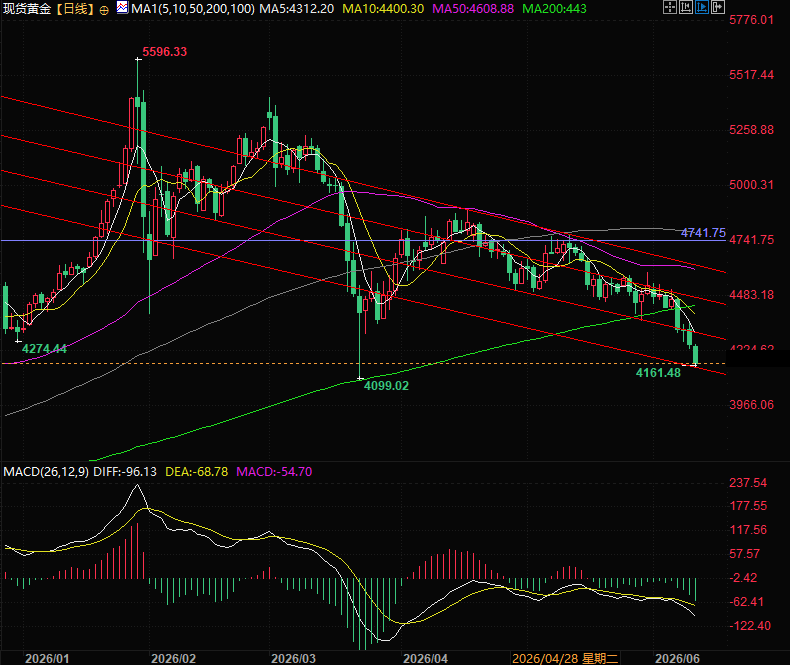
(Spot gold daily chart, source: FX678)
As the saying goes, "When gunfire erupts, gold soars," which usually refers to a full-scale war, the fall of one's homeland, the devaluation of one's own currency, and the complete paralysis of the financial network. As a natural form of currency, gold naturally sees its price rise. However, most modern "geopolitical conflicts" are localized, proxy-based, and controllable frictions. In such cases, the global financial network remains intact, the US dollar remains strong, and US Treasury bonds continue to pay interest.
The geopolitical turmoil has failed to provide sustained momentum for gold, a phenomenon that has left countless retail investors who blindly chase high prices for hedging purposes bewildered. Has the "safe haven myth" of gold truly failed?
To understand the underlying causes, we need to move beyond the emotional panic of macro narratives and delve into the underlying pricing logic and capital flows of global finance to find the answers.
Valuation anchor: High real interest rates raise the "holding cost" of gold.
While geopolitical conflicts can certainly bring short-term emotional premiums, the core of the gold pricing mechanism has never been news hype, but rather real interest rates. People will calmly calculate the costs and benefits using real interest rates and the amount of liquidity.
The real interest rate (nominal government bond yield minus long-term inflation expectations) reflects the real return for investors after deducting purchasing power losses and serves as an anchor for the valuation of all asset classes in the market.
The underlying financial attributes of gold: Gold is a special asset that does not accrue interest or pay dividends. The only reason to hold gold is that other assets cannot provide a satisfactory real return.
When geopolitical conflicts raise concerns about fiscal pressures, inflation, and supply chain disruptions, nominal yields on U.S. Treasuries often rise due to sell-offs.
If the market's long-term inflation expectations remain relatively stable at this time (reflecting the market's continued confidence in the central bank's ability to control inflation), the result will be a passive increase in real interest rates.
When real interest rates rise, the opportunity cost of holding gold increases significantly. In other words, when investors can obtain substantial and certain real returns by depositing money in government bonds, the appeal of gold as a "dead asset" is dealt a devastating blow.
Currently, this structurally high real interest rate has become a "mountain" weighing on gold prices, strongly offsetting and suppressing the safe-haven premium brought about by geopolitical conflicts.
On another level, global tech stocks have attracted yield-oriented funds, and tech infrastructure has attracted long-term institutional money, leading to less money being used to buy US Treasury bonds and invest in gold. The decrease in US Treasury bond purchases has in turn led to higher US Treasury yields, i.e., higher market interest rates, which in turn have passively increased real interest rates and suppressed gold prices.
Stifling at the Transaction Level: Energy Crisis Creates "Dollar Shortage," Central Banks Forced to Sell Gold
From the perspective of trading leverage, when geopolitical conflicts evolve into energy crises, they often trigger another counterintuitive chain reaction—a liquidity crunch and a "dollar shortage."
When core commodities such as crude oil experience price spikes or supply constraints due to conflict, the demand for liquidity (especially US dollar cash) in global supply chains and energy-importing countries increases exponentially.
In extreme circumstances, in order to maintain exchange rate stability, pay high energy import bills, or rescue their domestic banking systems from liquidity depletion, some central banks and sovereign institutions around the world will make a mechanical choice: to convert their highly liquid gold assets into US dollar cash.
This kind of liquidity squeeze caused by a "dollar shortage" has occurred at the beginning of several financial crises in history.
At this point, gold is no longer a safe haven, but has become "the only ATM that can be exchanged for cash" in the hands of institutions.
The central bank's shift from a "strategic buyer" to an "emergency seller" has created direct mechanical selling pressure on gold prices.
Reversal of Supply-Demand Mismatch: Marginal Increase in Retail ETFs and Slowdown in Central Bank Gold Purchases
Looking back at the gold bull market of the past two years, one of its core drivers was the structural reserve diversification undertaken by global central banks (especially non-Western central banks) in the wave of "de-dollarization".
However, as gold prices hit record highs, by 2025, the pace of gold purchases by major central banks began to slow significantly at the margin.
It was precisely at this juncture, when the central bank, as the "main force," strategically withdrew and turned to a wait-and-see approach, that speculative funds, represented by gold ETFs and retail investors, began to rush in in a panic, drawn by geopolitical news.
Retail investors stepped in at the margin through ETFs, barely managing to keep gold prices at a high level for a period of time.
However, historical experience shows that demand driven by retail investors and leveraged speculators (ETFs) is highly "conditional and unstable".
They lack the strategic patience of central banks across cycles. If gold prices fail to surge as expected due to conflict, or if they encounter the aforementioned pressure from real interest rates, the funds of retail investors who are stuck at high levels will quickly turn against their positions, triggering a stampede of liquidation and causing gold prices to fall rapidly.
The loss of investment value: Gold and tech stocks move in tandem.
In the traditional asset allocation framework, gold is regarded as the "holy grail" because it has zero or even negative correlation with most risky assets (such as stocks and real estate).
Adding gold to an investment portfolio can effectively hedge against the risk of a stock market crash and reduce the overall volatility of the portfolio.
However, a dangerous anomaly has emerged in the current global financial markets: gold and risk assets, represented by technology stocks, have shown a high degree of positive correlation.
The underlying reason for this phenomenon is the extreme popularity of passive investing (ETFs) and the proliferation of leveraged funds in the market in recent years. When market liquidity is abundant, speculative funds simultaneously flow into technology stocks and gold, driving up the prices of both.
When geopolitical conflicts cause volatility (VIX) to surge and leveraged funds face margin calls, institutions may choose to simultaneously liquidate their positions in technology stocks and gold in order to control losses and reduce exposure.
When gold loses its "maverick" trend and becomes a speculative asset that is "highly volatile and resonates with the broader market," it completely loses its value as an investment for large multi-strategy funds and sovereign wealth funds in reducing portfolio volatility.
Institutions have begun to systematically reduce their gold holdings, further withdrawing long-term support funds from the underlying gold price.
Conclusion: Structural framing triumphs over reactive news.
The "failure" of gold's safe-haven function is essentially a heavy blow from the market to all investors who adhere to simplistic cause-and-effect reasoning.
While news of geopolitical conflicts can certainly stir up emotions, under the quadruple blows of high real interest rates, mechanical dollar shortages and selling pressure, slowed central bank lending, and diminished investment value, emotional panic ultimately cannot overcome rational financial pricing principles.
For investors, the key takeaway from this is: never equate news hype with market direction. In turbulent times, establishing a structured assessment framework based on real interest rates, liquidity cycles, and asset correlations is far more prudent than reacting to headlines with impulsive buying.
(Spot gold daily chart, source: FX678)
- Risk Warning and Disclaimer
- The market involves risk, and trading may not be suitable for all investors. This article is for reference only and does not constitute personal investment advice, nor does it take into account certain users’ specific investment objectives, financial situation, or other needs. Any investment decisions made based on this information are at your own risk.