Euro Analysis: The ECB's hawkish stance failed to trigger new buying; investors should be prepared for volatility.
2026-06-12 19:21:47
As of June 12, 2026, the euro is at a critical turning point. Although the European Central Bank's policy meeting on June 11 was widely regarded as having a hawkish stance, it failed to effectively push the EUR/USD exchange rate above 1.16. This article combines the latest fundamental developments with a detailed technical analysis of EUR/USD to provide traders with trading guidance for the coming weeks.
Fundamental Background: The ECB's hawkish stance failed to fully realize the euro's appreciation.
The European Central Bank's meeting yesterday sent a clear signal of tightening. The market has received multiple messages from the ECB indicating that another 25 basis point rate hike is very likely in July. However, the core issue for the euro is that the market has already fully priced in more aggressive tightening measures from the ECB over the next nine months, with a cumulative rate hike potentially reaching 75 basis points. Investors do not want this tightening expectation to intensify further.
The European Central Bank's actions are aimed at addressing the current stagflation caused by supply shocks, but excessive tightening could also amplify the risk of a slowdown in Eurozone economic growth. Before US President Trump's comments last night, the euro/dollar pair hovered near the key support level of 1.1500. Currently, the exchange rate remains below 1.1600. This suggests that despite the ECB's hawkish stance, the impact of the Federal Reserve's tightening policy appears to be more significant. Unless the Fed releases a surprisingly dovish statement next Wednesday, the dollar will continue to receive strong support.
In short, the Federal Reserve's policy signals have a greater impact on the market than the European Central Bank's actions. The consensus among institutions like Bloomberg remains that there will be two rate hikes before the end of 2026 (in June and September), with some analysts believing a move as early as July is possible. This hawkish bias contrasts with the Fed's cautious stance. After the US CPI rose to 4.2% year-on-year in May, market expectations for a Fed rate hike before the end of the year slightly decreased from 73% to 69%. Investors are focusing on the slowdown in month-on-month growth, interpreting it as a signal that inflation may have peaked, which provides the Fed with room to keep interest rates unchanged.
Policy divergence should have benefited the euro, but its actual effect was partially offset. The dollar failed to fully capitalize on safe-haven buying driven by Middle East geopolitical tensions and stock market volatility, while adjustments in the oil market to supply disruptions continued to put pressure on the dollar. However, the European Central Bank's hawkish stance had already been priced in by the market and failed to trigger a new round of euro buying.
Historical experience also serves as a cautionary tale. Institutions like TSLombard warn that the European Central Bank (ECB) needs to avoid repeating the mistakes of 2011 and 2008—premature or inappropriate tightening could trigger even greater problems. Currently, the ECB's focus is on preventing runaway inflation like in 2022, aiming to anchor inflation expectations by tightening now while retaining flexibility for future rate cuts (expected as early as March 2027).
European Central Bank President Christine Lagarde's post-meeting remarks will be crucial. Hawkish signals or an upward revision of inflation forecasts would support the euro, while dovish statements emphasizing growth risks could limit gains. The June rate hike has already been fully priced in; market reaction will depend more on forward guidance, updated economic forecasts, and subsequent actions from the Federal Reserve.
The broader context continues to provide some resilience for the euro: the trajectory of US real yields, changes in risk sentiment, and energy-driven inflation in Europe. However, conflicting news regarding the prospects for peace in the Middle East continues to generate volatility; any signs of easing tensions could exacerbate dollar selling, while conversely, they could strengthen the dollar's safe-haven status.
Technical Outlook: EUR/USD rebounds from 1.15, dollar weakness persists.
(EUR/USD daily chart source: FX678)
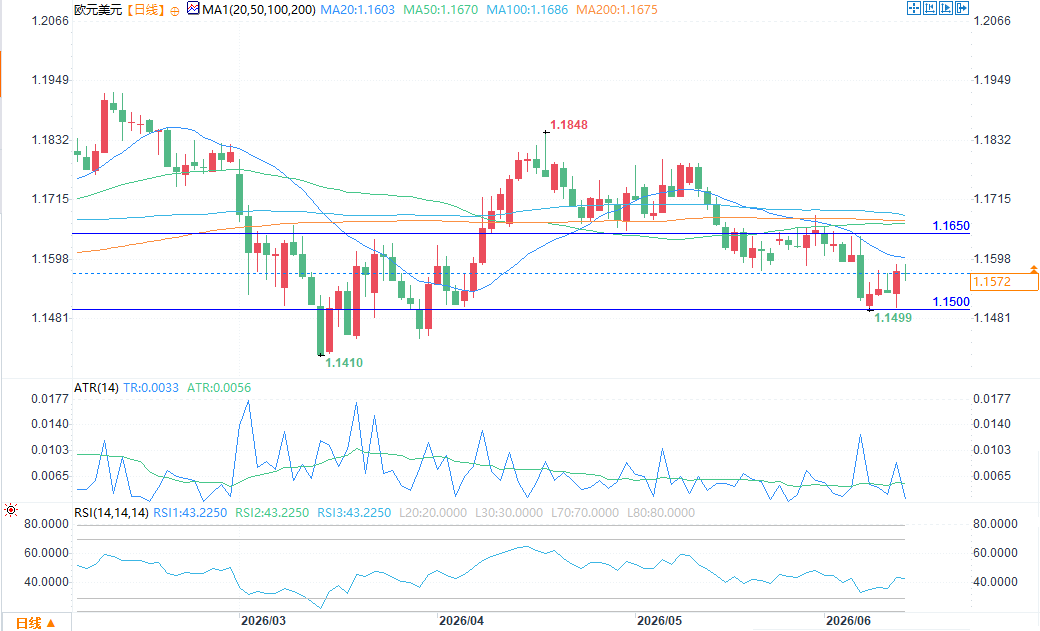
On the daily chart, EUR/USD is in a clear downtrend since its April 2026 high, characterized by a series of lower highs and lower lows. However, a double bottom pattern has formed near the psychological level of 1.15, and a bullish engulfing candlestick appeared on Thursday, indicating active buying. Increased volume during yesterday's rebound provided some support, but the pair failed to break above 1.16, and the 1.1585–1.1600 range is likely to become the day's high area again.
A weak dollar remains the main driver, but sustained dollar pressure or improved risk sentiment is needed to maintain the rebound. Conflicting news from the Middle East situation could quickly weaken the current rally, allowing bears to regain control.
Key technological levels deserve close attention:
Support levels: The 1.1500–1.15 area remains key. A decisive break below this level, accompanied by high volume and a bearish candlestick pattern, would invalidate the double bottom and point to the 1.13–1.14 area (corresponding to the early 2026 low).
Resistance levels: Immediate resistance is located at 1.1585–1.1600. Only a sustained break above 1.1650 (the May high) can shatter recent market optimism regarding the US dollar, invalidate the daily bearish trend, and open up space towards the 200-day moving average and the previous weekly VPOC (approximately the 1.17–1.18 area). The 20-day moving average continues to slope downwards, forming dynamic resistance during any rebound.
Fibonacci retracement analysis shows that the 38.2% retracement level is near 1.16, while the 50% and 61.8% retracement levels are around 1.1650–1.1720. Bulls see these as profit targets, while bears may reposition their short positions near the 200-day moving average or around 1.1650.
The euro/dollar pair is currently trading below its 200-day moving average, and the long-term trend filter remains cautious. Only a decisive break above this moving average would confirm a trend reversal signal.
The daily stochastic oscillator is recovering from oversold territory but has not yet given a clear buy signal; the rebound may first be followed by consolidation. The ATR (Advanced Tempo Variation Ratio) indicates a widening range during the event period. Traders should pay attention to Lagarde's comments and the increased volatility expected during next week's Fed meeting. Implied volatility for euro options remains relatively high, reflecting continued two-way risk.
Summarize
Despite the European Central Bank's hawkish stance yesterday and hints at a possible rate hike in July, the market had already priced in a more aggressive tightening path (75 basis points cumulatively over the next nine months), preventing the euro/dollar from effectively breaking through 1.16. The exchange rate remains capped in the 1.1585–1.1600 range; only a break above 1.1650 would truly challenge the expectation of a strong dollar.
The euro remains "in the hands of the European Central Bank," but the Federal Reserve's statements next week could have a greater impact. Traders and investors need to prepare for volatility and pay close attention to the policy battle between inflation control and growth preservation on both sides of the Atlantic.
Fundamental Background: The ECB's hawkish stance failed to fully realize the euro's appreciation.
The European Central Bank's meeting yesterday sent a clear signal of tightening. The market has received multiple messages from the ECB indicating that another 25 basis point rate hike is very likely in July. However, the core issue for the euro is that the market has already fully priced in more aggressive tightening measures from the ECB over the next nine months, with a cumulative rate hike potentially reaching 75 basis points. Investors do not want this tightening expectation to intensify further.
The European Central Bank's actions are aimed at addressing the current stagflation caused by supply shocks, but excessive tightening could also amplify the risk of a slowdown in Eurozone economic growth. Before US President Trump's comments last night, the euro/dollar pair hovered near the key support level of 1.1500. Currently, the exchange rate remains below 1.1600. This suggests that despite the ECB's hawkish stance, the impact of the Federal Reserve's tightening policy appears to be more significant. Unless the Fed releases a surprisingly dovish statement next Wednesday, the dollar will continue to receive strong support.
In short, the Federal Reserve's policy signals have a greater impact on the market than the European Central Bank's actions. The consensus among institutions like Bloomberg remains that there will be two rate hikes before the end of 2026 (in June and September), with some analysts believing a move as early as July is possible. This hawkish bias contrasts with the Fed's cautious stance. After the US CPI rose to 4.2% year-on-year in May, market expectations for a Fed rate hike before the end of the year slightly decreased from 73% to 69%. Investors are focusing on the slowdown in month-on-month growth, interpreting it as a signal that inflation may have peaked, which provides the Fed with room to keep interest rates unchanged.
Policy divergence should have benefited the euro, but its actual effect was partially offset. The dollar failed to fully capitalize on safe-haven buying driven by Middle East geopolitical tensions and stock market volatility, while adjustments in the oil market to supply disruptions continued to put pressure on the dollar. However, the European Central Bank's hawkish stance had already been priced in by the market and failed to trigger a new round of euro buying.
Historical experience also serves as a cautionary tale. Institutions like TSLombard warn that the European Central Bank (ECB) needs to avoid repeating the mistakes of 2011 and 2008—premature or inappropriate tightening could trigger even greater problems. Currently, the ECB's focus is on preventing runaway inflation like in 2022, aiming to anchor inflation expectations by tightening now while retaining flexibility for future rate cuts (expected as early as March 2027).
European Central Bank President Christine Lagarde's post-meeting remarks will be crucial. Hawkish signals or an upward revision of inflation forecasts would support the euro, while dovish statements emphasizing growth risks could limit gains. The June rate hike has already been fully priced in; market reaction will depend more on forward guidance, updated economic forecasts, and subsequent actions from the Federal Reserve.
The broader context continues to provide some resilience for the euro: the trajectory of US real yields, changes in risk sentiment, and energy-driven inflation in Europe. However, conflicting news regarding the prospects for peace in the Middle East continues to generate volatility; any signs of easing tensions could exacerbate dollar selling, while conversely, they could strengthen the dollar's safe-haven status.
Technical Outlook: EUR/USD rebounds from 1.15, dollar weakness persists.
(EUR/USD daily chart source: FX678)
On the daily chart, EUR/USD is in a clear downtrend since its April 2026 high, characterized by a series of lower highs and lower lows. However, a double bottom pattern has formed near the psychological level of 1.15, and a bullish engulfing candlestick appeared on Thursday, indicating active buying. Increased volume during yesterday's rebound provided some support, but the pair failed to break above 1.16, and the 1.1585–1.1600 range is likely to become the day's high area again.
A weak dollar remains the main driver, but sustained dollar pressure or improved risk sentiment is needed to maintain the rebound. Conflicting news from the Middle East situation could quickly weaken the current rally, allowing bears to regain control.
Key technological levels deserve close attention:
Support levels: The 1.1500–1.15 area remains key. A decisive break below this level, accompanied by high volume and a bearish candlestick pattern, would invalidate the double bottom and point to the 1.13–1.14 area (corresponding to the early 2026 low).
Resistance levels: Immediate resistance is located at 1.1585–1.1600. Only a sustained break above 1.1650 (the May high) can shatter recent market optimism regarding the US dollar, invalidate the daily bearish trend, and open up space towards the 200-day moving average and the previous weekly VPOC (approximately the 1.17–1.18 area). The 20-day moving average continues to slope downwards, forming dynamic resistance during any rebound.
Fibonacci retracement analysis shows that the 38.2% retracement level is near 1.16, while the 50% and 61.8% retracement levels are around 1.1650–1.1720. Bulls see these as profit targets, while bears may reposition their short positions near the 200-day moving average or around 1.1650.
The euro/dollar pair is currently trading below its 200-day moving average, and the long-term trend filter remains cautious. Only a decisive break above this moving average would confirm a trend reversal signal.
The daily stochastic oscillator is recovering from oversold territory but has not yet given a clear buy signal; the rebound may first be followed by consolidation. The ATR (Advanced Tempo Variation Ratio) indicates a widening range during the event period. Traders should pay attention to Lagarde's comments and the increased volatility expected during next week's Fed meeting. Implied volatility for euro options remains relatively high, reflecting continued two-way risk.
Summarize
Despite the European Central Bank's hawkish stance yesterday and hints at a possible rate hike in July, the market had already priced in a more aggressive tightening path (75 basis points cumulatively over the next nine months), preventing the euro/dollar from effectively breaking through 1.16. The exchange rate remains capped in the 1.1585–1.1600 range; only a break above 1.1650 would truly challenge the expectation of a strong dollar.
The euro remains "in the hands of the European Central Bank," but the Federal Reserve's statements next week could have a greater impact. Traders and investors need to prepare for volatility and pay close attention to the policy battle between inflation control and growth preservation on both sides of the Atlantic.
- Risk Warning and Disclaimer
- The market involves risk, and trading may not be suitable for all investors. This article is for reference only and does not constitute personal investment advice, nor does it take into account certain users’ specific investment objectives, financial situation, or other needs. Any investment decisions made based on this information are at your own risk.