Analysts: AI bubble threatens dollar, gold poised for a super rally to over $10,000.
2026-06-16 10:35:16
Following the provisional agreement reached between the US and Iran for navigation in the Strait of Hormuz, global capital markets experienced a short-term surge, with international oil prices falling to a two-month low and US risk assets rising in tandem. However, senior macro analyst David Woo offers a disruptive perspective, arguing that the market's current optimism is severely skewed, ignoring the strategic setbacks the agreement represents for the US, as well as the deep-seated crises lurking in the dollar and artificial intelligence sectors. He further suggests that gold is quietly pricing in this significant, unnoticed risk.
David Wu, a former senior analyst at Bank of America with 20 years of experience in global interest rate and exchange rate research, stated that the US-Iran ceasefire and air travel agreement represents the most significant single strategic defeat for the US since the Vietnam War, amounting to a complete compromise with foreign powers. He emphasized that the market is currently only seeing the short-term benefits of lower oil prices and reduced inflation, completely ignoring the far-reaching impact of the event. Countries around the world will reassess the US's international credibility, and the US's global hegemonic position may be at a critical turning point.
Behind the seemingly recovering market lies a profound restructuring of the global monetary and geopolitical landscape.
Amid geopolitical risks reshaping market expectations, gold led the way with its independent price movement. Spot gold rose for the third consecutive trading day on Monday, gaining 2.19% to close firmly at $4309.05 per ounce. Although gold has seen a slight pullback over the past month, its annual gain still exceeds 28%, maintaining its solid long-term investment value.
Regarding the market's focus on the short-term pullback in gold prices, David Wu offered a niche interpretation that aligns with fundamentals. He stated that this round of gold price declines was not due to a decline in investment demand, but rather a passive cash-out behavior by Gulf oil-producing countries. During the Middle East conflict, oil-producing countries faced obstacles in crude oil exports and cash flow pressures. Selling US Treasury bonds was susceptible to US regulatory scrutiny, making gold the only viable channel for liquidation. This passive selling in the short term suppressed gold prices.
From a long-term perspective, the support for gold is very solid. Data from the World Gold Council shows that global central bank gold purchases reached 863 tons in 2025, far exceeding the historical average for the fourth consecutive year, and official gold purchases continued in the first quarter of 2026. Currently, gold has surpassed US Treasury bonds to become the world's largest reserve asset, directly reflecting the long-term trend of global de-dollarization. David Wu believes that a gold price above $4,000 per ounce presents an excellent opportunity for long-term investment.
David Wu points out that the current strength of the US dollar relies entirely on the benefits of the artificial intelligence industry. The global deployment of US AI technology, chips, and model assets requires substantial purchases of US dollars, forming the core support for the dollar . He bluntly states that if the AI bubble bursts, the dollar will completely lose its support, and the market will experience a sharp decline.
The AI industry is currently facing a double squeeze, with downside risks accumulating. The US is tightening export regulations on high-end AI technologies for security reasons, while domestic competitors offering high-performance, cost-effective products continue to seize market share, leading to a continued inflation of valuation bubbles in US AI companies. Meanwhile, leading global technology companies saw a significant decline in capital expenditures in the first quarter, slowing the industry's expansion pace. This is likely to trigger a cooling of the AI market in the second half of the year, thereby undermining the core foundation of a strong US dollar.
As a non-interest-bearing asset, gold's price movement is highly negatively correlated with real yields. Previously, rising real yields on US Treasury bonds increased the cost of holding gold, suppressing its price. However, the current rise in real yields is supported by both rising oil prices and the expansion of the AI industry. Now, with the US-Iran reconciliation driving oil prices down significantly, the core negative factors have subsided.
David Wu analyzes that as long as oil prices continue to fall or the AI boom cools down, gold can stabilize and rebound. If the AI bubble bursts completely, it will trigger an economic recession and interest rates will return to low levels, at which point gold prices could potentially hit a historic high of $10,000 per ounce. Furthermore, the US federal debt has climbed to $39 trillion, with annual interest payments exceeding $1 trillion; the continuously deteriorating fiscal situation will also continue to provide long-term upward momentum for gold.
Overall , the current market's short-term optimism contains significant misconceptions. The reshaping of the geopolitical landscape behind the US-Iran agreement, the weakening of the US dollar's foundation, and the risk of an AI bubble are all core variables affecting global assets. With multiple positive factors in geopolitics, fiscal policy, and monetary policy, the long-term bullish logic for gold remains unchanged, and short-term corrections present excellent buying opportunities.
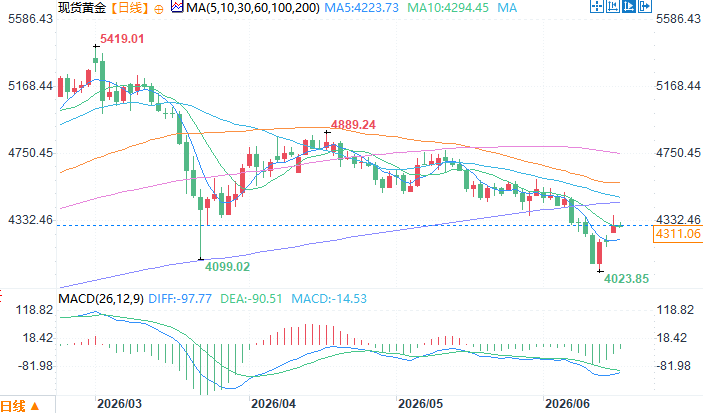
Spot gold daily chart source: EasyForex
At 10:34 AM Beijing time on June 16, spot gold was trading at $4317.06 per ounce.
The US-Iran agreement is not a positive development, but rather a historic strategic concession by the United States.
David Wu, a former senior analyst at Bank of America with 20 years of experience in global interest rate and exchange rate research, stated that the US-Iran ceasefire and air travel agreement represents the most significant single strategic defeat for the US since the Vietnam War, amounting to a complete compromise with foreign powers. He emphasized that the market is currently only seeing the short-term benefits of lower oil prices and reduced inflation, completely ignoring the far-reaching impact of the event. Countries around the world will reassess the US's international credibility, and the US's global hegemonic position may be at a critical turning point.
Behind the seemingly recovering market lies a profound restructuring of the global monetary and geopolitical landscape.
Amid geopolitical risks reshaping market expectations, gold led the way with its independent price movement. Spot gold rose for the third consecutive trading day on Monday, gaining 2.19% to close firmly at $4309.05 per ounce. Although gold has seen a slight pullback over the past month, its annual gain still exceeds 28%, maintaining its solid long-term investment value.
Unveiling the truth behind the short-term pullback in gold prices: it's not due to weakening fundamentals.
Regarding the market's focus on the short-term pullback in gold prices, David Wu offered a niche interpretation that aligns with fundamentals. He stated that this round of gold price declines was not due to a decline in investment demand, but rather a passive cash-out behavior by Gulf oil-producing countries. During the Middle East conflict, oil-producing countries faced obstacles in crude oil exports and cash flow pressures. Selling US Treasury bonds was susceptible to US regulatory scrutiny, making gold the only viable channel for liquidation. This passive selling in the short term suppressed gold prices.
From a long-term perspective, the support for gold is very solid. Data from the World Gold Council shows that global central bank gold purchases reached 863 tons in 2025, far exceeding the historical average for the fourth consecutive year, and official gold purchases continued in the first quarter of 2026. Currently, gold has surpassed US Treasury bonds to become the world's largest reserve asset, directly reflecting the long-term trend of global de-dollarization. David Wu believes that a gold price above $4,000 per ounce presents an excellent opportunity for long-term investment.
The AI bubble harbors the risk of collapse, and the foundation of the US dollar faces a fatal blow.
David Wu points out that the current strength of the US dollar relies entirely on the benefits of the artificial intelligence industry. The global deployment of US AI technology, chips, and model assets requires substantial purchases of US dollars, forming the core support for the dollar . He bluntly states that if the AI bubble bursts, the dollar will completely lose its support, and the market will experience a sharp decline.
The AI industry is currently facing a double squeeze, with downside risks accumulating. The US is tightening export regulations on high-end AI technologies for security reasons, while domestic competitors offering high-performance, cost-effective products continue to seize market share, leading to a continued inflation of valuation bubbles in US AI companies. Meanwhile, leading global technology companies saw a significant decline in capital expenditures in the first quarter, slowing the industry's expansion pace. This is likely to trigger a cooling of the AI market in the second half of the year, thereby undermining the core foundation of a strong US dollar.
The logic of real yields has changed, and gold has reached an upward turning point.
As a non-interest-bearing asset, gold's price movement is highly negatively correlated with real yields. Previously, rising real yields on US Treasury bonds increased the cost of holding gold, suppressing its price. However, the current rise in real yields is supported by both rising oil prices and the expansion of the AI industry. Now, with the US-Iran reconciliation driving oil prices down significantly, the core negative factors have subsided.
David Wu analyzes that as long as oil prices continue to fall or the AI boom cools down, gold can stabilize and rebound. If the AI bubble bursts completely, it will trigger an economic recession and interest rates will return to low levels, at which point gold prices could potentially hit a historic high of $10,000 per ounce. Furthermore, the US federal debt has climbed to $39 trillion, with annual interest payments exceeding $1 trillion; the continuously deteriorating fiscal situation will also continue to provide long-term upward momentum for gold.
Overall , the current market's short-term optimism contains significant misconceptions. The reshaping of the geopolitical landscape behind the US-Iran agreement, the weakening of the US dollar's foundation, and the risk of an AI bubble are all core variables affecting global assets. With multiple positive factors in geopolitics, fiscal policy, and monetary policy, the long-term bullish logic for gold remains unchanged, and short-term corrections present excellent buying opportunities.
Spot gold daily chart source: EasyForex
At 10:34 AM Beijing time on June 16, spot gold was trading at $4317.06 per ounce.
- Risk Warning and Disclaimer
- The market involves risk, and trading may not be suitable for all investors. This article is for reference only and does not constitute personal investment advice, nor does it take into account certain users’ specific investment objectives, financial situation, or other needs. Any investment decisions made based on this information are at your own risk.