Gold prices maintained a volatile rebound ahead of the Fed's interest rate decision, awaiting a stress test.
2026-06-17 09:24:56
Gold prices (XAU/USD) maintained a modest rise in Asian trading on Wednesday, trading around $4,350. After a period of consolidation, gold prices rebounded technically from near the yearly lows reached last week, but the overall trend remains influenced by both easing global geopolitical risks and the outlook for Federal Reserve policy.

The United States and Iran are preparing to formally sign a provisional peace agreement, with both sides stating that positive progress has been made. US officials revealed that the full agreement may be released within the next two days, with a signing ceremony planned for Switzerland. Markets believe that if the agreement is successfully implemented, it will further facilitate the restoration of normal shipping traffic in the Strait of Hormuz and alleviate the energy supply risks that have previously plagued global markets.
US President Trump said on Tuesday that the Strait of Hormuz could reopen on Friday, emphasizing that the relevant agreements were largely finalized. The Strait of Hormuz handles approximately 20% of global seaborne crude oil shipments, and its resumption of normal operations would help alleviate international energy price pressures and reduce the risk of renewed global inflation. As the energy shock gradually subsides, market bets on further tightening of monetary policy by the Federal Reserve have declined.
According to data from the CME Group's FedWatch tool, the market's expectation of a Federal Reserve rate hike in December has fallen from nearly 70% last week to about 58%. This means that investors believe the decline in energy prices may reduce the need for the Fed to take a more hawkish stance in the future, and also weakens the support that the gold market has gained from inflation concerns.
The market widely expects the Federal Reserve to keep interest rates unchanged at its June policy meeting, with the target range for the federal funds rate expected to remain between 3.50% and 3.75%. However, investors are paying closer attention to the press conference following the meeting, led by Fed Chairman Kevin Warsh, hoping to glean clues about the future direction of interest rates. If the Fed signals a continued commitment to combating inflation and leaves open the possibility of future rate hikes, the dollar may regain support, limiting the upside potential for gold. Conversely, if policymakers emphasize economic growth risks and project a more dovish policy stance, gold is likely to attract renewed inflows.
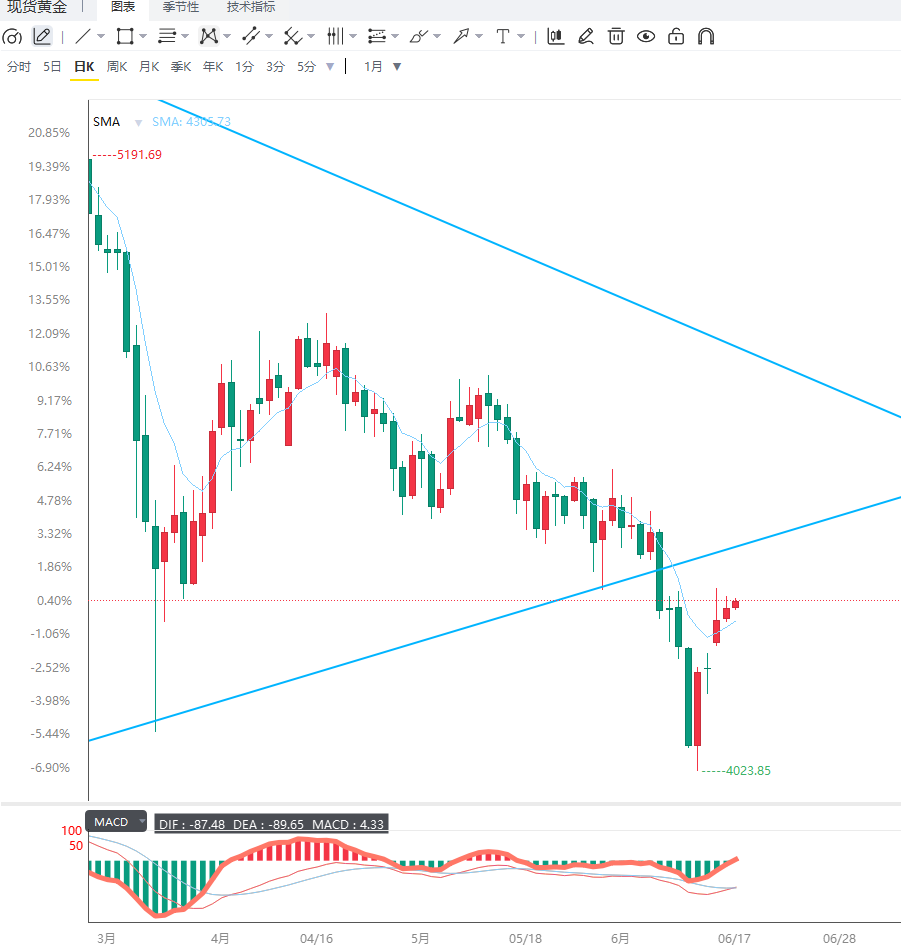
From a technical perspective, observing the daily chart, gold found some buying support around $4300 after its previous rapid decline and is currently in a correction phase following the oversold condition, but the overall trend remains downward. In the short term, the $4350 to $4380 area constitutes the primary resistance zone. If it fails to break through effectively, the price of gold may retest the key psychological level of $4300, and a further break below this level could open up room for a pullback towards the $4250 area. If the bulls can hold above $4380, it will increase the possibility of a further rebound towards the $4450 area.
From a 4-hour chart perspective, gold's short-term decline has slowed, with prices finding temporary support around $4300. Short-term moving averages are gradually flattening, indicating a weakening of bearish momentum. Technical indicators suggest the market has recovered from its previous oversold condition, and there is potential for further short-term rebound. However, until a breakout of key resistance levels is achieved, the overall trend remains one of consolidation and correction. Investors should pay close attention to the potential directional breakout from the Fed's decision and the Chairman's speech.
Editor's Summary:
The gold market is currently in a phase of easing geopolitical risks and uncertainty surrounding monetary policy. The de-escalating situation in the Middle East has weakened gold's safe-haven appeal, while falling energy prices have reduced market concerns about sustained inflation. However, the Federal Reserve's policy stance will remain the core factor determining gold's short-term direction. If the Fed maintains a hawkish tone, gold prices may continue to be under pressure and test support below $4,300; if the policy rhetoric is more dovish, gold may use technical corrections to retest the resistance zone above $4,350. Investors should focus on interest rate decisions, policy statements, and the market's repricing of future interest rate paths in the short term.
The United States and Iran are preparing to formally sign a provisional peace agreement, with both sides stating that positive progress has been made. US officials revealed that the full agreement may be released within the next two days, with a signing ceremony planned for Switzerland. Markets believe that if the agreement is successfully implemented, it will further facilitate the restoration of normal shipping traffic in the Strait of Hormuz and alleviate the energy supply risks that have previously plagued global markets.
US President Trump said on Tuesday that the Strait of Hormuz could reopen on Friday, emphasizing that the relevant agreements were largely finalized. The Strait of Hormuz handles approximately 20% of global seaborne crude oil shipments, and its resumption of normal operations would help alleviate international energy price pressures and reduce the risk of renewed global inflation. As the energy shock gradually subsides, market bets on further tightening of monetary policy by the Federal Reserve have declined.
According to data from the CME Group's FedWatch tool, the market's expectation of a Federal Reserve rate hike in December has fallen from nearly 70% last week to about 58%. This means that investors believe the decline in energy prices may reduce the need for the Fed to take a more hawkish stance in the future, and also weakens the support that the gold market has gained from inflation concerns.
The market widely expects the Federal Reserve to keep interest rates unchanged at its June policy meeting, with the target range for the federal funds rate expected to remain between 3.50% and 3.75%. However, investors are paying closer attention to the press conference following the meeting, led by Fed Chairman Kevin Warsh, hoping to glean clues about the future direction of interest rates. If the Fed signals a continued commitment to combating inflation and leaves open the possibility of future rate hikes, the dollar may regain support, limiting the upside potential for gold. Conversely, if policymakers emphasize economic growth risks and project a more dovish policy stance, gold is likely to attract renewed inflows.
From a technical perspective, observing the daily chart, gold found some buying support around $4300 after its previous rapid decline and is currently in a correction phase following the oversold condition, but the overall trend remains downward. In the short term, the $4350 to $4380 area constitutes the primary resistance zone. If it fails to break through effectively, the price of gold may retest the key psychological level of $4300, and a further break below this level could open up room for a pullback towards the $4250 area. If the bulls can hold above $4380, it will increase the possibility of a further rebound towards the $4450 area.
From a 4-hour chart perspective, gold's short-term decline has slowed, with prices finding temporary support around $4300. Short-term moving averages are gradually flattening, indicating a weakening of bearish momentum. Technical indicators suggest the market has recovered from its previous oversold condition, and there is potential for further short-term rebound. However, until a breakout of key resistance levels is achieved, the overall trend remains one of consolidation and correction. Investors should pay close attention to the potential directional breakout from the Fed's decision and the Chairman's speech.
Editor's Summary:
The gold market is currently in a phase of easing geopolitical risks and uncertainty surrounding monetary policy. The de-escalating situation in the Middle East has weakened gold's safe-haven appeal, while falling energy prices have reduced market concerns about sustained inflation. However, the Federal Reserve's policy stance will remain the core factor determining gold's short-term direction. If the Fed maintains a hawkish tone, gold prices may continue to be under pressure and test support below $4,300; if the policy rhetoric is more dovish, gold may use technical corrections to retest the resistance zone above $4,350. Investors should focus on interest rate decisions, policy statements, and the market's repricing of future interest rate paths in the short term.
- Risk Warning and Disclaimer
- The market involves risk, and trading may not be suitable for all investors. This article is for reference only and does not constitute personal investment advice, nor does it take into account certain users’ specific investment objectives, financial situation, or other needs. Any investment decisions made based on this information are at your own risk.