The Federal Reserve enters the "Wash era": shortened statements, a shift in the dot plot towards rate hikes, and the Fed reshapes its hawkish image overnight.
2026-06-18 08:47:25
On Thursday (June 18) during the Asian session, the US dollar index saw a slight pullback after a strong rebound in the previous trading day, and is currently trading around 100.30.
Early Thursday morning, Kevin Warsh chaired a policy meeting for the first time as Federal Reserve Chairman, marking a significant departure from the Fed's operating style during the Jerome Powell era.
From a drastically shortened policy statement to five working groups that could reshape the central bank's architecture, and the dot plot's abrupt shift towards rate hikes—Wash's debut sent a series of strong signals. Below are the five most noteworthy highlights of this meeting, and what they reveal about the Fed's future direction.
Faced with severe pressure from accelerating inflation, the market widely expected the Federal Reserve to further strengthen its anti-inflation policy stance at this meeting. However, the actual outcome was more hawkish than the market anticipated, exceeding the expectations of most investors. This shift not only reflects the Fed's high level of vigilance regarding inflation risks but also signifies a clear adjustment in the path of monetary policy.
The latest summary of economic projections (dot plot) shows that nine Federal Reserve officials expect at least one more rate hike this year, a dramatic reversal from zero forecasts three months ago (at the March meeting). At that time, most officials still believed that interest rates would remain stable or even begin a rate-cutting cycle this year, but now a hawkish stance has prevailed. This sharp shift in expectations highlights the Fed's concerns about sticky inflation and its potential second-order effects.
One of the key external factors driving this policy shift is the deteriorating geopolitical situation in the Middle East. The continued escalation of the conflict in Iran has led to sharp fluctuations in global energy prices and commodity markets, with the costs of crude oil, natural gas, and related raw materials rising rapidly, directly increasing imported inflationary pressures in the United States. The risk of supply chain disruptions, coupled with resilient demand, has resulted in a slower-than-expected decline in core inflation indicators, with housing, food, and service prices all facing upward pressure.
Against this backdrop, Federal Reserve officials emphasized in their statement that they will be data-driven and maintain higher interest rates for an extended period to ensure that inflation steadily falls back to the long-term target of 2%. The market reacted strongly, with the US Treasury yield curve steepening, the dollar index strengthening in the short term, and stock markets experiencing some volatility. Investors need to closely monitor subsequent economic data, especially the employment market, retail sales, and PCE inflation readings, as these will determine the pace of the Fed's next move.
At this crucial moment of the Federal Reserve chairmanship transition, incoming Chairman Warsh demonstrated the central bank's independence with a clear stance. Although President Trump clearly favored a low-interest-rate, growth-stimulating policy in selecting Powell's successor, Warsh did not cater to this demand in his first press conference. Instead, he focused on data and mission, sending a strong signal of anti-inflation.
Warsh repeatedly emphasized at the meeting that the US inflation rate has been higher than the Federal Reserve's long-term target of 2% for many years, and the erosion of household, business, and economic stability by rising prices can no longer be ignored. He reiterated that the Federal Reserve will firmly fulfill its core responsibility of curbing price increases and ensure that inflation expectations are effectively anchored through necessary monetary policy tools. This statement not only surprised some market participants but also highlighted the Federal Reserve's decision-making logic as an independent institution: unaffected by short-term political pressures and focused on long-term economic health.
Of particular note is the significant simplification of this post-meeting statement compared to previous ones. The core message directly states that the Federal Open Market Committee (FOMC) will achieve price stability, while deliberately omitting previously common phrases such as "supporting the labor market to maximize employment." This significant omission in wording clearly signals a strong shift in policy balance towards curbing inflation. In a complex environment of accelerating inflation and geopolitical conflicts driving up energy prices, Warsh's adjustment has been interpreted by the market as the Federal Reserve placing price stability as an absolute priority, even if it may put some pressure on economic growth and employment in the short term.
Analysts point out that Warsh's hawkish stance helps boost market confidence in the Fed's credibility and prevents policy from being politicized. The dollar index strengthened slightly after the statement, Treasury yields rose somewhat, and the stock market showed a divergent trend. Going forward, the Fed under Warsh's leadership will face more challenges: how to balance inflation control and a soft landing for the economy in a high-interest-rate environment, and how to cope with imported pressures from external uncertainties.
At his first press conference, Chairman Warsh immediately signaled significant reforms, announcing the establishment of several special working groups covering five core areas: communication mechanisms, balance sheet management, data sources, productivity and employment, and inflation assessment. This move demonstrates the new chairman's strong emphasis on the efficiency and policy adaptability of the Federal Reserve's internal operations.
Warsh explicitly hinted that by the end of 2026, the Federal Reserve's operations in these areas are expected to undergo a complete restructuring. He stated that these working groups will systematically review the strengths and weaknesses of the existing framework and optimize it in light of the latest economic realities. For example, in terms of data sources, more real-time, high-frequency indicators may be introduced to improve the accuracy of decision-making; in terms of inflation assessment, a deeper understanding of structural factors will be developed to avoid biases in traditional models.
Furthermore, Warsh signaled an important shift in communication strategy. He noted that press conferences are "only valuable when there is substantial information to convey," suggesting a possible move away from the established practice of holding press conferences after every FOMC meeting, pioneered by Powell, and towards a more selective and focused communication model. This change aims to improve communication efficiency, avoid information redundancy, while retaining the flexibility to speak out promptly at key moments.
Market analysts believe that Warsh's reform measures reflect a pragmatic yet forward-looking approach, helping the Federal Reserve better adapt to a complex and volatile macroeconomic environment. The progress of these working groups will be closely watched going forward, potentially profoundly impacting the transparency and effectiveness of future monetary policy.
Typically, expectations of interest rate cuts significantly boost risk asset prices, driving up stock and commodity markets. However, the Fed's hawkish tone at this meeting, with inflation at its core, completely extinguished any illusions Wall Street had about short-term monetary easing. Chairman Warsh's remarks and the hawkish shift in the dot plot quickly made the market realize that the high-interest-rate environment may persist for longer, and the path of interest rate cuts in the short term has been significantly delayed.
The bond market reacted particularly strongly to this. Short-term US Treasury yields saw their biggest single-day increase in three months. The 10-year US Treasury yield also rose in tandem, reflecting investors' repricing of future inflation and policy rates.
Stock markets came under significant pressure and declined sharply, with the S&P 500 falling about 1.2% on the day, led by technology and growth stocks. The Nasdaq index fell even more, with some highly valued stocks suffering heavy losses. The US dollar index, on the other hand, rebounded strongly, hitting a recent high, further increasing pressure on emerging market assets.
At Powell's last meeting, four officials cast opposing votes, exposing divisions within the committee. Warsh, however, chose to condense the policy statement from over 300 words in April to just 132 words, using a more vague but focused approach, successfully winning unanimous support. Although differing opinions remained within the committee on the economic outlook and policy path, by reducing textual details and highlighting core objectives, Warsh achieved a semblance of unity at the first meeting—a crucial opening strategy for a chair with only one vote.
Changes in the Federal Reserve's internal policy statements and communication strategies directly affect the pricing of dollar assets, resulting in a clear bullish structure in the technical charts.
Technically, the US dollar index is currently holding above the 20-day, 50-day, 100-day, and 200-day moving averages on the daily chart, with the moving averages in a bullish alignment, providing solid support for a medium-term uptrend. The price action shows gradually rising lows, with resistance at the previous high of 100.57-100.64. Further resistance lies at 101.24, while short-term key support is the 20-day moving average at 99.58, and key medium-term support is at 98.93. Indicators show the MACD lines maintaining a golden cross and the red histogram continuing, indicating ample bullish momentum and no immediate bearish divergence. The RSI is at 63.83, within bullish territory but below the 70 overbought threshold, suggesting further upward potential in the short term.
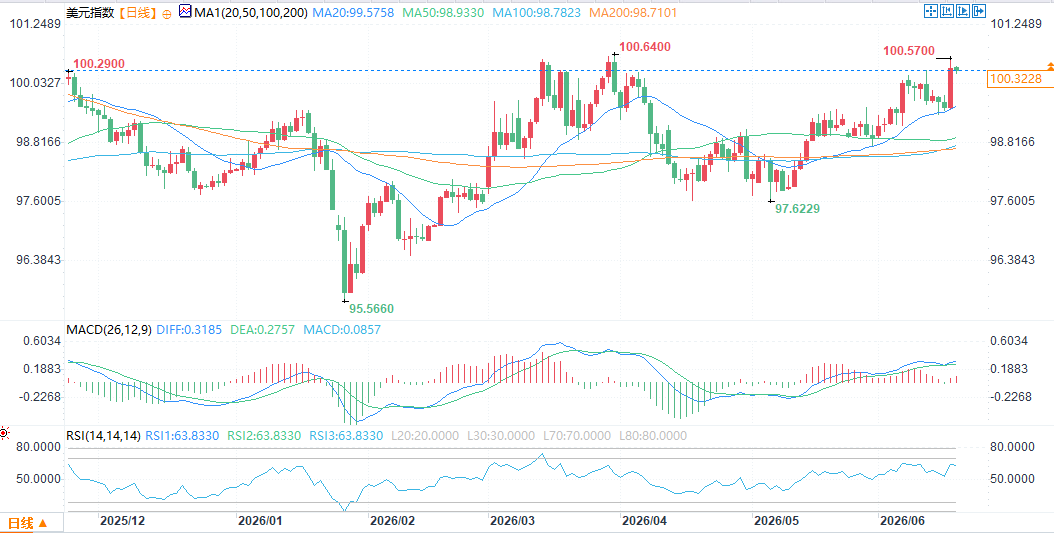
(US Dollar Index Daily Chart, Source: FX678)
At 8:22 AM Beijing time on June 18, the US dollar index was at 100.31.
Early Thursday morning, Kevin Warsh chaired a policy meeting for the first time as Federal Reserve Chairman, marking a significant departure from the Fed's operating style during the Jerome Powell era.
From a drastically shortened policy statement to five working groups that could reshape the central bank's architecture, and the dot plot's abrupt shift towards rate hikes—Wash's debut sent a series of strong signals. Below are the five most noteworthy highlights of this meeting, and what they reveal about the Fed's future direction.
Expectations for interest rate hikes have suddenly intensified.
Faced with severe pressure from accelerating inflation, the market widely expected the Federal Reserve to further strengthen its anti-inflation policy stance at this meeting. However, the actual outcome was more hawkish than the market anticipated, exceeding the expectations of most investors. This shift not only reflects the Fed's high level of vigilance regarding inflation risks but also signifies a clear adjustment in the path of monetary policy.
The latest summary of economic projections (dot plot) shows that nine Federal Reserve officials expect at least one more rate hike this year, a dramatic reversal from zero forecasts three months ago (at the March meeting). At that time, most officials still believed that interest rates would remain stable or even begin a rate-cutting cycle this year, but now a hawkish stance has prevailed. This sharp shift in expectations highlights the Fed's concerns about sticky inflation and its potential second-order effects.
One of the key external factors driving this policy shift is the deteriorating geopolitical situation in the Middle East. The continued escalation of the conflict in Iran has led to sharp fluctuations in global energy prices and commodity markets, with the costs of crude oil, natural gas, and related raw materials rising rapidly, directly increasing imported inflationary pressures in the United States. The risk of supply chain disruptions, coupled with resilient demand, has resulted in a slower-than-expected decline in core inflation indicators, with housing, food, and service prices all facing upward pressure.
Against this backdrop, Federal Reserve officials emphasized in their statement that they will be data-driven and maintain higher interest rates for an extended period to ensure that inflation steadily falls back to the long-term target of 2%. The market reacted strongly, with the US Treasury yield curve steepening, the dollar index strengthening in the short term, and stock markets experiencing some volatility. Investors need to closely monitor subsequent economic data, especially the employment market, retail sales, and PCE inflation readings, as these will determine the pace of the Fed's next move.
Walsh clearly demonstrates independence
At this crucial moment of the Federal Reserve chairmanship transition, incoming Chairman Warsh demonstrated the central bank's independence with a clear stance. Although President Trump clearly favored a low-interest-rate, growth-stimulating policy in selecting Powell's successor, Warsh did not cater to this demand in his first press conference. Instead, he focused on data and mission, sending a strong signal of anti-inflation.
Warsh repeatedly emphasized at the meeting that the US inflation rate has been higher than the Federal Reserve's long-term target of 2% for many years, and the erosion of household, business, and economic stability by rising prices can no longer be ignored. He reiterated that the Federal Reserve will firmly fulfill its core responsibility of curbing price increases and ensure that inflation expectations are effectively anchored through necessary monetary policy tools. This statement not only surprised some market participants but also highlighted the Federal Reserve's decision-making logic as an independent institution: unaffected by short-term political pressures and focused on long-term economic health.
Of particular note is the significant simplification of this post-meeting statement compared to previous ones. The core message directly states that the Federal Open Market Committee (FOMC) will achieve price stability, while deliberately omitting previously common phrases such as "supporting the labor market to maximize employment." This significant omission in wording clearly signals a strong shift in policy balance towards curbing inflation. In a complex environment of accelerating inflation and geopolitical conflicts driving up energy prices, Warsh's adjustment has been interpreted by the market as the Federal Reserve placing price stability as an absolute priority, even if it may put some pressure on economic growth and employment in the short term.
Analysts point out that Warsh's hawkish stance helps boost market confidence in the Fed's credibility and prevents policy from being politicized. The dollar index strengthened slightly after the statement, Treasury yields rose somewhat, and the stock market showed a divergent trend. Going forward, the Fed under Warsh's leadership will face more challenges: how to balance inflation control and a soft landing for the economy in a high-interest-rate environment, and how to cope with imported pressures from external uncertainties.
Reform blueprint emerges
At his first press conference, Chairman Warsh immediately signaled significant reforms, announcing the establishment of several special working groups covering five core areas: communication mechanisms, balance sheet management, data sources, productivity and employment, and inflation assessment. This move demonstrates the new chairman's strong emphasis on the efficiency and policy adaptability of the Federal Reserve's internal operations.
Warsh explicitly hinted that by the end of 2026, the Federal Reserve's operations in these areas are expected to undergo a complete restructuring. He stated that these working groups will systematically review the strengths and weaknesses of the existing framework and optimize it in light of the latest economic realities. For example, in terms of data sources, more real-time, high-frequency indicators may be introduced to improve the accuracy of decision-making; in terms of inflation assessment, a deeper understanding of structural factors will be developed to avoid biases in traditional models.
Furthermore, Warsh signaled an important shift in communication strategy. He noted that press conferences are "only valuable when there is substantial information to convey," suggesting a possible move away from the established practice of holding press conferences after every FOMC meeting, pioneered by Powell, and towards a more selective and focused communication model. This change aims to improve communication efficiency, avoid information redundancy, while retaining the flexibility to speak out promptly at key moments.
Market analysts believe that Warsh's reform measures reflect a pragmatic yet forward-looking approach, helping the Federal Reserve better adapt to a complex and volatile macroeconomic environment. The progress of these working groups will be closely watched going forward, potentially profoundly impacting the transparency and effectiveness of future monetary policy.
Markets reacted nervously, dampening expectations of an interest rate cut.
Typically, expectations of interest rate cuts significantly boost risk asset prices, driving up stock and commodity markets. However, the Fed's hawkish tone at this meeting, with inflation at its core, completely extinguished any illusions Wall Street had about short-term monetary easing. Chairman Warsh's remarks and the hawkish shift in the dot plot quickly made the market realize that the high-interest-rate environment may persist for longer, and the path of interest rate cuts in the short term has been significantly delayed.
The bond market reacted particularly strongly to this. Short-term US Treasury yields saw their biggest single-day increase in three months. The 10-year US Treasury yield also rose in tandem, reflecting investors' repricing of future inflation and policy rates.
Stock markets came under significant pressure and declined sharply, with the S&P 500 falling about 1.2% on the day, led by technology and growth stocks. The Nasdaq index fell even more, with some highly valued stocks suffering heavy losses. The US dollar index, on the other hand, rebounded strongly, hitting a recent high, further increasing pressure on emerging market assets.
Building consensus through "simplification"
At Powell's last meeting, four officials cast opposing votes, exposing divisions within the committee. Warsh, however, chose to condense the policy statement from over 300 words in April to just 132 words, using a more vague but focused approach, successfully winning unanimous support. Although differing opinions remained within the committee on the economic outlook and policy path, by reducing textual details and highlighting core objectives, Warsh achieved a semblance of unity at the first meeting—a crucial opening strategy for a chair with only one vote.
Changes in the Federal Reserve's internal policy statements and communication strategies directly affect the pricing of dollar assets, resulting in a clear bullish structure in the technical charts.
Technically, the US dollar index is currently holding above the 20-day, 50-day, 100-day, and 200-day moving averages on the daily chart, with the moving averages in a bullish alignment, providing solid support for a medium-term uptrend. The price action shows gradually rising lows, with resistance at the previous high of 100.57-100.64. Further resistance lies at 101.24, while short-term key support is the 20-day moving average at 99.58, and key medium-term support is at 98.93. Indicators show the MACD lines maintaining a golden cross and the red histogram continuing, indicating ample bullish momentum and no immediate bearish divergence. The RSI is at 63.83, within bullish territory but below the 70 overbought threshold, suggesting further upward potential in the short term.
(US Dollar Index Daily Chart, Source: FX678)
At 8:22 AM Beijing time on June 18, the US dollar index was at 100.31.
- Risk Warning and Disclaimer
- The market involves risk, and trading may not be suitable for all investors. This article is for reference only and does not constitute personal investment advice, nor does it take into account certain users’ specific investment objectives, financial situation, or other needs. Any investment decisions made based on this information are at your own risk.