The Fed's hawkish stance supported the dollar, and the USD/JPY pair broke through a strong resistance zone.
2026-06-18 11:14:46
The USD/JPY pair traded in a range around 160.50 during Thursday's Asian session. After four consecutive days of gains, the pair has reached its highest level since July 2024. While the dollar index saw some profit-taking following the Federal Reserve's interest rate decision, its overall trend remains supported by the US interest rate advantage.
US President Donald Trump and Iranian President Masoud Pezechiyan have signed a memorandum of understanding to end the conflict, and the two sides will begin 60 days of negotiations to finalize the agreement and promote the restoration of normal navigation in the Strait of Hormuz. Trump also stated that the timeframe for negotiations on the Iranian nuclear issue is not an absolute limit, which further boosted market confidence that a peace agreement will eventually be reached.
As a result, global risk appetite improved significantly, with some funds flowing out of safe-haven assets like the US dollar, causing a technical pullback in the dollar index after hitting its highest level since the end of March. However, due to the Federal Reserve's latest policy stance remaining hawkish, the dollar as a whole continues to maintain its strong position.
The Federal Reserve unanimously decided on Wednesday to keep the federal funds rate unchanged at 3.50%-3.75%. Meanwhile, several policymakers hinted that the likelihood of further rate hikes this year is rising as inflation risks persist. Newly appointed Chairman Kevin Warsh emphasized that the Fed will continue to prioritize its price stability goal.
The market generally believes that the expectation of a potential interest rate hike by the Federal Reserve means that US Treasury yields will remain high. Due to Japan's prolonged low-interest-rate environment, the significant interest rate differential between the US and Japan continues to attract carry trade funds into dollar assets, providing sustained support for the USD/JPY exchange rate.
However, further appreciation of the exchange rate also faces pressure from Japan. As the USD/JPY exchange rate approaches the 161 mark again, expectations of Japanese government intervention are rising once more. Japanese Finance Ministry official Jun Mimura and Finance Minister Satsuki Katayama have recently stated multiple times that the government is closely monitoring exchange rate fluctuations and is prepared to take necessary measures to address excessive speculation.
Furthermore, the Bank of Japan previously raised its policy rate to its highest level since 1995, indicating that the normalization of monetary policy is still underway. Although Japanese interest rates remain significantly lower than those in the US, the policy direction has shifted, providing some support for the yen. From a market perspective, the USD/JPY exchange rate is currently primarily driven by the US-Japan interest rate differential. As long as US interest rates remain high and the Bank of Japan continues its slow pace of rate hikes, carry trade demand will persist. However, as the exchange rate approaches a sensitive area for Japanese authorities, market vigilance regarding official intervention is also rising, which is expected to lead to a significant increase in short-term volatility.
Investors will now focus on US initial jobless claims, subsequent inflation data, and the Japanese government's latest statements on exchange rate issues to determine whether the USD/JPY pair can break through previous highs and open up new upside potential.
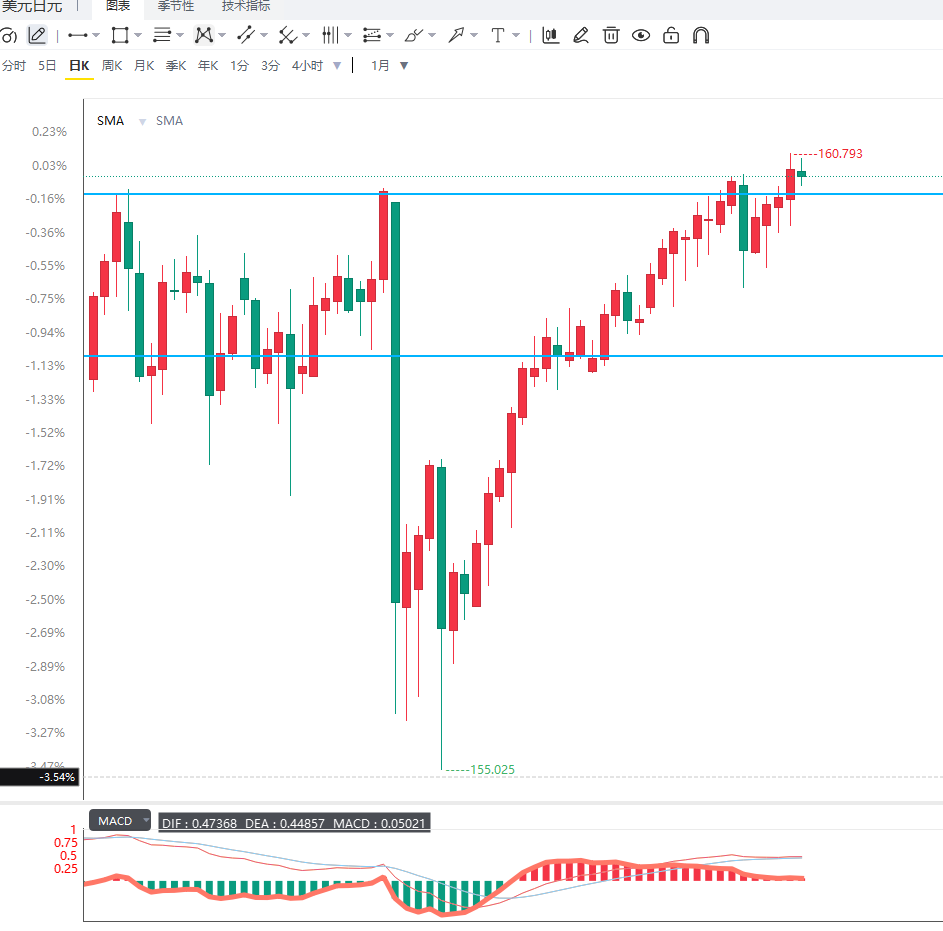
From a daily chart perspective, the USD/JPY pair has successfully broken through the important psychological level of 160.00, reaching a new high since July 2024, and maintaining a clear upward trend overall. The moving average system is in a bullish alignment, and the medium-to-long-term upward structure remains intact. The MACD continues to operate above the zero line, indicating that bullish momentum still dominates. However, the 160.80 to 162.00 area has entered a sensitive zone that is of great concern to the Japanese authorities, and there are strong expectations of policy intervention in the market. Resistance levels to watch are 160.80, 162.00, and 163.50; support levels to watch are 159.50, 158.00, and 156.80.
From the 4-hour chart, the exchange rate has entered a consolidation phase at high levels after a continuous rise. The MACD is showing overbought conditions, indicating a slowdown in bullish momentum, but no clear top signal has yet formed. The short-term moving average system remains upwardly diverging, suggesting the trend has not changed. If it can effectively break through the 160.80 resistance, it may further test the 162.00 area; if it falls below the 159.50 support due to intervention expectations, it may undergo a phase of correction and retrace to the support near 158.00. Overall, as long as it does not fall below 158.00, the short-term strategy remains to buy on dips.
Editor's Summary : The current USD/JPY exchange rate movement remains primarily driven by the USD/JPY interest rate differential. Following the Federal Reserve's signal of a rate hike this year, the US yield advantage has been further solidified. While the Bank of Japan has entered a rate hike cycle, its overall policy remains relatively loose, fueling continued active carry trades. In the short term, there is still some upward momentum above the 160 level, but the risk of intervention by the Japanese government is rapidly escalating and could become a significant factor limiting further appreciation. Future market focus will be on US economic data and the Japanese government's stance on exchange rate fluctuations. If expectations of a Fed rate hike strengthen further, USD/JPY may still challenge 162; however, if the Japanese authorities take substantial intervention measures, a rapid pullback in the exchange rate cannot be ruled out.
US President Donald Trump and Iranian President Masoud Pezechiyan have signed a memorandum of understanding to end the conflict, and the two sides will begin 60 days of negotiations to finalize the agreement and promote the restoration of normal navigation in the Strait of Hormuz. Trump also stated that the timeframe for negotiations on the Iranian nuclear issue is not an absolute limit, which further boosted market confidence that a peace agreement will eventually be reached.
As a result, global risk appetite improved significantly, with some funds flowing out of safe-haven assets like the US dollar, causing a technical pullback in the dollar index after hitting its highest level since the end of March. However, due to the Federal Reserve's latest policy stance remaining hawkish, the dollar as a whole continues to maintain its strong position.
The Federal Reserve unanimously decided on Wednesday to keep the federal funds rate unchanged at 3.50%-3.75%. Meanwhile, several policymakers hinted that the likelihood of further rate hikes this year is rising as inflation risks persist. Newly appointed Chairman Kevin Warsh emphasized that the Fed will continue to prioritize its price stability goal.
The market generally believes that the expectation of a potential interest rate hike by the Federal Reserve means that US Treasury yields will remain high. Due to Japan's prolonged low-interest-rate environment, the significant interest rate differential between the US and Japan continues to attract carry trade funds into dollar assets, providing sustained support for the USD/JPY exchange rate.
However, further appreciation of the exchange rate also faces pressure from Japan. As the USD/JPY exchange rate approaches the 161 mark again, expectations of Japanese government intervention are rising once more. Japanese Finance Ministry official Jun Mimura and Finance Minister Satsuki Katayama have recently stated multiple times that the government is closely monitoring exchange rate fluctuations and is prepared to take necessary measures to address excessive speculation.
Furthermore, the Bank of Japan previously raised its policy rate to its highest level since 1995, indicating that the normalization of monetary policy is still underway. Although Japanese interest rates remain significantly lower than those in the US, the policy direction has shifted, providing some support for the yen. From a market perspective, the USD/JPY exchange rate is currently primarily driven by the US-Japan interest rate differential. As long as US interest rates remain high and the Bank of Japan continues its slow pace of rate hikes, carry trade demand will persist. However, as the exchange rate approaches a sensitive area for Japanese authorities, market vigilance regarding official intervention is also rising, which is expected to lead to a significant increase in short-term volatility.
Investors will now focus on US initial jobless claims, subsequent inflation data, and the Japanese government's latest statements on exchange rate issues to determine whether the USD/JPY pair can break through previous highs and open up new upside potential.
From a daily chart perspective, the USD/JPY pair has successfully broken through the important psychological level of 160.00, reaching a new high since July 2024, and maintaining a clear upward trend overall. The moving average system is in a bullish alignment, and the medium-to-long-term upward structure remains intact. The MACD continues to operate above the zero line, indicating that bullish momentum still dominates. However, the 160.80 to 162.00 area has entered a sensitive zone that is of great concern to the Japanese authorities, and there are strong expectations of policy intervention in the market. Resistance levels to watch are 160.80, 162.00, and 163.50; support levels to watch are 159.50, 158.00, and 156.80.
From the 4-hour chart, the exchange rate has entered a consolidation phase at high levels after a continuous rise. The MACD is showing overbought conditions, indicating a slowdown in bullish momentum, but no clear top signal has yet formed. The short-term moving average system remains upwardly diverging, suggesting the trend has not changed. If it can effectively break through the 160.80 resistance, it may further test the 162.00 area; if it falls below the 159.50 support due to intervention expectations, it may undergo a phase of correction and retrace to the support near 158.00. Overall, as long as it does not fall below 158.00, the short-term strategy remains to buy on dips.
Editor's Summary : The current USD/JPY exchange rate movement remains primarily driven by the USD/JPY interest rate differential. Following the Federal Reserve's signal of a rate hike this year, the US yield advantage has been further solidified. While the Bank of Japan has entered a rate hike cycle, its overall policy remains relatively loose, fueling continued active carry trades. In the short term, there is still some upward momentum above the 160 level, but the risk of intervention by the Japanese government is rapidly escalating and could become a significant factor limiting further appreciation. Future market focus will be on US economic data and the Japanese government's stance on exchange rate fluctuations. If expectations of a Fed rate hike strengthen further, USD/JPY may still challenge 162; however, if the Japanese authorities take substantial intervention measures, a rapid pullback in the exchange rate cannot be ruled out.
- Risk Warning and Disclaimer
- The market involves risk, and trading may not be suitable for all investors. This article is for reference only and does not constitute personal investment advice, nor does it take into account certain users’ specific investment objectives, financial situation, or other needs. Any investment decisions made based on this information are at your own risk.