Although a paper agreement has been signed, market opinions are divided, and the sharp drop in oil prices may harbor hidden risks.
2026-06-18 17:51:21
After days of confidential negotiations and information warfare, Donald Trump and the Iranian president officially signed a peace framework agreement with the core objectives of ending the full-scale conflict in the region and reopening the Strait of Hormuz.
The agreement took effect immediately upon signing and includes not only a comprehensive plan for Iran's post-war economic reconstruction, but also a commitment from the US to phase out all sanctions and restrictions against Tehran. However, the disagreement over Iran's nuclear program, which was the core trigger for the US military action, still leaves a 60-day window for special consultations.
The agreement was signed at the Palace of Versailles in France, a place that has witnessed countless historic agreements.
On Wednesday local time, Trump signed the original paper agreement during a working dinner with French President Emmanuel Macron.
Video footage shows that after Trump sat down next to Macron to sign the agreement, he handed the document and pen to Secretary of State Marco Rubio, and those present applauded in response.
A video shared by Macron captured Trump's reflections before putting pen to paper: "It was incredibly difficult to reach this agreement."
Previously, Trump and Vice President Vance had completed the online electronic signing over the weekend, but the core terms have remained confidential.
The public signing ceremony originally scheduled by the White House for Friday in Switzerland remains highly uncertain due to information conflicts among the US, Iran, and Pakistan.
Upon leaving the Versailles dinner, Trump, who had just concluded his trip to the G7 summit, stated unequivocally: "The agreement has been signed."
In Iran, the state-run news agency Islamic Republic News Agency (IRNA) released a photo of President Masoud Pezehizian signing the agreement with an expressionless face, holding a document bearing both his and Trump's signatures.
It is worth noting that the full legal text of the agreement has not yet been officially released. An anonymous U.S. official gave a verbal account of the draft to the media, and the core content of the text subsequently disclosed by Iranian state television is basically consistent with it.
Iranian Parliament Speaker and key negotiator Mohammad Bagher Ghalibaf sent a strong signal, saying, "If hostile forces refuse rational dialogue and communication, we will have no choice but to respond with military force."
While emphasizing that the agreement could avert a "systemic economic crisis that would sweep the globe," Trump also drew a hard line: if a final, complete agreement could not be reached within sixty days, the US military would launch high-density airstrikes across the entire territory of Iran.
This agreement has triggered very different reactions from the international community, with the attitudes of the United States and Israel being particularly prominent.
Significant divisions have emerged among the top levels of American politics, forming two opposing camps.
After in-depth discussions with the U.S. envoy, Trump's key ally, Republican Senator Lindsey Graham, revised his previous negative assessment, believing that the agreement is in the long-term interests of the United States and will promote the full reopening of the Strait of Hormuz and end the military standoff between the U.S. and Iran.
Conversely, Senator Ted Cruz accused Trump of taking "highly misleading advice," while Bill Cassidy sharply commented that "Reagan would not rest easy if he knew about this agreement," expressing concern that Iran's nuclear expansion demands were not substantially constrained and that the Strait of Hormuz would be repeatedly used as leverage in the future.
Susan Rice, a former senior official in the Obama and Biden administrations, characterized it as "the most serious strategic blunder the United States has made in geosecurity in recent decades."
There is a generally negative attitude towards the agreement within Israel, with senior political and military officials questioning whether Iran will be able to maintain its commitment to the nuclear negotiations after the US has lifted its dual economic and military pressure.
A cabinet official confirmed that the Netanyahu government did not review the full text of the agreement beforehand. Opposition leader Yair Lapid publicly criticized that Netanyahu's promised "historic geopolitical victory" ultimately turned into a situation of "a diplomatic rift between the US and Israel, the Iranian Revolutionary Guard receiving huge sums of money, and ballistic missiles being aimed at Israel," while Israel was marginalized in the negotiations.
However, there are also a few rational and optimistic voices. Dani Sitrinovich, former head of the Iranian branch of the Israeli military intelligence agency, believes that the agreement marks a return to objective reality in US policy toward Iran and avoids the geopolitical situation from completely spiraling out of control.
The agreement's provisions regarding the restoration of pre-war cargo volumes in the Strait of Hormuz within 30 days and the lifting of the US maritime blockade directly impact the global energy market landscape.
As a core hub handling approximately one-fifth of the world's oil and liquefied natural gas trade, the strait's previous blockade had triggered a historic energy crisis. However, after news of the agreement's implementation, international crude oil spot and futures prices plummeted simultaneously. Currently, WTI oil prices have narrowed their decline, having fallen by more than 3% at one point during the session, trading around 74.2.
Market analysis shows that the decline in oil prices is not only due to expectations of the reopening of the Strait of Hormuz, but also influenced by factors such as the improved global oil supply and demand balance and the reduction of official selling prices by Gulf oil-producing countries such as Saudi Arabia.
However, industry insiders also cautioned that tanker backlogs, high war insurance costs, low inventory levels, and uncertainty surrounding the sustainability of agreements will continue to support risk premiums in the energy market. It may take several weeks or even two months for oil prices to stabilize, and there is also a lag effect in the transmission of fuel prices to end consumers.
Meanwhile, the recent rapid decline in international oil prices may reflect the optimistic expectations of crude oil buyers for a smooth signing of the agreement and the smooth opening of the Strait of Hormuz. However, the objective reality is that oil prices could rebound at any time as the positive effects of the signing are realized, and any unexpected events in the US-Iran peace talks could lead to a rapid rebound in oil prices.
Technical Analysis: WTI oil prices rebounded after breaking below the key level of 79.42, but then continued to fall, which is a standard downtrend pattern. However, if the price does not accelerate its decline after confirming the break below this level, but instead slows down, it suggests that a rebound may be imminent.
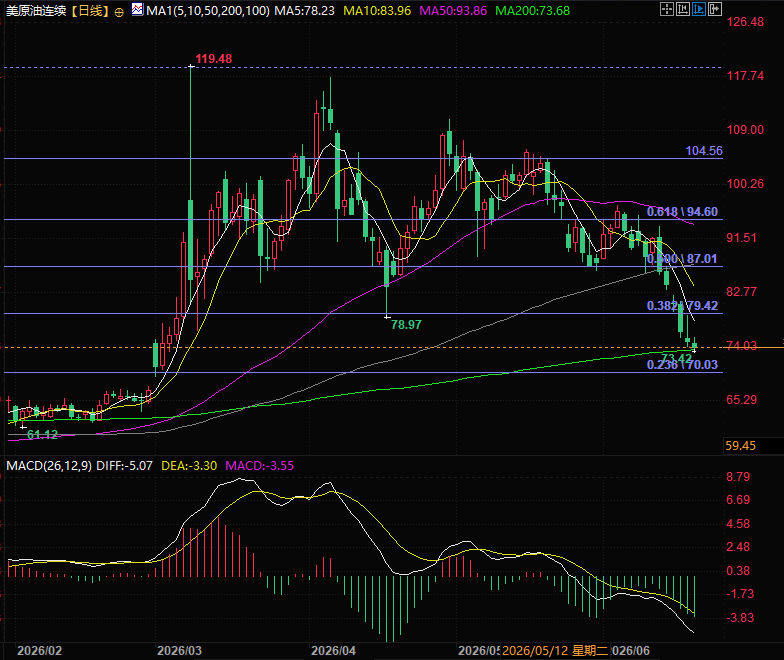
(WTI crude oil futures daily chart, source: EasyForex)
At 17:45 Beijing time, WTI crude oil futures were trading at $74.10 per ounce.
The agreement took effect immediately upon signing and includes not only a comprehensive plan for Iran's post-war economic reconstruction, but also a commitment from the US to phase out all sanctions and restrictions against Tehran. However, the disagreement over Iran's nuclear program, which was the core trigger for the US military action, still leaves a 60-day window for special consultations.
The agreement was signed at the Palace of Versailles in France, a place that has witnessed countless historic agreements.
On Wednesday local time, Trump signed the original paper agreement during a working dinner with French President Emmanuel Macron.
Video footage shows that after Trump sat down next to Macron to sign the agreement, he handed the document and pen to Secretary of State Marco Rubio, and those present applauded in response.
A video shared by Macron captured Trump's reflections before putting pen to paper: "It was incredibly difficult to reach this agreement."
Previously, Trump and Vice President Vance had completed the online electronic signing over the weekend, but the core terms have remained confidential.
The public signing ceremony originally scheduled by the White House for Friday in Switzerland remains highly uncertain due to information conflicts among the US, Iran, and Pakistan.
Upon leaving the Versailles dinner, Trump, who had just concluded his trip to the G7 summit, stated unequivocally: "The agreement has been signed."
Iran responds: Signing the agreement coexists with a tough stance.
In Iran, the state-run news agency Islamic Republic News Agency (IRNA) released a photo of President Masoud Pezehizian signing the agreement with an expressionless face, holding a document bearing both his and Trump's signatures.
It is worth noting that the full legal text of the agreement has not yet been officially released. An anonymous U.S. official gave a verbal account of the draft to the media, and the core content of the text subsequently disclosed by Iranian state television is basically consistent with it.
Iranian Parliament Speaker and key negotiator Mohammad Bagher Ghalibaf sent a strong signal, saying, "If hostile forces refuse rational dialogue and communication, we will have no choice but to respond with military force."
While emphasizing that the agreement could avert a "systemic economic crisis that would sweep the globe," Trump also drew a hard line: if a final, complete agreement could not be reached within sixty days, the US military would launch high-density airstrikes across the entire territory of Iran.
Positions of all parties: Internal divisions within the United States, with Israel largely opposing.
This agreement has triggered very different reactions from the international community, with the attitudes of the United States and Israel being particularly prominent.
Significant divisions have emerged among the top levels of American politics, forming two opposing camps.
After in-depth discussions with the U.S. envoy, Trump's key ally, Republican Senator Lindsey Graham, revised his previous negative assessment, believing that the agreement is in the long-term interests of the United States and will promote the full reopening of the Strait of Hormuz and end the military standoff between the U.S. and Iran.
Conversely, Senator Ted Cruz accused Trump of taking "highly misleading advice," while Bill Cassidy sharply commented that "Reagan would not rest easy if he knew about this agreement," expressing concern that Iran's nuclear expansion demands were not substantially constrained and that the Strait of Hormuz would be repeatedly used as leverage in the future.
Susan Rice, a former senior official in the Obama and Biden administrations, characterized it as "the most serious strategic blunder the United States has made in geosecurity in recent decades."
There is a generally negative attitude towards the agreement within Israel, with senior political and military officials questioning whether Iran will be able to maintain its commitment to the nuclear negotiations after the US has lifted its dual economic and military pressure.
A cabinet official confirmed that the Netanyahu government did not review the full text of the agreement beforehand. Opposition leader Yair Lapid publicly criticized that Netanyahu's promised "historic geopolitical victory" ultimately turned into a situation of "a diplomatic rift between the US and Israel, the Iranian Revolutionary Guard receiving huge sums of money, and ballistic missiles being aimed at Israel," while Israel was marginalized in the negotiations.
However, there are also a few rational and optimistic voices. Dani Sitrinovich, former head of the Iranian branch of the Israeli military intelligence agency, believes that the agreement marks a return to objective reality in US policy toward Iran and avoids the geopolitical situation from completely spiraling out of control.
Market impact: Crude oil prices plummeted by over 3% in response.
The agreement's provisions regarding the restoration of pre-war cargo volumes in the Strait of Hormuz within 30 days and the lifting of the US maritime blockade directly impact the global energy market landscape.
As a core hub handling approximately one-fifth of the world's oil and liquefied natural gas trade, the strait's previous blockade had triggered a historic energy crisis. However, after news of the agreement's implementation, international crude oil spot and futures prices plummeted simultaneously. Currently, WTI oil prices have narrowed their decline, having fallen by more than 3% at one point during the session, trading around 74.2.
Market analysis shows that the decline in oil prices is not only due to expectations of the reopening of the Strait of Hormuz, but also influenced by factors such as the improved global oil supply and demand balance and the reduction of official selling prices by Gulf oil-producing countries such as Saudi Arabia.
However, industry insiders also cautioned that tanker backlogs, high war insurance costs, low inventory levels, and uncertainty surrounding the sustainability of agreements will continue to support risk premiums in the energy market. It may take several weeks or even two months for oil prices to stabilize, and there is also a lag effect in the transmission of fuel prices to end consumers.
Meanwhile, the recent rapid decline in international oil prices may reflect the optimistic expectations of crude oil buyers for a smooth signing of the agreement and the smooth opening of the Strait of Hormuz. However, the objective reality is that oil prices could rebound at any time as the positive effects of the signing are realized, and any unexpected events in the US-Iran peace talks could lead to a rapid rebound in oil prices.
Technical Analysis: WTI oil prices rebounded after breaking below the key level of 79.42, but then continued to fall, which is a standard downtrend pattern. However, if the price does not accelerate its decline after confirming the break below this level, but instead slows down, it suggests that a rebound may be imminent.
(WTI crude oil futures daily chart, source: EasyForex)
At 17:45 Beijing time, WTI crude oil futures were trading at $74.10 per ounce.
- Risk Warning and Disclaimer
- The market involves risk, and trading may not be suitable for all investors. This article is for reference only and does not constitute personal investment advice, nor does it take into account certain users’ specific investment objectives, financial situation, or other needs. Any investment decisions made based on this information are at your own risk.