Logistics not yet ready for negotiations, White House announces postponement of Swiss talks! Oil prices rally again?
2026-06-19 13:44:08
On Friday (June 19) during the Asian session, US crude oil futures opened lower but then fluctuated higher, briefly breaking through the $76.00/barrel mark, and are currently trading around $75.90/barrel.
On the evening of June 18, 2026, local time, the White House announced that Vice President Vance would postpone his planned trip to Switzerland to participate in the next phase of negotiations with Iran. This decision was primarily due to the fact that logistical arrangements and technical details for the negotiations had not yet been finalized.
The White House stated that Vance had clearly mentioned earlier that day at a White House press conference that the specific details of the upcoming technical negotiations were still under discussion.
Although the U.S. delegation is ready to depart at any time, Vance will not depart at this time to ensure the smooth progress of the negotiations.
Once the follow-up arrangements are finalized, the White House will release relevant information in a timely manner and reiterate its expectation to start this round of technical negotiations as soon as possible.
This decision to postpone the meeting highlights the Trump administration's consistent cautious approach to foreign affairs.
White House officials emphasized that the technical negotiations involve many complex issues, including a verification mechanism for Iran's nuclear facilities, specific steps for lifting sanctions, third-party monitoring arrangements, and long-term safeguards for shipping in the Strait of Hormuz. Rushing the process could lead to loopholes in the agreement's implementation or trigger new disputes.
Therefore, the U.S. chose to prioritize thorough preparation, ensuring that every step was based on reliable coordination.
Previously, Vance had been appointed as the principal person in charge of the next phase of negotiations. His role extends beyond simply attending meetings; it includes coordinating cross-departmental resources, harmonizing allied positions, and developing contingency plans. Postponing the trip also gives the US team more time for behind-the-scenes communication with Iranian representatives, avoiding any unexpected public disagreements that could affect the overall atmosphere.
The White House also sent positive signals, indicating that the U.S. remains optimistic about the prospects for negotiations and pledged to move forward with the dialogue process quickly when conditions are right.
The previous US-Iran agreement set a 60-day window for both sides, aiming to suspend the conflict, reopen the Strait of Hormuz, and create conditions for nuclear negotiations.
Vance had previously been designated to lead the next phase of negotiations, focusing on complex issues such as technical verification of Iran's nuclear program, adjustments to economic sanctions, and regional stability measures. This postponement reflects the US's attention to detail in diplomatic execution, avoiding the uncertainties of hasty action.
Within the 60-day window, both sides need to complete the transition from a temporary ceasefire to a long-term framework, which involves numerous technical and political challenges. For example, issues such as transparency monitoring of Iranian nuclear facilities, the approach of the International Atomic Energy Agency's involvement, the timetable for the gradual lifting of US oil sanctions, and how to deal with Iran's proxy forces in Lebanon, Yemen, and other regions all require detailed negotiations.
Postponing Vance's trip provides both sides with additional buffer time, which will help clarify differences in positions through multiple rounds of preparatory meetings, while also testing the Trump administration's internal decision-making and coordination capabilities. Analysts believe this adjustment will not change the overall direction of the negotiations, but may extend the timeline for an agreement's implementation, causing short-term fluctuations in confidence within the Middle East energy market.
Following this announcement, market attention has increased regarding expectations of a de-escalation of tensions in the Middle East. The Strait of Hormuz, a crucial global oil shipping route, directly impacts international energy price trends.
Analysts point out that while the postponement of negotiations is a normal diplomatic adjustment, it also highlights that the US and Iran still have technical differences and need more time to coordinate their positions.
International crude oil futures prices fluctuated slightly after the news was released, with investors closely monitoring subsequent developments. Geopolitical risk premiums remain; if negotiations proceed smoothly, they will further stabilize the global energy supply chain; conversely, delays could exacerbate regional tensions.
Major energy-importing countries in Europe and Asia are particularly sensitive to this process, and have called on both sides to exercise restraint and accelerate the pace of dialogue.
Goldman Sachs analysts point out that the US-Iran agreement has eased short-term geopolitical risk premiums, but the long-term supply fundamentals remain relatively loose. Non-OPEC+ oil-producing countries are ramping up production, while global demand growth is relatively moderate, and the risk of demand disruption is rising, especially against the backdrop of economic uncertainty.
The bank emphasized that if Iran rapidly resumes exports, inventory accumulation will accelerate, potentially putting further downward pressure on oil prices in the second half of 2026. Investors should pay attention to the effectiveness of OPEC+ production cuts and changes in the global macroeconomic environment. Goldman Sachs maintains a neutral-to-bearish view on oil prices, advising energy sector investors to allocate cautiously, focusing on opportunities in downstream refining, while also being wary of short-term rebound risks from unforeseen geopolitical events.
Overall, Goldman Sachs believes that the oil market will shift from tight to balanced in 2026, with prices gradually declining.
JPMorgan Chase maintained a relatively cautious outlook on oil prices in its latest report. Despite the US-Iran agreement pushing for the reopening of the Strait of Hormuz, the bank expects the average Brent crude price for 2026 to remain around $60 per barrel, with short-term fluctuations followed by a return to supply and demand fundamentals. Analyst Natasha Kaneva pointed out that the global crude oil market will face significant oversupply and substantial inventory accumulation pressure in 2026, requiring voluntary or involuntary production cuts to balance the situation.
The bank believes that while geopolitical conflicts had initially driven up prices, supply recovered faster than expected after the agreement was implemented, while demand was constrained by slowing global economic growth. JPMorgan Chase warns that without additional production cuts, oil prices may face further downside risks, potentially even testing lower levels in 2027. The bank advises market participants to pay attention to US shale oil production dynamics and OPEC+ policy adjustments, while emphasizing the dampening effect of energy transition on long-term demand.
Overall, JPMorgan Chase holds a bearish view on oil prices in 2026, believing that current prices have largely reflected optimistic expectations, and that downward pressure will prevail. Investors should reduce their allocation to the upstream sector and shift to a diversified defensive strategy.
Technically, US crude oil is showing an overall weakening trend on the daily chart, with prices falling continuously from the March high of 119.48. The moving averages are in a bearish alignment, with the short-term MA5 and MA10 continuing to decline, putting pressure on prices below the moving averages. The MA60 has also turned downwards, indicating a clear medium-term downtrend.
The MACD indicator's DIFF and DEA lines are running below the zero axis, but the green bars are slightly contracting, indicating that although the bearish trend continues, the momentum is decreasing.
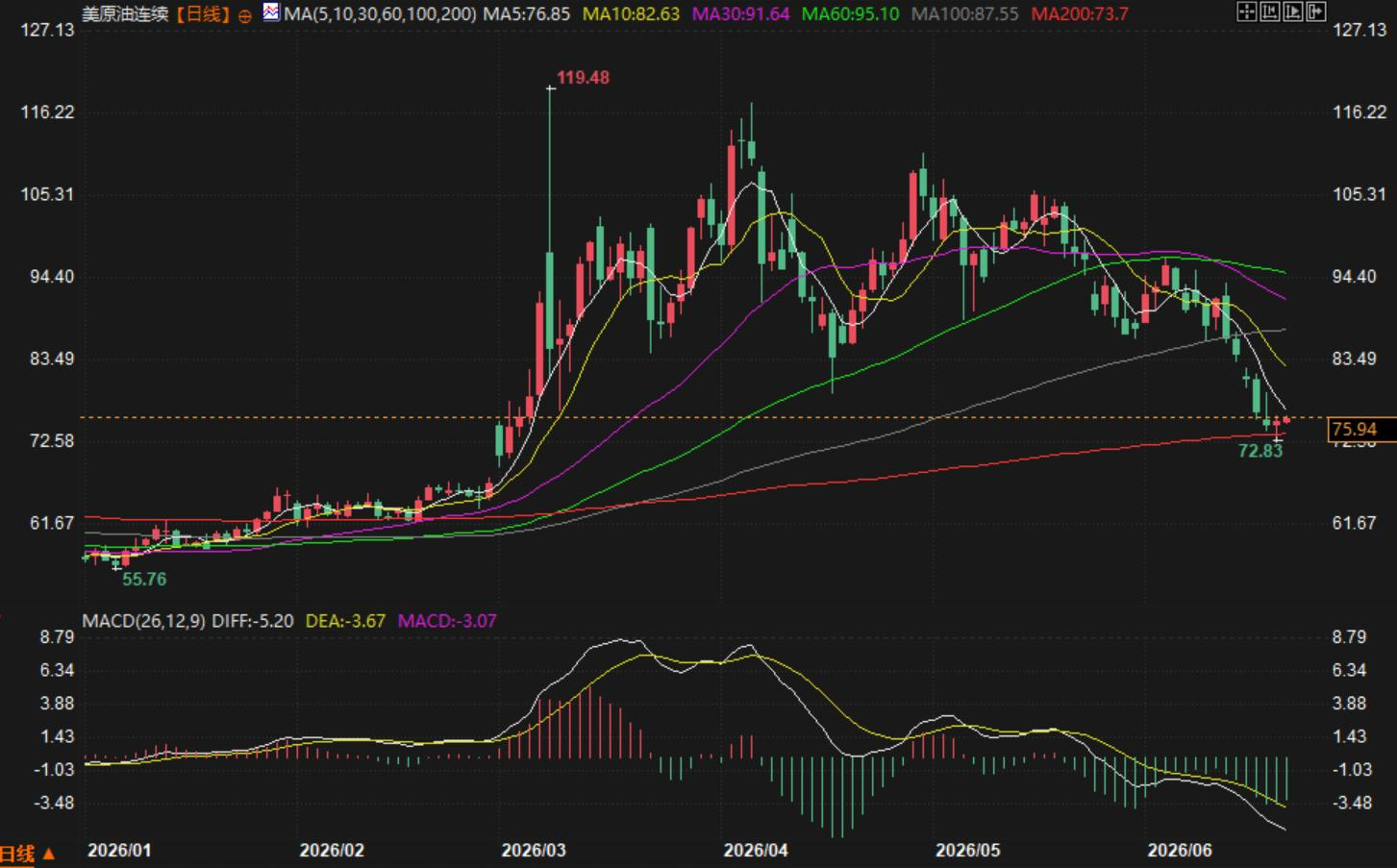
(US crude oil futures daily chart, source: FX678)
At 13:29 Beijing time on June 19, US crude oil futures were trading at $75.93 per barrel.
On the evening of June 18, 2026, local time, the White House announced that Vice President Vance would postpone his planned trip to Switzerland to participate in the next phase of negotiations with Iran. This decision was primarily due to the fact that logistical arrangements and technical details for the negotiations had not yet been finalized.
White House responds to lack of preparation for negotiations
The White House stated that Vance had clearly mentioned earlier that day at a White House press conference that the specific details of the upcoming technical negotiations were still under discussion.
Although the U.S. delegation is ready to depart at any time, Vance will not depart at this time to ensure the smooth progress of the negotiations.
Once the follow-up arrangements are finalized, the White House will release relevant information in a timely manner and reiterate its expectation to start this round of technical negotiations as soon as possible.
This decision to postpone the meeting highlights the Trump administration's consistent cautious approach to foreign affairs.
White House officials emphasized that the technical negotiations involve many complex issues, including a verification mechanism for Iran's nuclear facilities, specific steps for lifting sanctions, third-party monitoring arrangements, and long-term safeguards for shipping in the Strait of Hormuz. Rushing the process could lead to loopholes in the agreement's implementation or trigger new disputes.
Therefore, the U.S. chose to prioritize thorough preparation, ensuring that every step was based on reliable coordination.
Previously, Vance had been appointed as the principal person in charge of the next phase of negotiations. His role extends beyond simply attending meetings; it includes coordinating cross-departmental resources, harmonizing allied positions, and developing contingency plans. Postponing the trip also gives the US team more time for behind-the-scenes communication with Iranian representatives, avoiding any unexpected public disagreements that could affect the overall atmosphere.
The White House also sent positive signals, indicating that the U.S. remains optimistic about the prospects for negotiations and pledged to move forward with the dialogue process quickly when conditions are right.
Subsequent challenges under the 60-day agreement framework
The previous US-Iran agreement set a 60-day window for both sides, aiming to suspend the conflict, reopen the Strait of Hormuz, and create conditions for nuclear negotiations.
Vance had previously been designated to lead the next phase of negotiations, focusing on complex issues such as technical verification of Iran's nuclear program, adjustments to economic sanctions, and regional stability measures. This postponement reflects the US's attention to detail in diplomatic execution, avoiding the uncertainties of hasty action.
Within the 60-day window, both sides need to complete the transition from a temporary ceasefire to a long-term framework, which involves numerous technical and political challenges. For example, issues such as transparency monitoring of Iranian nuclear facilities, the approach of the International Atomic Energy Agency's involvement, the timetable for the gradual lifting of US oil sanctions, and how to deal with Iran's proxy forces in Lebanon, Yemen, and other regions all require detailed negotiations.
Postponing Vance's trip provides both sides with additional buffer time, which will help clarify differences in positions through multiple rounds of preparatory meetings, while also testing the Trump administration's internal decision-making and coordination capabilities. Analysts believe this adjustment will not change the overall direction of the negotiations, but may extend the timeline for an agreement's implementation, causing short-term fluctuations in confidence within the Middle East energy market.
Market and geopolitical impacts remain a focus.
Following this announcement, market attention has increased regarding expectations of a de-escalation of tensions in the Middle East. The Strait of Hormuz, a crucial global oil shipping route, directly impacts international energy price trends.
Analysts point out that while the postponement of negotiations is a normal diplomatic adjustment, it also highlights that the US and Iran still have technical differences and need more time to coordinate their positions.
International crude oil futures prices fluctuated slightly after the news was released, with investors closely monitoring subsequent developments. Geopolitical risk premiums remain; if negotiations proceed smoothly, they will further stabilize the global energy supply chain; conversely, delays could exacerbate regional tensions.
Major energy-importing countries in Europe and Asia are particularly sensitive to this process, and have called on both sides to exercise restraint and accelerate the pace of dialogue.
Institutional Views
Goldman Sachs analysts point out that the US-Iran agreement has eased short-term geopolitical risk premiums, but the long-term supply fundamentals remain relatively loose. Non-OPEC+ oil-producing countries are ramping up production, while global demand growth is relatively moderate, and the risk of demand disruption is rising, especially against the backdrop of economic uncertainty.
The bank emphasized that if Iran rapidly resumes exports, inventory accumulation will accelerate, potentially putting further downward pressure on oil prices in the second half of 2026. Investors should pay attention to the effectiveness of OPEC+ production cuts and changes in the global macroeconomic environment. Goldman Sachs maintains a neutral-to-bearish view on oil prices, advising energy sector investors to allocate cautiously, focusing on opportunities in downstream refining, while also being wary of short-term rebound risks from unforeseen geopolitical events.
Overall, Goldman Sachs believes that the oil market will shift from tight to balanced in 2026, with prices gradually declining.
JPMorgan Chase maintained a relatively cautious outlook on oil prices in its latest report. Despite the US-Iran agreement pushing for the reopening of the Strait of Hormuz, the bank expects the average Brent crude price for 2026 to remain around $60 per barrel, with short-term fluctuations followed by a return to supply and demand fundamentals. Analyst Natasha Kaneva pointed out that the global crude oil market will face significant oversupply and substantial inventory accumulation pressure in 2026, requiring voluntary or involuntary production cuts to balance the situation.
The bank believes that while geopolitical conflicts had initially driven up prices, supply recovered faster than expected after the agreement was implemented, while demand was constrained by slowing global economic growth. JPMorgan Chase warns that without additional production cuts, oil prices may face further downside risks, potentially even testing lower levels in 2027. The bank advises market participants to pay attention to US shale oil production dynamics and OPEC+ policy adjustments, while emphasizing the dampening effect of energy transition on long-term demand.
Overall, JPMorgan Chase holds a bearish view on oil prices in 2026, believing that current prices have largely reflected optimistic expectations, and that downward pressure will prevail. Investors should reduce their allocation to the upstream sector and shift to a diversified defensive strategy.
Technically, US crude oil is showing an overall weakening trend on the daily chart, with prices falling continuously from the March high of 119.48. The moving averages are in a bearish alignment, with the short-term MA5 and MA10 continuing to decline, putting pressure on prices below the moving averages. The MA60 has also turned downwards, indicating a clear medium-term downtrend.
The MACD indicator's DIFF and DEA lines are running below the zero axis, but the green bars are slightly contracting, indicating that although the bearish trend continues, the momentum is decreasing.
(US crude oil futures daily chart, source: FX678)
At 13:29 Beijing time on June 19, US crude oil futures were trading at $75.93 per barrel.
- Risk Warning and Disclaimer
- The market involves risk, and trading may not be suitable for all investors. This article is for reference only and does not constitute personal investment advice, nor does it take into account certain users’ specific investment objectives, financial situation, or other needs. Any investment decisions made based on this information are at your own risk.