Global central banks are racing to raise interest rates, so why is the Bank of England holding steady? The dilemma behind 3.75%.
2026-06-19 14:24:14
On Friday (June 19) during the Asian session, the pound sterling hovered at low levels against the dollar, currently trading around 1.3195. This followed two consecutive days of declines.
The Bank of England announced on Thursday that it would keep its benchmark interest rate unchanged at 3.75%, as policymakers continue to seek a balance between above-target inflation and weak economic output. The decision was in line with expectations from economists surveyed by the media, with seven of the nine members of the Monetary Policy Committee voting in favor.
Bank of England Chief Economist Hugh Peale and External Committee member Megan Green voted against the rate hike, both supporting a 25 basis point increase to 4%.
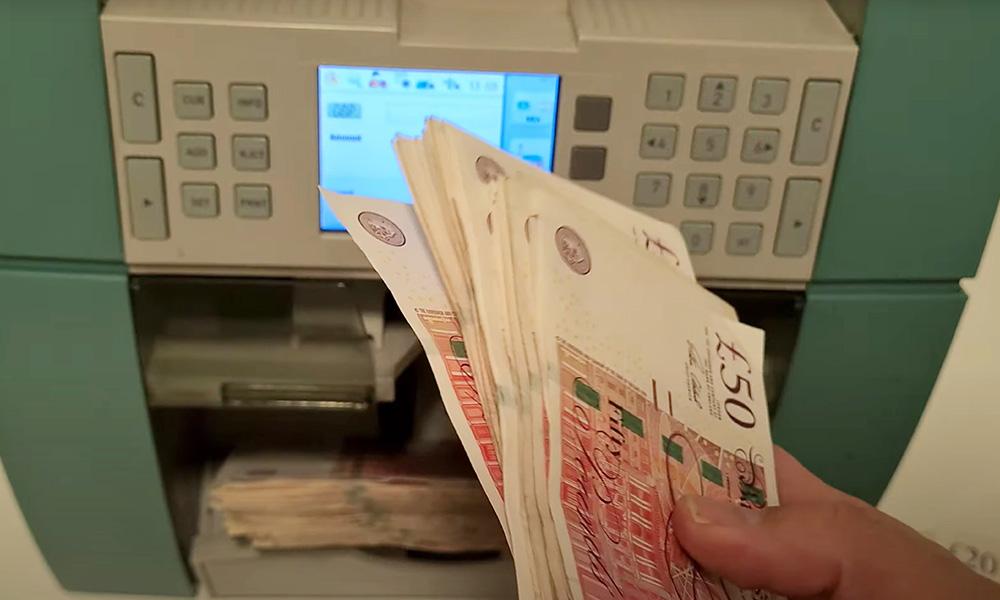
This interest rate decision comes at a time when the war with Iran is pushing up global energy costs. As a net energy importer, the UK is particularly sensitive to price shocks. In its policy summary on Thursday, the Bank of England stated that although prices have retreated from their initial surge, the war "makes it difficult to predict future trends."
UK inflation held steady at 2.8% in May, below expectations, with price increases primarily driven by transport fuel costs. However, data released last week showed the economy contracted by 0.1% in April. The cooling inflation was largely attributed to the adjustment of the UK energy price cap, but this effect is not expected to be sustainable – the cap will be raised by 13% this summer, at which point energy costs will reach a two-year high.
Despite some easing of inflation, the Bank of England expects it to rise again as energy prices have a ripple effect on the overall economy. The central bank's statement noted: "The duration of persistently high energy prices will determine their impact on the economy and inflation. Monetary policy cannot control global energy prices; our responsibility is to ensure that inflation does not persist and have a long-term impact on the economy. We are closely monitoring the situation."
Despite breakthrough progress in peace talks between Washington and Tehran, markets are still betting that the Bank of England will raise interest rates before the end of the year.
Previously, at its April meeting, the Monetary Policy Committee voted to keep interest rates unchanged, with traders pricing in a 96% probability of maintaining the current rate.
This decision followed the Federal Reserve's decision to keep interest rates unchanged at 3.5%-3.75%, in line with expectations. However, investors were uneasy about Kevin Warsh chairing the meeting for the first time as Fed chairman, and his hawkish signals triggered a decline in major stock indices.
Last week, the European Central Bank became the first major central bank to raise interest rates due to the energy crisis caused by the Iran war.
The Bank of Japan followed suit on Tuesday, raising its policy rate to a 31-year high of 1%.
Luke Bartholomew, deputy chief economist at Aberdeen Bank, said: "We believe the Bank of England can avoid the kind of monetary tightening that the ECB has already begun and that the Fed hinted at last night. In fact, if energy prices continue to ease, the debate may turn back to rate cuts, but that may not happen until next year."
Schroders senior economist George Brown believes the Bank of England cannot afford to be complacent in the face of persistent inflation risks. "Currently, the central bank is buying time, not taking proactive action. We believe the threshold for raising interest rates remains high. A softening labor market and weak growth should help limit the second-round effect, while progress on the reopening of the Strait of Hormuz should also reduce some of the extreme upside risks to energy prices."
Suren Thiru, chief economist at the Institute of Chartered Accountants in England and Wales, said that UK monetary policy is "at a crossroads."
He pointed out that the US-Iran peace framework has raised hopes that inflation can be contained without further tightening, but warned that the balance could tip back toward interest rate hikes if hostilities break out again.
According to the daily chart, the British pound has recently broken down sharply against the US dollar, completely disrupting the previous range-bound trading pattern. The price has fallen from a high of 1.3657 and is currently trading around 1.3195, having reached a low of 1.3162. The short-term 10-day and 30-day moving averages (MA10 and MA30) are providing strong resistance, and the price has broken significantly below the 60-day, 100-day, and 200-day moving averages (MA60, MA100, and MA200), with multiple moving averages now acting as resistance levels. The medium-term trend has completely shifted from range-bound to bearish.
From a technical perspective, the MACD lines (DIFF -0.0050 and DEA -0.0030) are running below the zero line, with the green bars continuing to expand, indicating a concentrated release of bearish momentum. There are no signs of a golden cross forming, suggesting the downward momentum has not yet weakened. The previous support level of 1.3346-1.3467 has been completely breached, transforming this area into a strong resistance zone. The first resistance level is 1.3346, followed by the 30-day moving average (MA30) at 1.3410. On the downside, short-term support is seen at the previous low of 1.3162. A decisive break below this level would open up further downside potential, with the next support level around 1.3100.
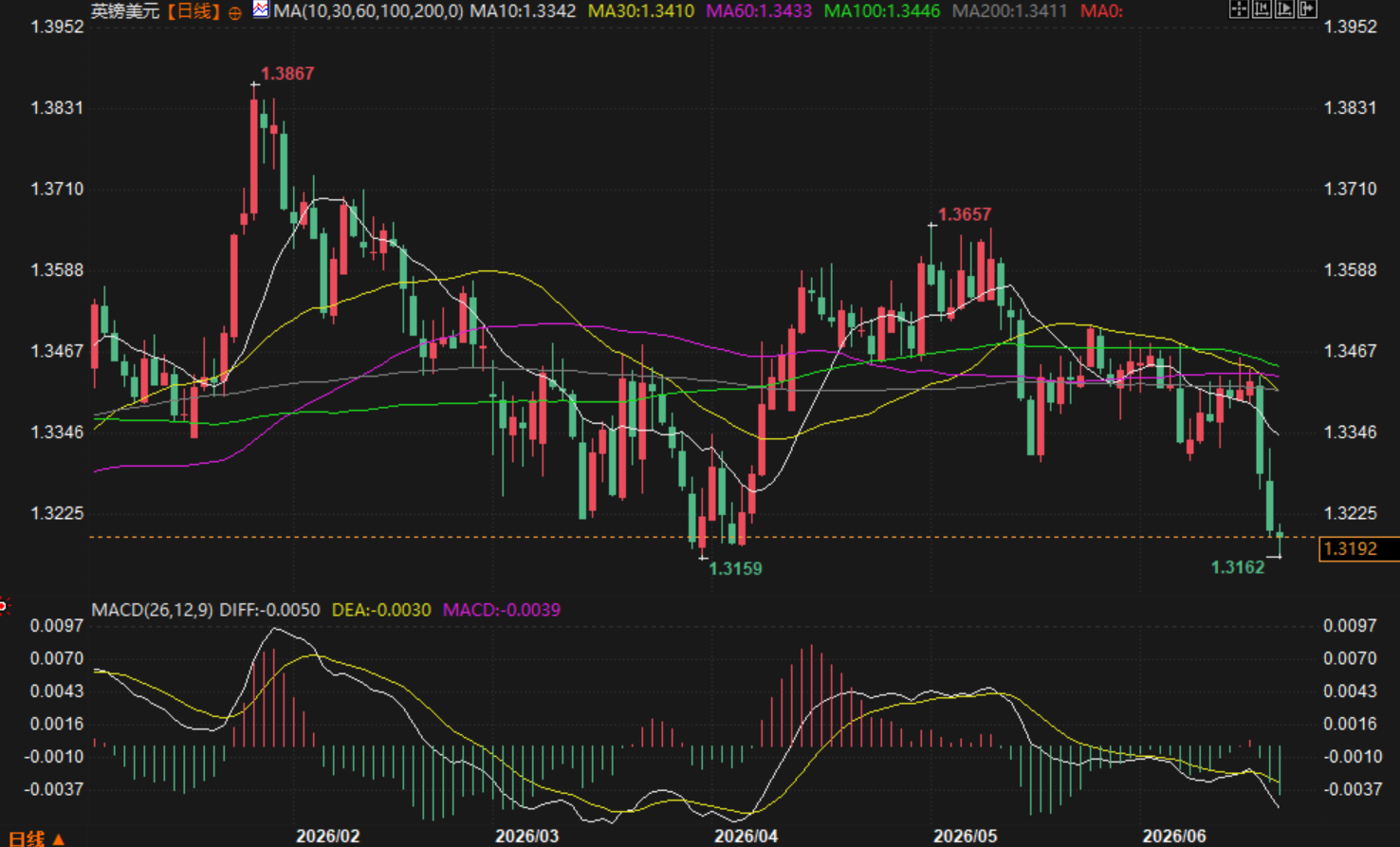
(GBP/USD daily chart, source: FX678)
At 14:07 Beijing time on June 19, the British pound was trading at 1.3193/94 against the US dollar.
The Bank of England announced on Thursday that it would keep its benchmark interest rate unchanged at 3.75%, as policymakers continue to seek a balance between above-target inflation and weak economic output. The decision was in line with expectations from economists surveyed by the media, with seven of the nine members of the Monetary Policy Committee voting in favor.
Bank of England Chief Economist Hugh Peale and External Committee member Megan Green voted against the rate hike, both supporting a 25 basis point increase to 4%.
The war with Iran has driven up energy costs, and Britain, as a net importer, is particularly vulnerable.
This interest rate decision comes at a time when the war with Iran is pushing up global energy costs. As a net energy importer, the UK is particularly sensitive to price shocks. In its policy summary on Thursday, the Bank of England stated that although prices have retreated from their initial surge, the war "makes it difficult to predict future trends."
UK inflation held steady at 2.8% in May, below expectations, with price increases primarily driven by transport fuel costs. However, data released last week showed the economy contracted by 0.1% in April. The cooling inflation was largely attributed to the adjustment of the UK energy price cap, but this effect is not expected to be sustainable – the cap will be raised by 13% this summer, at which point energy costs will reach a two-year high.
The risk of an inflation rebound remains, and the market is betting on an interest rate hike by the end of the year.
Despite some easing of inflation, the Bank of England expects it to rise again as energy prices have a ripple effect on the overall economy. The central bank's statement noted: "The duration of persistently high energy prices will determine their impact on the economy and inflation. Monetary policy cannot control global energy prices; our responsibility is to ensure that inflation does not persist and have a long-term impact on the economy. We are closely monitoring the situation."
Despite breakthrough progress in peace talks between Washington and Tehran, markets are still betting that the Bank of England will raise interest rates before the end of the year.
Previously, at its April meeting, the Monetary Policy Committee voted to keep interest rates unchanged, with traders pricing in a 96% probability of maintaining the current rate.
Global central bank policies diverge: Europe and the US have taken the lead, while the Bank of England remains on hold.
This decision followed the Federal Reserve's decision to keep interest rates unchanged at 3.5%-3.75%, in line with expectations. However, investors were uneasy about Kevin Warsh chairing the meeting for the first time as Fed chairman, and his hawkish signals triggered a decline in major stock indices.
Last week, the European Central Bank became the first major central bank to raise interest rates due to the energy crisis caused by the Iran war.
The Bank of Japan followed suit on Tuesday, raising its policy rate to a 31-year high of 1%.
Institutional View: The Bank of England may be able to avoid aggressive tightening, but should not be complacent.
Luke Bartholomew, deputy chief economist at Aberdeen Bank, said: "We believe the Bank of England can avoid the kind of monetary tightening that the ECB has already begun and that the Fed hinted at last night. In fact, if energy prices continue to ease, the debate may turn back to rate cuts, but that may not happen until next year."
Schroders senior economist George Brown believes the Bank of England cannot afford to be complacent in the face of persistent inflation risks. "Currently, the central bank is buying time, not taking proactive action. We believe the threshold for raising interest rates remains high. A softening labor market and weak growth should help limit the second-round effect, while progress on the reopening of the Strait of Hormuz should also reduce some of the extreme upside risks to energy prices."
Suren Thiru, chief economist at the Institute of Chartered Accountants in England and Wales, said that UK monetary policy is "at a crossroads."
He pointed out that the US-Iran peace framework has raised hopes that inflation can be contained without further tightening, but warned that the balance could tip back toward interest rate hikes if hostilities break out again.
Technical Analysis
According to the daily chart, the British pound has recently broken down sharply against the US dollar, completely disrupting the previous range-bound trading pattern. The price has fallen from a high of 1.3657 and is currently trading around 1.3195, having reached a low of 1.3162. The short-term 10-day and 30-day moving averages (MA10 and MA30) are providing strong resistance, and the price has broken significantly below the 60-day, 100-day, and 200-day moving averages (MA60, MA100, and MA200), with multiple moving averages now acting as resistance levels. The medium-term trend has completely shifted from range-bound to bearish.
From a technical perspective, the MACD lines (DIFF -0.0050 and DEA -0.0030) are running below the zero line, with the green bars continuing to expand, indicating a concentrated release of bearish momentum. There are no signs of a golden cross forming, suggesting the downward momentum has not yet weakened. The previous support level of 1.3346-1.3467 has been completely breached, transforming this area into a strong resistance zone. The first resistance level is 1.3346, followed by the 30-day moving average (MA30) at 1.3410. On the downside, short-term support is seen at the previous low of 1.3162. A decisive break below this level would open up further downside potential, with the next support level around 1.3100.
(GBP/USD daily chart, source: FX678)
At 14:07 Beijing time on June 19, the British pound was trading at 1.3193/94 against the US dollar.
- Risk Warning and Disclaimer
- The market involves risk, and trading may not be suitable for all investors. This article is for reference only and does not constitute personal investment advice, nor does it take into account certain users’ specific investment objectives, financial situation, or other needs. Any investment decisions made based on this information are at your own risk.