The Bank of Japan's deputy governor made a rare and candid statement: The yen's influence is no longer what it used to be, and the door to interest rate hikes is opening wider and wider.
2026-06-19 16:00:48
On Friday (June 19) during the Asian session, the USD/JPY pair fluctuated at high levels, currently trading around 161.30. In the previous trading day, the USD/JPY pair briefly tested the 161.80 level.
At a sensitive time when the yen continues to be under pressure, a speech by Bank of Japan Deputy Governor Himino on Friday provided the market with a key policy signal.
Bank of Japan Deputy Governor Himino reiterated the central bank's stance of continuing to raise interest rates in a public speech on Friday, while also sending a clear signal on the yen's exchange rate, the implications of which are hard for market participants to ignore.
Himino stated that the Bank of Japan expects to continue raising interest rates based on economic, price, and financial developments, and the pace and timing of rate hikes will be flexibly adjusted based on the probability of the baseline scenario and its associated risks.
He also pointed out that underlying inflation is approaching 2%, but there is a risk of it deviating upwards from the target—not due to a temporary surge in energy prices, but because of a more persistent change in the price-setting environment. This distinction is crucial, echoing concerns raised in the April meeting minutes: Japan is gradually moving away from a deflationary mindset, making the economy more sensitive to cost pressures than in previous cycles.

Himino reiterated the Bank of Japan's policy guidance following its June meeting: the Bank of Japan will continue to raise interest rates, with the pace and timing depending on the evolution of the baseline scenario and the associated risks. He specifically pointed out that while underlying inflation is approaching 2%, the risk of it deviating from the target is skewed to the upside, not due to a temporary surge in energy prices, but rather to more persistent structural changes in the price-setting environment.
This statement warrants in-depth analysis. Himino's wording echoes a core concern in the April meeting minutes—Japan is gradually shedding its long-standing deflationary mindset, and its economy is becoming more sensitive to cost pressures than in previous cycles. This implies that future price trends will be more resilient, providing justification for further interest rate hikes by the central bank.
Despite the drag on the economy from high oil prices, Himino assesses that the Japanese economy is generally robust, with corporate profits and household income remaining high, providing fundamental support for continued interest rate hikes.
The most market-relevant part of Himino's speech was his commentary on foreign exchange. He first reiterated the central bank's standard stance: monetary policy is not targeted at exchange rates. But he then added a more significant assessment—that, compared to the past, the transmission effect of the yen's depreciation on inflation has significantly increased due to changes in corporate behavior.
The deeper implication of this statement is that a sustained weakening of the yen will transmit to the price level at a faster pace and with a wider range than historical models have shown, thereby affecting inflation expectations and the underlying inflation path that the Bank of Japan is attempting to manage. This causal relationship necessitates that the central bank place exchange rate factors at a more central position when assessing its policy path.
Himino's wording provides the Bank of Japan with an implicit layer of policy maneuvering: if the yen continues to weaken, the central bank has ample reason to accelerate interest rate hikes—without formally announcing that the exchange rate is a policy target. At the same time, the warning about the risk of underlying inflation deviating from its target echoes the hawkish tone of the April meeting minutes, making the expectation of the next interest rate hike clearer.
Himino's statement came at a time when the USD/JPY exchange rate experienced a sharp reversal after testing the 161.80 level on Thursday. At this sensitive juncture, with the yen hitting multi-month lows, Himino's clear statement that "the impact of exchange rates is greater than in the past" carries a weight beyond conventional communication.
The market interprets this as the Bank of Japan closely monitoring the yen's movements and not being indifferent to its current level—and the policy rate is the core tool connecting exchange rates and inflation.
Goldman Sachs analysts point out that the expansionary fiscal policies of Japanese Prime Minister Sanae Takaichi's government will increase concerns about fiscal sustainability, further suppressing the yen's performance. Meanwhile, the Bank of Japan's slow pace of monetary policy normalization, the lingering negative interest rates, and the low-yield environment limit the yen's attractiveness. Although the Federal Reserve may continue to adjust its policy in 2026, the resilience of US economic growth and asset demand continue to support the US dollar. In the short term, geopolitical risks and a recovery in risk appetite may push USD/JPY to test the 160 level.
JPMorgan Chase maintained a bearish stance on the yen in its 2026 market outlook, predicting that the USD/JPY exchange rate will rise to around 164 by the end of 2026, making it one of the most hawkish forecasts on Wall Street.
Junya Tanase, the bank's chief Japan FX strategist, stated that the yen's fundamentals are weak, making sustainable appreciation through policy measures difficult. Japan's expansionary fiscal policy and the nearing end of the global monetary easing cycle will accelerate the yen's use as a funding currency, pushing the USD/JPY exchange rate higher. While the Federal Reserve's concerns about the labor market may exert some downward pressure on the dollar, robust US growth and sticky inflation limit the dollar's potential for significant weakness. The market has already fully priced in the Bank of Japan's interest rate hike expectations, leaving limited actual policy space.
According to the daily chart, the USD/JPY pair maintains its medium- to long-term upward trend, with the price reaching a new high of 161.81. The short-term 10-day and 30-day moving averages continue to rise, and the price has firmly established itself above all medium- and long-term moving averages. The previous low of 155.03 provides strong support, and the upward channel remains intact.
The MACD indicator shows DIFF at 0.387 and DEA at 0.417, with both lines running above the zero axis. The red bars are slightly contracting, forming a mild bearish divergence signal, indicating a short-term need for a pullback. The upper resistance is the previous high of 161.81; a break above this level would open up new upward potential. The lower short-term support is the 10-day moving average (MA10) at 156.59, followed by the 30-day moving average (MA30) at 156.07.
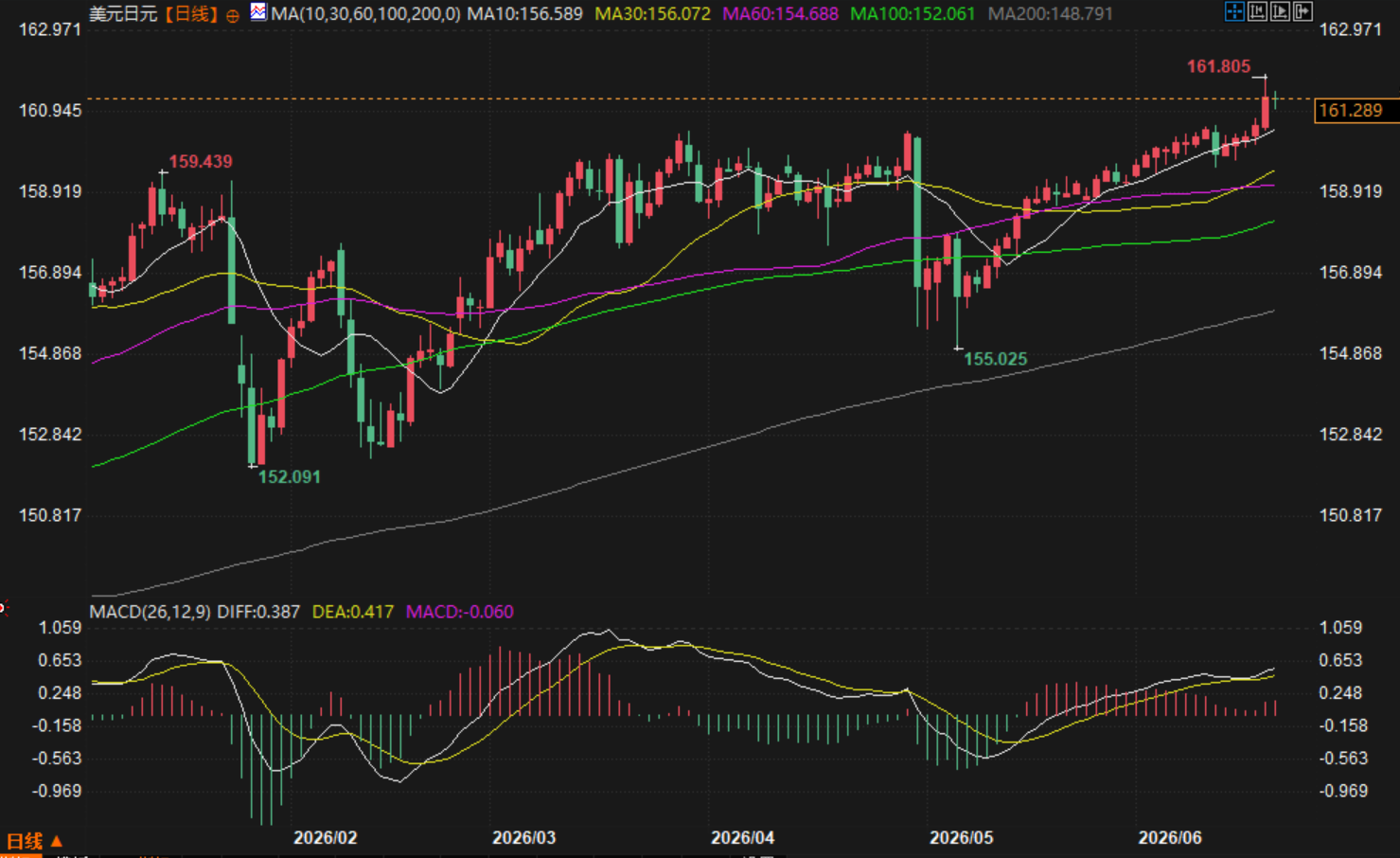
(USD/JPY daily chart, source: FX678)
At 16:00 Beijing time on June 19, the USD/JPY exchange rate was 161.27/28.
At a sensitive time when the yen continues to be under pressure, a speech by Bank of Japan Deputy Governor Himino on Friday provided the market with a key policy signal.
Bank of Japan Deputy Governor Himino reiterated the central bank's stance of continuing to raise interest rates in a public speech on Friday, while also sending a clear signal on the yen's exchange rate, the implications of which are hard for market participants to ignore.
Himino stated that the Bank of Japan expects to continue raising interest rates based on economic, price, and financial developments, and the pace and timing of rate hikes will be flexibly adjusted based on the probability of the baseline scenario and its associated risks.
He also pointed out that underlying inflation is approaching 2%, but there is a risk of it deviating upwards from the target—not due to a temporary surge in energy prices, but because of a more persistent change in the price-setting environment. This distinction is crucial, echoing concerns raised in the April meeting minutes: Japan is gradually moving away from a deflationary mindset, making the economy more sensitive to cost pressures than in previous cycles.
The bias towards interest rate hikes remains unchanged, but the risk to underlying inflation is tilted to the upside.
Himino reiterated the Bank of Japan's policy guidance following its June meeting: the Bank of Japan will continue to raise interest rates, with the pace and timing depending on the evolution of the baseline scenario and the associated risks. He specifically pointed out that while underlying inflation is approaching 2%, the risk of it deviating from the target is skewed to the upside, not due to a temporary surge in energy prices, but rather to more persistent structural changes in the price-setting environment.
This statement warrants in-depth analysis. Himino's wording echoes a core concern in the April meeting minutes—Japan is gradually shedding its long-standing deflationary mindset, and its economy is becoming more sensitive to cost pressures than in previous cycles. This implies that future price trends will be more resilient, providing justification for further interest rate hikes by the central bank.
Despite the drag on the economy from high oil prices, Himino assesses that the Japanese economy is generally robust, with corporate profits and household income remaining high, providing fundamental support for continued interest rate hikes.
The yen's influence is not what it used to be, and the policy logic has subtly changed.
The most market-relevant part of Himino's speech was his commentary on foreign exchange. He first reiterated the central bank's standard stance: monetary policy is not targeted at exchange rates. But he then added a more significant assessment—that, compared to the past, the transmission effect of the yen's depreciation on inflation has significantly increased due to changes in corporate behavior.
The deeper implication of this statement is that a sustained weakening of the yen will transmit to the price level at a faster pace and with a wider range than historical models have shown, thereby affecting inflation expectations and the underlying inflation path that the Bank of Japan is attempting to manage. This causal relationship necessitates that the central bank place exchange rate factors at a more central position when assessing its policy path.
Himino's wording provides the Bank of Japan with an implicit layer of policy maneuvering: if the yen continues to weaken, the central bank has ample reason to accelerate interest rate hikes—without formally announcing that the exchange rate is a policy target. At the same time, the warning about the risk of underlying inflation deviating from its target echoes the hawkish tone of the April meeting minutes, making the expectation of the next interest rate hike clearer.
Amid pressure on the yen, the path of interest rate hikes is being reassessed.
Himino's statement came at a time when the USD/JPY exchange rate experienced a sharp reversal after testing the 161.80 level on Thursday. At this sensitive juncture, with the yen hitting multi-month lows, Himino's clear statement that "the impact of exchange rates is greater than in the past" carries a weight beyond conventional communication.
The market interprets this as the Bank of Japan closely monitoring the yen's movements and not being indifferent to its current level—and the policy rate is the core tool connecting exchange rates and inflation.
Institutional Views
Goldman Sachs analysts point out that the expansionary fiscal policies of Japanese Prime Minister Sanae Takaichi's government will increase concerns about fiscal sustainability, further suppressing the yen's performance. Meanwhile, the Bank of Japan's slow pace of monetary policy normalization, the lingering negative interest rates, and the low-yield environment limit the yen's attractiveness. Although the Federal Reserve may continue to adjust its policy in 2026, the resilience of US economic growth and asset demand continue to support the US dollar. In the short term, geopolitical risks and a recovery in risk appetite may push USD/JPY to test the 160 level.
JPMorgan Chase maintained a bearish stance on the yen in its 2026 market outlook, predicting that the USD/JPY exchange rate will rise to around 164 by the end of 2026, making it one of the most hawkish forecasts on Wall Street.
Junya Tanase, the bank's chief Japan FX strategist, stated that the yen's fundamentals are weak, making sustainable appreciation through policy measures difficult. Japan's expansionary fiscal policy and the nearing end of the global monetary easing cycle will accelerate the yen's use as a funding currency, pushing the USD/JPY exchange rate higher. While the Federal Reserve's concerns about the labor market may exert some downward pressure on the dollar, robust US growth and sticky inflation limit the dollar's potential for significant weakness. The market has already fully priced in the Bank of Japan's interest rate hike expectations, leaving limited actual policy space.
Technical Analysis
According to the daily chart, the USD/JPY pair maintains its medium- to long-term upward trend, with the price reaching a new high of 161.81. The short-term 10-day and 30-day moving averages continue to rise, and the price has firmly established itself above all medium- and long-term moving averages. The previous low of 155.03 provides strong support, and the upward channel remains intact.
The MACD indicator shows DIFF at 0.387 and DEA at 0.417, with both lines running above the zero axis. The red bars are slightly contracting, forming a mild bearish divergence signal, indicating a short-term need for a pullback. The upper resistance is the previous high of 161.81; a break above this level would open up new upward potential. The lower short-term support is the 10-day moving average (MA10) at 156.59, followed by the 30-day moving average (MA30) at 156.07.
(USD/JPY daily chart, source: FX678)
At 16:00 Beijing time on June 19, the USD/JPY exchange rate was 161.27/28.
- Risk Warning and Disclaimer
- The market involves risk, and trading may not be suitable for all investors. This article is for reference only and does not constitute personal investment advice, nor does it take into account certain users’ specific investment objectives, financial situation, or other needs. Any investment decisions made based on this information are at your own risk.