From an overwhelming victory to a dismal exit: With Starmer's departure imminent, can the pound finally see the "bad news fully priced in"?
2026-06-22 11:11:26
On Monday (June 22) in early Asian trading, the pound opened sharply lower, but market sentiment gradually calmed down after a short-term sell-off, and the exchange rate rebounded from its lows to around 1.3225.
British Prime Minister Keir Starmer faces political challenges and is expected to announce his resignation within days, causing a sudden surge in political uncertainty. Coupled with hawkish signals from the Federal Reserve continuing to boost the dollar, the pound is caught in a double bind.
British politics has once again descended into turmoil. Reports indicate that Starmer's allies expect him to announce his timetable for leaving office in the coming days to make way for a new Labour leader. This would be Britain's seventh prime minister in a decade, highlighting the ongoing instability in British politics since Brexit.
Reports indicate that current Manchester Mayor Andy Burnham is a likely successor to Starmer as Prime Minister. British Business Secretary Peter Kyle confirmed last Sunday (June 21) that Starmer is reflecting on the "current political challenges he faces."
Meanwhile, US President Trump also posted on Truth Social that Starmer would resign as prime minister—this external "certification" further fueled market expectations of a political upheaval in the UK.
Despite the Labour Party's overwhelming victory in the 2024 general election, its support has continued to decline under multiple pressures, including a sluggish economic recovery, a crisis in public services, and internal party divisions.
Starmer's early departure means that Britain will once again enter a period of uncertainty regarding leadership transition, which is undoubtedly a short-term negative for the pound.
In addition to the political turmoil in the UK, the strength of the US dollar is another key variable suppressing the pound.
Last week, at its first policy meeting chaired by Warsh, the Federal Reserve decided to maintain the benchmark interest rate at 3.50%-3.75%. However, in the post-meeting press conference, Warsh clearly stated that "price stability" would be the Fed's guiding principle—a statement interpreted by the market as the Fed continuing to prioritize combating inflation rather than rushing to ease monetary policy.
The federal funds futures market has fully priced in a 25 basis point rate hike at the September meeting, and even the possibility of a direct rate hike at the July meeting has not been completely ruled out. This hawkish tone means that the interest rate differential between the US and the UK is unlikely to narrow in the short term, providing continued support for the US dollar.
In the short term, the pound's performance will mainly depend on two variables.
One key factor is whether the British political situation can become clearer soon. The specific timetable for Starmer's resignation, the smoothness of the succession process within the Labour Party, and the policy direction of the new government will directly determine whether the pound can recover after the "bad news has been fully priced in."
If the transfer of power proceeds smoothly and orderly, the market is expected to quickly absorb the political premium, and the pound may get a breather; conversely, if the internal party struggle intensifies and the succession process becomes chaotic, the pound may face further downward pressure.
Secondly, there is the difference in policy paths between the Bank of England and the Bank of China. Although the Bank of England has already begun its interest rate cut cycle, as long as the Federal Reserve continues to maintain a hawkish stance, the interest rate differential between the UK and the US will be difficult to narrow, and the US dollar will continue to maintain its interest rate advantage over the pound.
Furthermore, whether the Bank of England will accelerate interest rate cuts due to economic weakness will profoundly influence market assessments of the pound's medium- to long-term value. If the Bank of England signals a more accommodative stance, the pound will suffer further; conversely, if it emphasizes inflation risks and remains restrained in its rate cuts, it could provide some support for the pound.
According to the daily chart, the overall medium-term downtrend for GBP/USD has been established. The price has oscillated downwards from its recent high of 1.3867, recently testing a new low of 1.3162 before stabilizing slightly, but the trend remains weak. The moving average system forms a complete bearish resistance, with the short-term MA20 (1.3377) and MA50 (1.3456), and the medium-to-long-term MA100 and MA200 all trending downwards. Previous support levels have now turned into strong resistance.
On the indicators side, the MACD lines are running below the zero axis, and the DIFF at -0.0053 is below the DEA at -0.0034, continuously outputting green momentum bars, indicating that the bearish force has not yet weakened; the RSI has fallen into the weak zone, and although it is close to the 30 oversold dividing line, no obvious bottom divergence structure has appeared. The short-term stabilization is only a slight oversold correction, and reversal signals are lacking.
Structurally, the market is exhibiting a downtrend channel with both highs and lows moving lower. The previous low of 1.3159 and the current low of 1.3162 form a short-term support zone. The primary resistance level is at the 20-day moving average (MA20) at 1.3377, where selling pressure is expected to be heavy. A slight stabilization in the short term is unlikely to change the medium-term downtrend. If the 1.3162 support level is breached, further downside potential will open up; if the support holds and a rebound occurs, it should be considered a pullback within the downtrend. The overall strategy should focus on selling on rallies. Long positions should only be considered after a clear bottoming signal is established, and short-term attempts to profit from rebounds should be approached with caution.
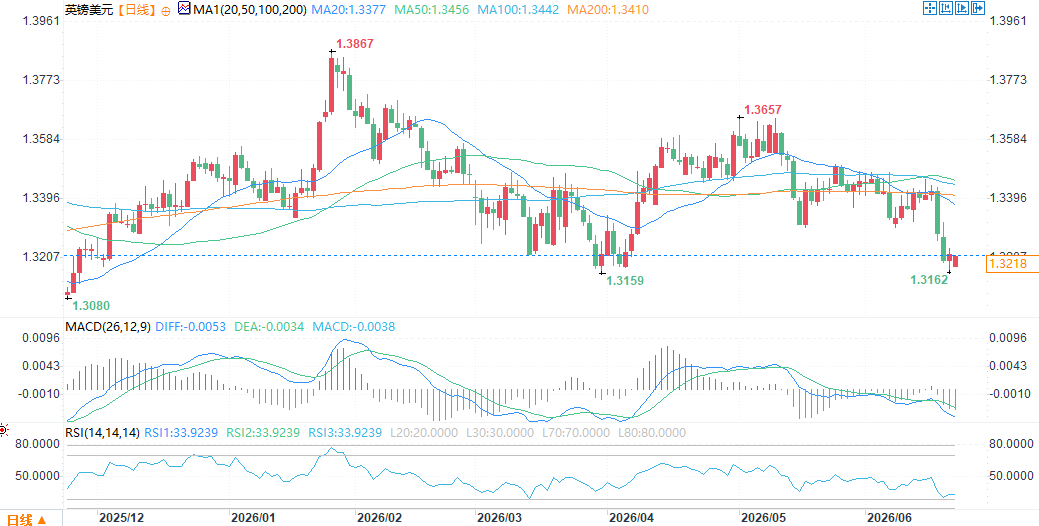
(GBP/USD daily chart, source: FX678)
At 11:11 Beijing time on June 22, the British pound was trading at 1.3223/24 against the US dollar.
British Prime Minister Keir Starmer faces political challenges and is expected to announce his resignation within days, causing a sudden surge in political uncertainty. Coupled with hawkish signals from the Federal Reserve continuing to boost the dollar, the pound is caught in a double bind.
Political upheaval in Britain: Starmer expected to resign, seventh prime minister in ten years on the horizon.
British politics has once again descended into turmoil. Reports indicate that Starmer's allies expect him to announce his timetable for leaving office in the coming days to make way for a new Labour leader. This would be Britain's seventh prime minister in a decade, highlighting the ongoing instability in British politics since Brexit.
Reports indicate that current Manchester Mayor Andy Burnham is a likely successor to Starmer as Prime Minister. British Business Secretary Peter Kyle confirmed last Sunday (June 21) that Starmer is reflecting on the "current political challenges he faces."
Meanwhile, US President Trump also posted on Truth Social that Starmer would resign as prime minister—this external "certification" further fueled market expectations of a political upheaval in the UK.
Despite the Labour Party's overwhelming victory in the 2024 general election, its support has continued to decline under multiple pressures, including a sluggish economic recovery, a crisis in public services, and internal party divisions.
Starmer's early departure means that Britain will once again enter a period of uncertainty regarding leadership transition, which is undoubtedly a short-term negative for the pound.
The Fed's hawkish stance: Continued expectations of interest rate hikes solidify the dollar's advantage.
In addition to the political turmoil in the UK, the strength of the US dollar is another key variable suppressing the pound.
Last week, at its first policy meeting chaired by Warsh, the Federal Reserve decided to maintain the benchmark interest rate at 3.50%-3.75%. However, in the post-meeting press conference, Warsh clearly stated that "price stability" would be the Fed's guiding principle—a statement interpreted by the market as the Fed continuing to prioritize combating inflation rather than rushing to ease monetary policy.
The federal funds futures market has fully priced in a 25 basis point rate hike at the September meeting, and even the possibility of a direct rate hike at the July meeting has not been completely ruled out. This hawkish tone means that the interest rate differential between the US and the UK is unlikely to narrow in the short term, providing continued support for the US dollar.
Key variables for the British pound: political clarity and central bank signals
In the short term, the pound's performance will mainly depend on two variables.
One key factor is whether the British political situation can become clearer soon. The specific timetable for Starmer's resignation, the smoothness of the succession process within the Labour Party, and the policy direction of the new government will directly determine whether the pound can recover after the "bad news has been fully priced in."
If the transfer of power proceeds smoothly and orderly, the market is expected to quickly absorb the political premium, and the pound may get a breather; conversely, if the internal party struggle intensifies and the succession process becomes chaotic, the pound may face further downward pressure.
Secondly, there is the difference in policy paths between the Bank of England and the Bank of China. Although the Bank of England has already begun its interest rate cut cycle, as long as the Federal Reserve continues to maintain a hawkish stance, the interest rate differential between the UK and the US will be difficult to narrow, and the US dollar will continue to maintain its interest rate advantage over the pound.
Furthermore, whether the Bank of England will accelerate interest rate cuts due to economic weakness will profoundly influence market assessments of the pound's medium- to long-term value. If the Bank of England signals a more accommodative stance, the pound will suffer further; conversely, if it emphasizes inflation risks and remains restrained in its rate cuts, it could provide some support for the pound.
Technical Analysis
According to the daily chart, the overall medium-term downtrend for GBP/USD has been established. The price has oscillated downwards from its recent high of 1.3867, recently testing a new low of 1.3162 before stabilizing slightly, but the trend remains weak. The moving average system forms a complete bearish resistance, with the short-term MA20 (1.3377) and MA50 (1.3456), and the medium-to-long-term MA100 and MA200 all trending downwards. Previous support levels have now turned into strong resistance.
On the indicators side, the MACD lines are running below the zero axis, and the DIFF at -0.0053 is below the DEA at -0.0034, continuously outputting green momentum bars, indicating that the bearish force has not yet weakened; the RSI has fallen into the weak zone, and although it is close to the 30 oversold dividing line, no obvious bottom divergence structure has appeared. The short-term stabilization is only a slight oversold correction, and reversal signals are lacking.
Structurally, the market is exhibiting a downtrend channel with both highs and lows moving lower. The previous low of 1.3159 and the current low of 1.3162 form a short-term support zone. The primary resistance level is at the 20-day moving average (MA20) at 1.3377, where selling pressure is expected to be heavy. A slight stabilization in the short term is unlikely to change the medium-term downtrend. If the 1.3162 support level is breached, further downside potential will open up; if the support holds and a rebound occurs, it should be considered a pullback within the downtrend. The overall strategy should focus on selling on rallies. Long positions should only be considered after a clear bottoming signal is established, and short-term attempts to profit from rebounds should be approached with caution.
(GBP/USD daily chart, source: FX678)
At 11:11 Beijing time on June 22, the British pound was trading at 1.3223/24 against the US dollar.
- Risk Warning and Disclaimer
- The market involves risk, and trading may not be suitable for all investors. This article is for reference only and does not constitute personal investment advice, nor does it take into account certain users’ specific investment objectives, financial situation, or other needs. Any investment decisions made based on this information are at your own risk.