60 Days! US-Iran negotiations enter final stretch; four key variables will determine whether commodity prices rise or fall.
2026-06-22 12:09:38
On Monday (June 22) during Asian trading hours, US crude oil futures opened higher but then fell, with prices rising as much as 3% to $78.14 per barrel before retreating. Currently, it is down about 0.2% and trading around $75.60 per barrel.
On Monday, the US and Iran held multiple rounds of talks in Switzerland and achieved substantial breakthroughs. The two sides agreed on a 60-day consultation period for a final agreement and issued a joint statement under the joint mediation of Qatar and Pakistan, confirming the overall positive atmosphere of the talks and simultaneously establishing a complete negotiation framework.
Both sides established a high-level committee to coordinate the entire negotiation process, with chief negotiators from each country regularly reporting on the progress of consultations. Three special working groups were established for nuclear issues, sanctions against Iran, and regional dispute resolution, and a coordinating group for hostilities in Lebanon was established to ensure the continued progress of the 60-day intensive dialogue through institutional mechanisms, reducing the probability of political fluctuations interrupting the negotiations.
Iranian Foreign Minister Araqchi disclosed positive developments in the negotiations, stating that Iran is expected to obtain exemptions for oil and petrochemical exports, the lifting of port blockades, and the phased unfreezing of overseas assets, while simultaneously initiating supporting negotiations for domestic reconstruction and development. He also stated that the ceasefire coordination mechanism in Lebanon will be the core test for the implementation of this agreement, as regional conflicts can easily hinder the overall diplomatic process.

The most practically valuable outcome of these negotiations was the establishment of a trilateral conflict coordination group involving the US, Iran, and Lebanon. The group aims to completely end armed conflict in Lebanon within a 60-day window and agreed to allow free passage through the Strait of Hormuz. The ongoing fighting between Israel and Hezbollah, supported by Iran, directly tests the effectiveness of this coordination mechanism.
The situation has quickly become tense: Iran's Islamic Revolutionary Guard Corps recently announced a temporary closure of the Strait of Hormuz due to Israel's continued attacks on Lebanon; the US publicly denied the closure, stating that Iran has no sole authority to control the strait. Iran's Tasnim News Agency simultaneously stated that the strait closure will remain in effect until two conditions are met: a complete ceasefire in Lebanon and the lifting of oil sanctions.
Trump then issued a strong warning on social media, demanding that Iran immediately halt its proxy armed operations in Lebanon, or face a more powerful military strike. This statement significantly exacerbated market doubts about whether the ceasefire mechanism could be successfully implemented, and geopolitical risk premiums rose again.
US Vice President Vance postponed his trip to Switzerland to lead the negotiations. A senior US diplomat confirmed that the two delegations were in continuous communication around the clock, comprehensively reviewing all the terms of the nuclear agreement, denying market rumors that Iran had withdrawn from the negotiations, and stating that the results of this consultation would serve as the basis for subsequent technical negotiations.
In response to the signal congestion in the Strait of Hormuz, the US has established a dedicated communication channel to ensure the openness of the waterway and is simultaneously advancing negotiations on the detailed implementation of the ceasefire in southern Lebanon. Vance has signaled a de-escalation, downplaying the negative impact of the Lebanese conflict, stating that the Trump administration intends to reshape US-Iran bilateral relations. He added that the proposed solution would strictly limit Iran's enriched uranium stockpile to weaken its nuclear expansion capabilities at the source, while retaining counterbalancing measures such as economic sanctions.
A clear policy divide has emerged within the White House. Trump continues to release threats of military strikes, and his tough stance strongly clashes with Vance's moderate approach to consultation. These contradictory signals continue to undermine Iran's trust in the US's commitment to fulfilling its obligations, sowing the seeds for a long-term power struggle in subsequent negotiations.
First, the situation in Lebanon is highly unpredictable. Israel was not involved in the current US-Iran bilateral understanding framework and has independent decision-making power regarding military operations. Even if the US and Iran reach a ceasefire agreement, continued Israeli airstrikes could directly trigger Iranian retaliation, and core provisions such as the strait's navigation and oil exports risk becoming invalid at any time.
Second, the White House's dual statements continue to undermine mutual trust. While advancing diplomatic consultations, it simultaneously issues warnings of military strikes. This protracted game of maneuvering easily prolongs the negotiation process, and the established 60-day timetable may be delayed or even shelved.
Third, both sides face significant domestic political obstacles. Hardline factions within Iran have extremely low tolerance for diplomatic concessions, and a large number of members of the US Congress also oppose compromise with Iran. Any domestic political change could overturn the existing negotiations.
Fourth, disagreements over technical terms remain unresolved. Key details such as nuclear enrichment controls, the pace of sanctions lifting, the timeline for unfreezing overseas assets, and long-term rules for managing the Taiwan Strait have not yet been agreed upon, putting significant pressure on technical negotiations within the 60-day window.
The recent US-Iran-Switzerland negotiations established a comprehensive 60-day consultation framework, creating communication channels on nuclear issues, sanctions, and regional ceasefires. This has temporarily eased expectations of extreme geopolitical conflict in the Middle East, which is beneficial for the recovery of risk appetite in commodities such as crude oil and non-ferrous metals. However, the implementation of the agreement faces multiple rigid constraints. Key variables include independent Israeli military action, policy differences within and outside the US government, domestic political pressures in both countries, and disagreements over the control of the Strait of Hormuz. Short-term geopolitical volatility will continue to disrupt energy and industrial commodity markets. During the 60-day negotiation period, the market needs to continuously monitor the implementation of the ceasefire in Lebanon, the stability of navigation in the Strait of Hormuz, and the progress of technical negotiations between the US and Iran. Neither unilateral positive nor negative factors offer sustained drivers, and commodities are expected to maintain an overall range-bound trading pattern.
Q: What are the core objectives of this 60-day US-Iran negotiations? What is the purpose of establishing multiple working groups?
A: The core objective is to finalize a comprehensive agreement covering nuclear control, sanctions lifting, and a ceasefire in the Middle East within a two-month window. Three special working groups are responsible for technical consultations in specific areas, a high-level committee coordinates political differences, and the Lebanon conflict coordination group handles regional conflicts separately. This tiered mechanism prevents disagreements on a single issue from disrupting overall negotiations and ensures the continued progress of consultations.
Q: Why is the situation in Lebanon considered crucial to the success or failure of these negotiations?
A: Iran considers the ceasefire in Lebanon as a red line for compliance. Israel is not bound by the bilateral agreement between the US and Iran. Continued attacks will prompt Iran to close the Strait of Hormuz again, directly violating core provisions such as open navigation and oil export exemptions. Once the control of the strait is tightened, the entire Memorandum of Understanding framework will lose its basis for implementation.
Q: What practical impact will the starkly contrasting statements from Trump and Vance have?
A: The dual signals significantly reduce Iran's trust in the US's commitment to the agreement, increasing the probability of protracted negotiations and extending the consultation period; at the same time, they continue to push up the geopolitical risk premium in the Middle East, amplifying the volatility of commodities such as crude oil and non-ferrous metals, making it difficult for the market to form a stable one-sided trading logic, and maintaining a volatile trend in the short term.
Q: What are the cascading effects of the repeated closures and openings of the Strait of Hormuz on global commodities?
A: The Taiwan Strait handles 30% of global seaborne crude oil transportation. A blockade would push up the war premium for crude oil, increase the cost of raw materials for chemical and non-ferrous metal production, and suppress the valuation of industrial products. If the strait is opened to navigation smoothly, the geopolitical premium will fall rapidly, and the recovery of risk appetite will benefit industrial metals. However, it will still take several months for supply to fully recover, and the bottom support for oil prices will still exist.
Q: During the 60-day negotiation period, which variables will directly disrupt the current market volatility pattern?
A: First, Israel suspends its military operations in Lebanon and navigation in the Strait of Hormuz is restored; second, the US and Iran reach a unified set of rules on nuclear enrichment and the lifting of sanctions; third, Trump abandons his stance on military deterrence; and fourth, hardline forces in both countries obstruct consultations and negotiations, causing the process to stall. Any one of these four events will lead to a breakout from the range-bound, one-sided market trend in commodities.
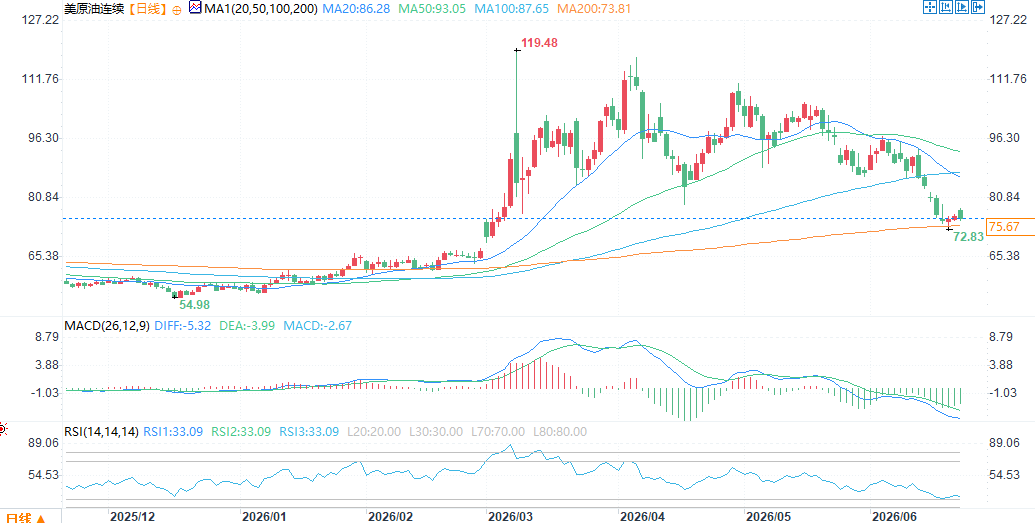
(US crude oil futures daily chart, source: FX678)
At 12:09 Beijing time on June 22, US crude oil futures were trading at $75.54 per barrel.
On Monday, the US and Iran held multiple rounds of talks in Switzerland and achieved substantial breakthroughs. The two sides agreed on a 60-day consultation period for a final agreement and issued a joint statement under the joint mediation of Qatar and Pakistan, confirming the overall positive atmosphere of the talks and simultaneously establishing a complete negotiation framework.
Both sides established a high-level committee to coordinate the entire negotiation process, with chief negotiators from each country regularly reporting on the progress of consultations. Three special working groups were established for nuclear issues, sanctions against Iran, and regional dispute resolution, and a coordinating group for hostilities in Lebanon was established to ensure the continued progress of the 60-day intensive dialogue through institutional mechanisms, reducing the probability of political fluctuations interrupting the negotiations.
Iranian Foreign Minister Araqchi disclosed positive developments in the negotiations, stating that Iran is expected to obtain exemptions for oil and petrochemical exports, the lifting of port blockades, and the phased unfreezing of overseas assets, while simultaneously initiating supporting negotiations for domestic reconstruction and development. He also stated that the ceasefire coordination mechanism in Lebanon will be the core test for the implementation of this agreement, as regional conflicts can easily hinder the overall diplomatic process.
Lebanon's ceasefire coordination mechanism: Tripartite bargaining becomes the first hurdle to implementing the agreement.
The most practically valuable outcome of these negotiations was the establishment of a trilateral conflict coordination group involving the US, Iran, and Lebanon. The group aims to completely end armed conflict in Lebanon within a 60-day window and agreed to allow free passage through the Strait of Hormuz. The ongoing fighting between Israel and Hezbollah, supported by Iran, directly tests the effectiveness of this coordination mechanism.
The situation has quickly become tense: Iran's Islamic Revolutionary Guard Corps recently announced a temporary closure of the Strait of Hormuz due to Israel's continued attacks on Lebanon; the US publicly denied the closure, stating that Iran has no sole authority to control the strait. Iran's Tasnim News Agency simultaneously stated that the strait closure will remain in effect until two conditions are met: a complete ceasefire in Lebanon and the lifting of oil sanctions.
Trump then issued a strong warning on social media, demanding that Iran immediately halt its proxy armed operations in Lebanon, or face a more powerful military strike. This statement significantly exacerbated market doubts about whether the ceasefire mechanism could be successfully implemented, and geopolitical risk premiums rose again.
US Two-Way Policy Signals: Vance Expresses Willingness to Cooperate, Trump Maintains High-Pressure Deterrence
US Vice President Vance postponed his trip to Switzerland to lead the negotiations. A senior US diplomat confirmed that the two delegations were in continuous communication around the clock, comprehensively reviewing all the terms of the nuclear agreement, denying market rumors that Iran had withdrawn from the negotiations, and stating that the results of this consultation would serve as the basis for subsequent technical negotiations.
In response to the signal congestion in the Strait of Hormuz, the US has established a dedicated communication channel to ensure the openness of the waterway and is simultaneously advancing negotiations on the detailed implementation of the ceasefire in southern Lebanon. Vance has signaled a de-escalation, downplaying the negative impact of the Lebanese conflict, stating that the Trump administration intends to reshape US-Iran bilateral relations. He added that the proposed solution would strictly limit Iran's enriched uranium stockpile to weaken its nuclear expansion capabilities at the source, while retaining counterbalancing measures such as economic sanctions.
A clear policy divide has emerged within the White House. Trump continues to release threats of military strikes, and his tough stance strongly clashes with Vance's moderate approach to consultation. These contradictory signals continue to undermine Iran's trust in the US's commitment to fulfilling its obligations, sowing the seeds for a long-term power struggle in subsequent negotiations.
Four core potential obstacles in the 60-day negotiation cycle
First, the situation in Lebanon is highly unpredictable. Israel was not involved in the current US-Iran bilateral understanding framework and has independent decision-making power regarding military operations. Even if the US and Iran reach a ceasefire agreement, continued Israeli airstrikes could directly trigger Iranian retaliation, and core provisions such as the strait's navigation and oil exports risk becoming invalid at any time.
Second, the White House's dual statements continue to undermine mutual trust. While advancing diplomatic consultations, it simultaneously issues warnings of military strikes. This protracted game of maneuvering easily prolongs the negotiation process, and the established 60-day timetable may be delayed or even shelved.
Third, both sides face significant domestic political obstacles. Hardline factions within Iran have extremely low tolerance for diplomatic concessions, and a large number of members of the US Congress also oppose compromise with Iran. Any domestic political change could overturn the existing negotiations.
Fourth, disagreements over technical terms remain unresolved. Key details such as nuclear enrichment controls, the pace of sanctions lifting, the timeline for unfreezing overseas assets, and long-term rules for managing the Taiwan Strait have not yet been agreed upon, putting significant pressure on technical negotiations within the 60-day window.
Editor's Summary
The recent US-Iran-Switzerland negotiations established a comprehensive 60-day consultation framework, creating communication channels on nuclear issues, sanctions, and regional ceasefires. This has temporarily eased expectations of extreme geopolitical conflict in the Middle East, which is beneficial for the recovery of risk appetite in commodities such as crude oil and non-ferrous metals. However, the implementation of the agreement faces multiple rigid constraints. Key variables include independent Israeli military action, policy differences within and outside the US government, domestic political pressures in both countries, and disagreements over the control of the Strait of Hormuz. Short-term geopolitical volatility will continue to disrupt energy and industrial commodity markets. During the 60-day negotiation period, the market needs to continuously monitor the implementation of the ceasefire in Lebanon, the stability of navigation in the Strait of Hormuz, and the progress of technical negotiations between the US and Iran. Neither unilateral positive nor negative factors offer sustained drivers, and commodities are expected to maintain an overall range-bound trading pattern.
Frequently Asked Questions
Q: What are the core objectives of this 60-day US-Iran negotiations? What is the purpose of establishing multiple working groups?
A: The core objective is to finalize a comprehensive agreement covering nuclear control, sanctions lifting, and a ceasefire in the Middle East within a two-month window. Three special working groups are responsible for technical consultations in specific areas, a high-level committee coordinates political differences, and the Lebanon conflict coordination group handles regional conflicts separately. This tiered mechanism prevents disagreements on a single issue from disrupting overall negotiations and ensures the continued progress of consultations.
Q: Why is the situation in Lebanon considered crucial to the success or failure of these negotiations?
A: Iran considers the ceasefire in Lebanon as a red line for compliance. Israel is not bound by the bilateral agreement between the US and Iran. Continued attacks will prompt Iran to close the Strait of Hormuz again, directly violating core provisions such as open navigation and oil export exemptions. Once the control of the strait is tightened, the entire Memorandum of Understanding framework will lose its basis for implementation.
Q: What practical impact will the starkly contrasting statements from Trump and Vance have?
A: The dual signals significantly reduce Iran's trust in the US's commitment to the agreement, increasing the probability of protracted negotiations and extending the consultation period; at the same time, they continue to push up the geopolitical risk premium in the Middle East, amplifying the volatility of commodities such as crude oil and non-ferrous metals, making it difficult for the market to form a stable one-sided trading logic, and maintaining a volatile trend in the short term.
Q: What are the cascading effects of the repeated closures and openings of the Strait of Hormuz on global commodities?
A: The Taiwan Strait handles 30% of global seaborne crude oil transportation. A blockade would push up the war premium for crude oil, increase the cost of raw materials for chemical and non-ferrous metal production, and suppress the valuation of industrial products. If the strait is opened to navigation smoothly, the geopolitical premium will fall rapidly, and the recovery of risk appetite will benefit industrial metals. However, it will still take several months for supply to fully recover, and the bottom support for oil prices will still exist.
Q: During the 60-day negotiation period, which variables will directly disrupt the current market volatility pattern?
A: First, Israel suspends its military operations in Lebanon and navigation in the Strait of Hormuz is restored; second, the US and Iran reach a unified set of rules on nuclear enrichment and the lifting of sanctions; third, Trump abandons his stance on military deterrence; and fourth, hardline forces in both countries obstruct consultations and negotiations, causing the process to stall. Any one of these four events will lead to a breakout from the range-bound, one-sided market trend in commodities.
(US crude oil futures daily chart, source: FX678)
At 12:09 Beijing time on June 22, US crude oil futures were trading at $75.54 per barrel.
- Risk Warning and Disclaimer
- The market involves risk, and trading may not be suitable for all investors. This article is for reference only and does not constitute personal investment advice, nor does it take into account certain users’ specific investment objectives, financial situation, or other needs. Any investment decisions made based on this information are at your own risk.