Oil prices have fallen from $118 to $80, but inflation hasn't returned! Analysts warn: the energy shock is far from over.
2026-06-22 11:48:49
Brent crude oil futures opened higher but then fell in early Asian trading on Monday (June 22). Prices initially rose more than 1.5% to above $81 per barrel before retreating, currently down more than 1% to around $79.50. The news that triggered the sharp market reaction stemmed from the latest developments in US-Iran negotiations.
According to Iranian media reports on the 22nd, Iranian Foreign Ministry spokesman Bagaei said that Iran and the United States reached an agreement after 18 hours of negotiations, and the text will be released by the two mediators, Qatar and Pakistan.
Bagae stated on the 22nd that the Iran-US negotiations discussed the groundwork for initiating negotiations on a final agreement. All parties agreed that the technical working groups would continue to work on issues requiring the effective implementation of the Iran-US memorandum of understanding. "The negotiating team's work has concluded," Bagae said, adding that Iran and the US discussed issues such as issuing licenses for Iranian oil sales and unfreezing Iranian assets, achieving good progress.
The Strait of Hormuz is showing initial signs of reopening, alleviating the most pressing threat to global energy supplies.
However, analysts warn that the economic damage caused by nearly four months of war will take months to heal. At the same time, the crisis has accelerated a structural rethinking of energy security strategies by policymakers in various countries.
Although the US and Iran signed a memorandum last Thursday agreeing to open the Strait of Hormuz, ending the war that has disrupted the global energy supply chain, economists generally believe that higher inflation has largely been "built into" the price systems of various economies.
Simon MacAdam, deputy chief global economist at Capital Economics, pointed out this week that it typically takes months for rising energy and fertilizer prices to pass on to consumers at the end of the food supply chain. Piped natural gas prices for residential use usually lag behind upstream markets by about three months. This means that even if Straits Exchange Foundation (SEF) traffic returns to normal, consumers will likely not feel a price drop in the short term.
The pressure is particularly pronounced in the fertilizer market. The World Bank predicts that global fertilizer prices could surge by as much as 38% this year due to supply disruptions and shortages of key raw materials from the Gulf region, with the effects continuing to spread through agricultural markets.
Europe faces particularly severe challenges. McAdam stated that with natural gas inventory levels remaining at historically low levels and rising U.S. liquefied natural gas (LNG) export prices, inflation rates in Europe and Japan are expected to rise by an additional 3 to 4 percentage points.
Brent crude futures prices fell back to around $80 a barrel last Friday, a significant pullback from the peak of $118 in March during the height of the war.
Goldman Sachs lowered its oil price forecast last Tuesday, predicting that Brent crude will average $80 by the end of 2026 and $75 in 2027, citing a faster-than-expected recovery in Persian Gulf oil supply.
However, lower oil prices do not mean that inflationary pressures will immediately subside. There is a time lag in the transmission of rising upstream energy costs and supply disruptions to downstream food and energy industries.
Furthermore, the backlog of vessels waiting to pass through the Strait of Hormuz may further delay the full recovery of cargo traffic – meaning that some of the impact is still in the pipeline and has not yet been fully reflected in end prices.
The Hormuz crisis has profoundly altered the policy calculations of major central banks—they are struggling to find a balance between slowing economic growth and persistently rising inflation.
The European Central Bank raised interest rates last week, marking its first tightening action in nearly three years and signaling a shift in policy among major central banks.
The Federal Reserve kept short-term interest rates unchanged at a meeting chaired by its new chairman, Warsh, but significantly raised its forecast for PCE inflation at the end of 2026 to 3.6% from 2.7% in March. Nine of the 18 voting members expect at least one more rate hike before the end of the year.
The Bank of England also kept its policy rate unchanged, but explicitly warned that "even if the conflict is resolved quickly, the recovery of energy production and transport may face logistical delays."
Alex Holmes, regional director of the Economist Intelligence Unit (EIU), points out that central banks that have shifted to a hawkish stance are unlikely to reverse their policy direction quickly, as fuel prices and inflation are expected to remain high. Furthermore, food inflation faces additional pressure—a super El Niño event could threaten global agricultural output in the coming months.
The World Bank last week lowered its global economic growth forecast to 2.5%, the slowest pace since the pandemic began, and expects global inflation to climb to 4% this year from 3.3% in 2025, even if oil supply disruptions ease in the coming weeks.
This crisis has prompted governments to re-examine their energy security strategies. Countries affected by the supply disruptions are expected to strengthen energy reserves, allocate resources to boost domestic production capacity, and seek alternative supply routes to reduce dependence on a single choke point.
"We must ensure that countries have a certain level of buffer reserves in peacetime so that they can have sufficient room to respond even in the face of global emergencies," Asian Development Bank Director Matteo Lanzafame said at an online conference last Thursday.
This approach marks a profound shift in energy policy from "just-in-time supply" to "preparedness for unforeseen circumstances." While the Hormuz crisis has temporarily subsided, its lessons and policy legacy will continue to shape the global energy governance landscape for years to come.
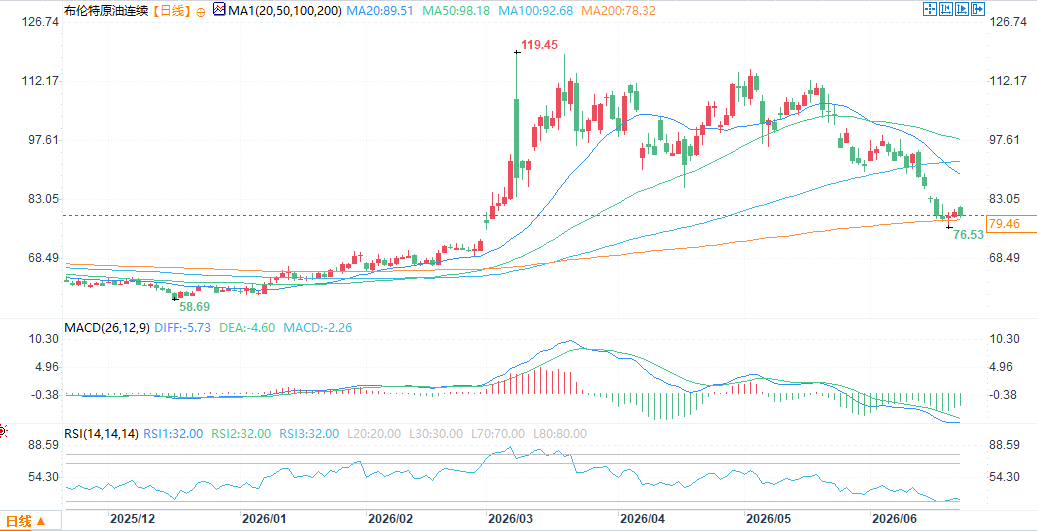
(Brent crude oil futures daily chart, source: FX678)
At 11:47 AM Beijing time on June 22, Brent crude oil futures were trading at $79.30 per barrel.
According to Iranian media reports on the 22nd, Iranian Foreign Ministry spokesman Bagaei said that Iran and the United States reached an agreement after 18 hours of negotiations, and the text will be released by the two mediators, Qatar and Pakistan.
Bagae stated on the 22nd that the Iran-US negotiations discussed the groundwork for initiating negotiations on a final agreement. All parties agreed that the technical working groups would continue to work on issues requiring the effective implementation of the Iran-US memorandum of understanding. "The negotiating team's work has concluded," Bagae said, adding that Iran and the US discussed issues such as issuing licenses for Iranian oil sales and unfreezing Iranian assets, achieving good progress.
The Strait of Hormuz is showing initial signs of reopening, alleviating the most pressing threat to global energy supplies.
However, analysts warn that the economic damage caused by nearly four months of war will take months to heal. At the same time, the crisis has accelerated a structural rethinking of energy security strategies by policymakers in various countries.
The energy shock is far from over.
Although the US and Iran signed a memorandum last Thursday agreeing to open the Strait of Hormuz, ending the war that has disrupted the global energy supply chain, economists generally believe that higher inflation has largely been "built into" the price systems of various economies.
Simon MacAdam, deputy chief global economist at Capital Economics, pointed out this week that it typically takes months for rising energy and fertilizer prices to pass on to consumers at the end of the food supply chain. Piped natural gas prices for residential use usually lag behind upstream markets by about three months. This means that even if Straits Exchange Foundation (SEF) traffic returns to normal, consumers will likely not feel a price drop in the short term.
The pressure is particularly pronounced in the fertilizer market. The World Bank predicts that global fertilizer prices could surge by as much as 38% this year due to supply disruptions and shortages of key raw materials from the Gulf region, with the effects continuing to spread through agricultural markets.
Europe faces particularly severe challenges. McAdam stated that with natural gas inventory levels remaining at historically low levels and rising U.S. liquefied natural gas (LNG) export prices, inflation rates in Europe and Japan are expected to rise by an additional 3 to 4 percentage points.
Lower oil prices ≠ subsiding inflation: Freight costs and inventory buildup are dragging down prices.
Brent crude futures prices fell back to around $80 a barrel last Friday, a significant pullback from the peak of $118 in March during the height of the war.
Goldman Sachs lowered its oil price forecast last Tuesday, predicting that Brent crude will average $80 by the end of 2026 and $75 in 2027, citing a faster-than-expected recovery in Persian Gulf oil supply.
However, lower oil prices do not mean that inflationary pressures will immediately subside. There is a time lag in the transmission of rising upstream energy costs and supply disruptions to downstream food and energy industries.
Furthermore, the backlog of vessels waiting to pass through the Strait of Hormuz may further delay the full recovery of cargo traffic – meaning that some of the impact is still in the pipeline and has not yet been fully reflected in end prices.
Central Bank Dilemma: Combating Inflation Remains the Top Priority
The Hormuz crisis has profoundly altered the policy calculations of major central banks—they are struggling to find a balance between slowing economic growth and persistently rising inflation.
The European Central Bank raised interest rates last week, marking its first tightening action in nearly three years and signaling a shift in policy among major central banks.
The Federal Reserve kept short-term interest rates unchanged at a meeting chaired by its new chairman, Warsh, but significantly raised its forecast for PCE inflation at the end of 2026 to 3.6% from 2.7% in March. Nine of the 18 voting members expect at least one more rate hike before the end of the year.
The Bank of England also kept its policy rate unchanged, but explicitly warned that "even if the conflict is resolved quickly, the recovery of energy production and transport may face logistical delays."
Alex Holmes, regional director of the Economist Intelligence Unit (EIU), points out that central banks that have shifted to a hawkish stance are unlikely to reverse their policy direction quickly, as fuel prices and inflation are expected to remain high. Furthermore, food inflation faces additional pressure—a super El Niño event could threaten global agricultural output in the coming months.
The World Bank last week lowered its global economic growth forecast to 2.5%, the slowest pace since the pandemic began, and expects global inflation to climb to 4% this year from 3.3% in 2025, even if oil supply disruptions ease in the coming weeks.
Structural Transformation: Accelerated Restructuring of Energy Security Strategy
This crisis has prompted governments to re-examine their energy security strategies. Countries affected by the supply disruptions are expected to strengthen energy reserves, allocate resources to boost domestic production capacity, and seek alternative supply routes to reduce dependence on a single choke point.
"We must ensure that countries have a certain level of buffer reserves in peacetime so that they can have sufficient room to respond even in the face of global emergencies," Asian Development Bank Director Matteo Lanzafame said at an online conference last Thursday.
This approach marks a profound shift in energy policy from "just-in-time supply" to "preparedness for unforeseen circumstances." While the Hormuz crisis has temporarily subsided, its lessons and policy legacy will continue to shape the global energy governance landscape for years to come.
(Brent crude oil futures daily chart, source: FX678)
At 11:47 AM Beijing time on June 22, Brent crude oil futures were trading at $79.30 per barrel.
- Risk Warning and Disclaimer
- The market involves risk, and trading may not be suitable for all investors. This article is for reference only and does not constitute personal investment advice, nor does it take into account certain users’ specific investment objectives, financial situation, or other needs. Any investment decisions made based on this information are at your own risk.