The US Treasury Secretary is optimistic about the economy returning to 3% growth, with the three core objectives progressing steadily.
2026-06-25 11:15:35
As the conflict with Iran gradually comes to an end, U.S. Treasury Secretary Scott Bessent released an optimistic economic assessment on Wednesday (June 24), believing that the U.S. economy is likely to return to the 3% annual growth range.
The US economy is currently hampered by multiple factors, including rebounding inflation, a weakening labor force, and tariff policies, resulting in a significant slowdown in growth over the past two quarters. However, officials remain optimistic about the medium- to long-term recovery prospects and have reiterated the "3-3-3" development goals, which include economic growth, fiscal deficit, and crude oil production capacity. They also discussed the challenge of balancing the high fiscal deficit with the Federal Reserve's monetary policy.
Bessant stated, " We are on track to achieve around 3% economic growth this year , and the fundamentals of the U.S. economy remain solid."
However, objective data reflects significant pressure on short-term growth. Previously, the annualized GDP growth rate of the United States in the fourth quarter of 2025 was only 0.5%, which rebounded slightly to 1.6% in the first quarter of 2026, with an overall growth rate of 2.1% for the whole of 2025.
Multiple factors constraining economic growth persist, with rising inflation suppressing consumption and investment, a decline in labor market activity, and President Trump's tariff measures increasing business operating costs. These factors combined are prolonging the economic recovery cycle.
Bessant added that in February, before the US and Israel launched their actions against Iran, the US economy's annualized growth rate was close to 4%, and the escalating geopolitical conflict directly disrupted the previously positive recovery pace.
Bessant reiterated that its proposed "3-3-3" core development goals are still within the feasible range, with the three indicators being 3% annual economic growth, 3% fiscal deficit as a percentage of GDP, and an increase of 3 million barrels per day in domestic crude oil production.
Regarding the key objective of deficit control, he stated, "The fiscal deficit as a percentage of GDP is expected to fall back to the 3% range before the end of this presidential term. Only after achieving this figure will the US government be able to continue to reduce the overall debt as a percentage of the total economy."
The US fiscal deficit rate exceeded 6% for two consecutive years in 2023 and 2024, before slightly declining to 5.8% by the end of 2025. Maintaining a high deficit for an extended period during peacetime is historically rare, primarily due to the lagged effects of the large-scale fiscal stimulus during the pandemic. The fiscal deficit reached $1.25 trillion in the first eight months of fiscal year 2026, a slight decrease of 9% year-on-year. Debt interest payments are the second largest fiscal expenditure after Social Security, continuously increasing the burden on the national treasury.
High interest costs have prompted Trump to repeatedly call on the Federal Reserve to lower benchmark interest rates in order to alleviate the federal government's debt burden. However, due to rising inflation this year, the Fed has chosen to slow down the pace of interest rate cuts, maintaining a generally tight monetary policy stance.
In response to market concerns about the direction of monetary policy, Bessant stated that President Trump has full confidence in the new Federal Reserve Chairman, Kevin Warsh, and recognizes his ability to formulate market-appropriate monetary policies that take into account the current inflation, employment, and growth environment.
In summary, the easing of geopolitical tensions provides an external boost to the US economic recovery, and the US Treasury Secretary has expressed clear expectations for a 3% economic growth rate. On Wednesday, the market had already priced in the relative resilience of the US economy and policy expectations, with the dollar index surging to a more than one-year high of 101.80, highlighting the dollar's strength. Short-term inflation, high fiscal deficits, and tight monetary policy remain unavoidable constraints, but the official medium- and long-term development goals have not been adjusted.
The market will continue to monitor energy and inflation changes following the resolution of the Iranian conflict, as well as subsequent monetary policies introduced by Federal Reserve Chairman Kevin Warsh. These two factors will jointly determine whether the US economy can achieve its recovery goals as scheduled.
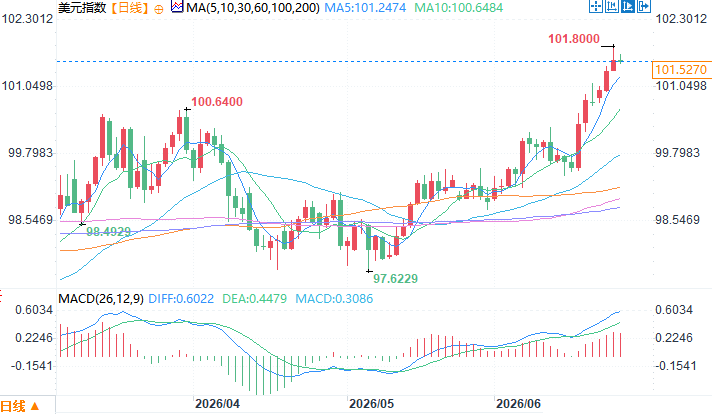
US Dollar Index Daily Chart Source: EasyForex
At 11:15 AM Beijing time on June 25, the US dollar index was at 101.50.
The US economy is currently hampered by multiple factors, including rebounding inflation, a weakening labor force, and tariff policies, resulting in a significant slowdown in growth over the past two quarters. However, officials remain optimistic about the medium- to long-term recovery prospects and have reiterated the "3-3-3" development goals, which include economic growth, fiscal deficit, and crude oil production capacity. They also discussed the challenge of balancing the high fiscal deficit with the Federal Reserve's monetary policy.
US Treasury Secretary expresses optimistic outlook, despite numerous obstacles to current economic recovery.
Bessant stated, " We are on track to achieve around 3% economic growth this year , and the fundamentals of the U.S. economy remain solid."
However, objective data reflects significant pressure on short-term growth. Previously, the annualized GDP growth rate of the United States in the fourth quarter of 2025 was only 0.5%, which rebounded slightly to 1.6% in the first quarter of 2026, with an overall growth rate of 2.1% for the whole of 2025.
Multiple factors constraining economic growth persist, with rising inflation suppressing consumption and investment, a decline in labor market activity, and President Trump's tariff measures increasing business operating costs. These factors combined are prolonging the economic recovery cycle.
Bessant added that in February, before the US and Israel launched their actions against Iran, the US economy's annualized growth rate was close to 4%, and the escalating geopolitical conflict directly disrupted the previously positive recovery pace.
Adhering to the "3-3-3" development blueprint, the fiscal deficit will improve the survival cycle.
Bessant reiterated that its proposed "3-3-3" core development goals are still within the feasible range, with the three indicators being 3% annual economic growth, 3% fiscal deficit as a percentage of GDP, and an increase of 3 million barrels per day in domestic crude oil production.
Regarding the key objective of deficit control, he stated, "The fiscal deficit as a percentage of GDP is expected to fall back to the 3% range before the end of this presidential term. Only after achieving this figure will the US government be able to continue to reduce the overall debt as a percentage of the total economy."
The US fiscal deficit rate exceeded 6% for two consecutive years in 2023 and 2024, before slightly declining to 5.8% by the end of 2025. Maintaining a high deficit for an extended period during peacetime is historically rare, primarily due to the lagged effects of the large-scale fiscal stimulus during the pandemic. The fiscal deficit reached $1.25 trillion in the first eight months of fiscal year 2026, a slight decrease of 9% year-on-year. Debt interest payments are the second largest fiscal expenditure after Social Security, continuously increasing the burden on the national treasury.
Debt pressures are driving demands for interest rate cuts; the White House trusts the new Federal Reserve Chairman.
High interest costs have prompted Trump to repeatedly call on the Federal Reserve to lower benchmark interest rates in order to alleviate the federal government's debt burden. However, due to rising inflation this year, the Fed has chosen to slow down the pace of interest rate cuts, maintaining a generally tight monetary policy stance.
In response to market concerns about the direction of monetary policy, Bessant stated that President Trump has full confidence in the new Federal Reserve Chairman, Kevin Warsh, and recognizes his ability to formulate market-appropriate monetary policies that take into account the current inflation, employment, and growth environment.
Summarize
In summary, the easing of geopolitical tensions provides an external boost to the US economic recovery, and the US Treasury Secretary has expressed clear expectations for a 3% economic growth rate. On Wednesday, the market had already priced in the relative resilience of the US economy and policy expectations, with the dollar index surging to a more than one-year high of 101.80, highlighting the dollar's strength. Short-term inflation, high fiscal deficits, and tight monetary policy remain unavoidable constraints, but the official medium- and long-term development goals have not been adjusted.
The market will continue to monitor energy and inflation changes following the resolution of the Iranian conflict, as well as subsequent monetary policies introduced by Federal Reserve Chairman Kevin Warsh. These two factors will jointly determine whether the US economy can achieve its recovery goals as scheduled.
US Dollar Index Daily Chart Source: EasyForex
At 11:15 AM Beijing time on June 25, the US dollar index was at 101.50.
- Risk Warning and Disclaimer
- The market involves risk, and trading may not be suitable for all investors. This article is for reference only and does not constitute personal investment advice, nor does it take into account certain users’ specific investment objectives, financial situation, or other needs. Any investment decisions made based on this information are at your own risk.