Spot gold prices fell below the $4,000 mark, but analysts say the short-term pullback does not change the long-term bullish trend.
2026-06-25 12:06:26
International spot gold experienced a sharp drop on Wednesday, with prices failing to hold above the key support level of $4,000 per ounce, falling 2.7% on the day to a low of $3,959.04 per ounce. On Thursday (June 25) in Asian trading, spot gold remained below the $4,000 mark, currently trading around $3,994 per ounce.
The core driver of this round of gold price weakness is the strong rise in the US dollar index. The market continues to price in expectations of a Federal Reserve interest rate hike, significantly increasing the opportunity cost of holding non-interest-bearing gold. However, senior industry analysts, after reviewing decades of gold bull market history, point out that a deep correction of around 30% is a normal fluctuation within a bull market cycle. The medium- to long-term supporting logic, such as continued central bank gold purchases, geopolitical risks, and high global sovereign debt, remains unchanged. Short-term declines will not end the long-term bull market for gold, while also warning the market to be wary of the potential risk of gold prices testing the $3,700 level.
On Wednesday, the US dollar index continued to rise in the foreign exchange market, reaching a new high in the past year, which directly put significant pressure on gold, a commodity priced in US dollars.
The Federal Reserve has repeatedly signaled its intention to strictly control inflation, causing a rapid shift in market sentiment as investors aggressively bet on an impending interest rate hike. Data from the CME FedWatch Tool shows that the mainstream market expectation is for the Fed to raise policy rates as early as September, with room for further tightening in December.
With expectations of rising interest rates, the drawback of not generating interest from holding gold has been amplified, leading to a concentrated outflow of funds and a sharp drop in gold prices. Spot gold has fallen below $4,000, a key support level that the market has been focusing on in recent weeks.
Paul Williams, Managing Director of Solomon Global, published his analysis on a professional financial information platform, stating that investors should not be bearish on the long-term trend of gold due to the short-term plunge. He noted that the recent pullback in gold prices from the historical high in January was nearly 30%, and that such a large-scale correction is quite common in the two major bull markets in history.
He said, "During the gold bull market of the 1970s, the price of gold retreated by as much as 45% from its mid-term high to its low in 1976, before surging all the way up to a record high in 1980. During the 2008 financial crisis, the price of gold corrected by about 30%, but then continued to strengthen, breaking the price record again in 2011. Historical data has shown that significant corrections are a normal phase in a long bull market for gold. The core criterion for judgment lies in whether there has been a fundamental change in the underlying fundamentals supporting gold, and currently, the relevant logic has not been shaken ."
Williams further analyzed that even after this round of sharp sell-off, gold's cumulative increase over the past twelve months is still close to 20%, and the overall return remains considerable. The three core factors supporting gold prices—continuous increases in gold reserves by central banks worldwide, ongoing global geopolitical uncertainty, and persistently high levels of sovereign debt—have not disappeared. Short-term fluctuations in gold prices are more influenced by short-term trading factors such as profit-taking, changes in Federal Reserve interest rate expectations, and the strength of the US dollar, and will not change gold's long-term investment value.
Based on market trends and institutional analysis, the short-term impact of a stronger dollar and rising interest rate expectations caused gold to experience a significant pullback, falling below the $4,000 mark. However, historical patterns and fundamentals support the continued long-term bullish trend for gold. Most analysts who are bullish on gold in the long term also remind investors to remain cautious, as short-term market sentiment is weak and gold prices could potentially fall further to $3,700 per ounce. From an operational perspective, it is necessary to manage volatility risk effectively and distinguish between short-term trading opportunities and long-term investment strategies.
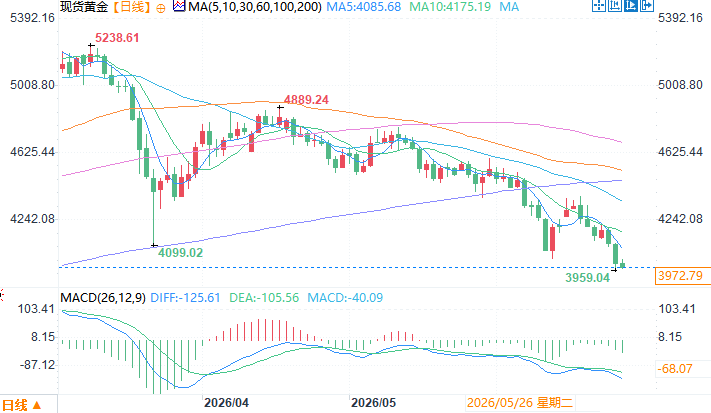
Spot gold daily chart source: EasyForex
At 12:06 Beijing time on June 25, spot gold was trading at $3994.13 per ounce.
The core driver of this round of gold price weakness is the strong rise in the US dollar index. The market continues to price in expectations of a Federal Reserve interest rate hike, significantly increasing the opportunity cost of holding non-interest-bearing gold. However, senior industry analysts, after reviewing decades of gold bull market history, point out that a deep correction of around 30% is a normal fluctuation within a bull market cycle. The medium- to long-term supporting logic, such as continued central bank gold purchases, geopolitical risks, and high global sovereign debt, remains unchanged. Short-term declines will not end the long-term bull market for gold, while also warning the market to be wary of the potential risk of gold prices testing the $3,700 level.
A strong US dollar is putting downward pressure on gold prices, with expectations of interest rate hikes triggering a concentrated sell-off in gold.
On Wednesday, the US dollar index continued to rise in the foreign exchange market, reaching a new high in the past year, which directly put significant pressure on gold, a commodity priced in US dollars.
The Federal Reserve has repeatedly signaled its intention to strictly control inflation, causing a rapid shift in market sentiment as investors aggressively bet on an impending interest rate hike. Data from the CME FedWatch Tool shows that the mainstream market expectation is for the Fed to raise policy rates as early as September, with room for further tightening in December.
With expectations of rising interest rates, the drawback of not generating interest from holding gold has been amplified, leading to a concentrated outflow of funds and a sharp drop in gold prices. Spot gold has fallen below $4,000, a key support level that the market has been focusing on in recent weeks.
Looking back at historical market trends, deep corrections are a normal occurrence in a gold bull market.
Paul Williams, Managing Director of Solomon Global, published his analysis on a professional financial information platform, stating that investors should not be bearish on the long-term trend of gold due to the short-term plunge. He noted that the recent pullback in gold prices from the historical high in January was nearly 30%, and that such a large-scale correction is quite common in the two major bull markets in history.
He said, "During the gold bull market of the 1970s, the price of gold retreated by as much as 45% from its mid-term high to its low in 1976, before surging all the way up to a record high in 1980. During the 2008 financial crisis, the price of gold corrected by about 30%, but then continued to strengthen, breaking the price record again in 2011. Historical data has shown that significant corrections are a normal phase in a long bull market for gold. The core criterion for judgment lies in whether there has been a fundamental change in the underlying fundamentals supporting gold, and currently, the relevant logic has not been shaken ."
The medium- to long-term support logic is solid, while short-term fluctuations are only driven by sentiment.
Williams further analyzed that even after this round of sharp sell-off, gold's cumulative increase over the past twelve months is still close to 20%, and the overall return remains considerable. The three core factors supporting gold prices—continuous increases in gold reserves by central banks worldwide, ongoing global geopolitical uncertainty, and persistently high levels of sovereign debt—have not disappeared. Short-term fluctuations in gold prices are more influenced by short-term trading factors such as profit-taking, changes in Federal Reserve interest rate expectations, and the strength of the US dollar, and will not change gold's long-term investment value.
Summarize
Based on market trends and institutional analysis, the short-term impact of a stronger dollar and rising interest rate expectations caused gold to experience a significant pullback, falling below the $4,000 mark. However, historical patterns and fundamentals support the continued long-term bullish trend for gold. Most analysts who are bullish on gold in the long term also remind investors to remain cautious, as short-term market sentiment is weak and gold prices could potentially fall further to $3,700 per ounce. From an operational perspective, it is necessary to manage volatility risk effectively and distinguish between short-term trading opportunities and long-term investment strategies.
Spot gold daily chart source: EasyForex
At 12:06 Beijing time on June 25, spot gold was trading at $3994.13 per ounce.
- Risk Warning and Disclaimer
- The market involves risk, and trading may not be suitable for all investors. This article is for reference only and does not constitute personal investment advice, nor does it take into account certain users’ specific investment objectives, financial situation, or other needs. Any investment decisions made based on this information are at your own risk.