The Federal Reserve is poised to raise interest rates, while the Bank of Canada remains on hold—the Canadian dollar faces a double whammy.
2026-06-25 11:18:04
On Thursday (June 25) during the Asian session, the US dollar fluctuated at high levels against the Canadian dollar, currently trading around 1.4230.
Despite rising market expectations for a Federal Reserve rate hike this year, the US dollar experienced a technical pullback after a period of continuous gains, providing the Canadian dollar with a brief respite.
However, the easing of tensions between the US and Iran has put pressure on oil prices, and coupled with weak domestic economic data in Canada, the upside potential of the Canadian dollar has been significantly limited.
Market expectations for a tightening of monetary policy by the Federal Reserve continue to strengthen. Fed Chairman Kevin Warsh recently signaled a clear focus on curbing inflation and noted that the overall U.S. economy remains stable. Driven by this hawkish stance, the CME FedWatch tool shows that the market is pricing in an 83.1% probability of a Fed rate hike in December.
Market focus is shifting to the upcoming release of the US Personal Consumption Expenditures (PCE) price index. The market expects the overall PCE year-on-year growth rate to rise to 4.1% in May from 3.8% in April, while the core PCE year-on-year growth rate is projected to rise slightly to 3.4% from 3.3%. If the data exceeds expectations, it will further solidify the necessity for the Federal Reserve to raise interest rates, potentially driving the dollar higher again. However, ahead of the data release, some bullish positions chose to take profits, leading to a temporary pullback in the dollar.
As one of the world's major crude oil exporters, Canada's economy is highly dependent on oil price movements. Recent breakthroughs in the US-Iran peace talks have significantly improved the global crude oil supply outlook, putting sustained pressure on oil prices.
U.S. Energy Secretary Chris Wright stated at the Global Energy Forum in New York that approximately 20 million barrels of crude oil left the Strait of Hormuz within 24 hours, marking a return to normal shipping operations. Shipping data corroborates this assessment—three oil tankers carrying approximately 5 million barrels of crude oil, previously stranded under the interim peace agreement, departed the Gulf region on Wednesday. Simultaneously, the U.S. granted temporary waivers for the purchase of already loaded Iranian crude oil, which is expected to further inject more supply into the market.
The continued weakness in crude oil prices has directly impacted the fundamentals of the Canadian economy. As the largest supplier of crude oil to the United States, Canada's export revenue is highly correlated with oil prices. Falling oil prices mean deteriorating terms of trade, which in turn puts downward pressure on the Canadian dollar.
Another source of pressure on the Canadian dollar comes from domestic factors. In late June, the yield on 10-year Canadian government bonds fell to a three-month low of 3.36%, reflecting market expectations of cooling domestic inflation. Signs of slowing core inflation data further reinforced market expectations that the Bank of Canada will not raise interest rates for the remainder of the year.
In stark contrast to the likely interest rate hike path in the United States, the divergence in monetary policy directions between the US and Canada is widening—the Federal Reserve faces pressure to raise rates, while the Bank of Canada may maintain its current interest rate or even consider easing. This expectation of policy divergence is putting downward pressure on the Canadian dollar in the medium term.
According to the daily chart, the USD/CAD pair continues its strong bullish trend, reaching a new high of 1.4247. The moving average system is in a complete bullish alignment, with the price firmly holding above the 20-day, 50-day, 100-day, and 200-day moving averages. The short-term 20-day moving average (1.4011) provides strong dynamic support, and multiple moving averages are diverging upwards in tandem, solidifying the foundation of the upward trend.
The MACD indicator's DIFF (0.0112) remains above the DEA (0.0092), with the red momentum bars steadily expanding, indicating continued bullish momentum and no signs of a top divergence or reversal. The RSI indicator has risen to 87.05, significantly exceeding the 70 overbought threshold, suggesting a short-term technical pullback to correct the overbought indicator, but the overall upward structure remains intact.
The overall market is dominated by bulls, but the short-term RSI is severely overbought, suggesting a potential for a slight pullback. Buying on dips to the short-term moving average support level is a good opportunity. If the price breaks through 1.4300 with increased volume, the upside potential will expand further. Only a decisive break below the 20-day moving average (MA20) would reverse the bullish trend in the short term.
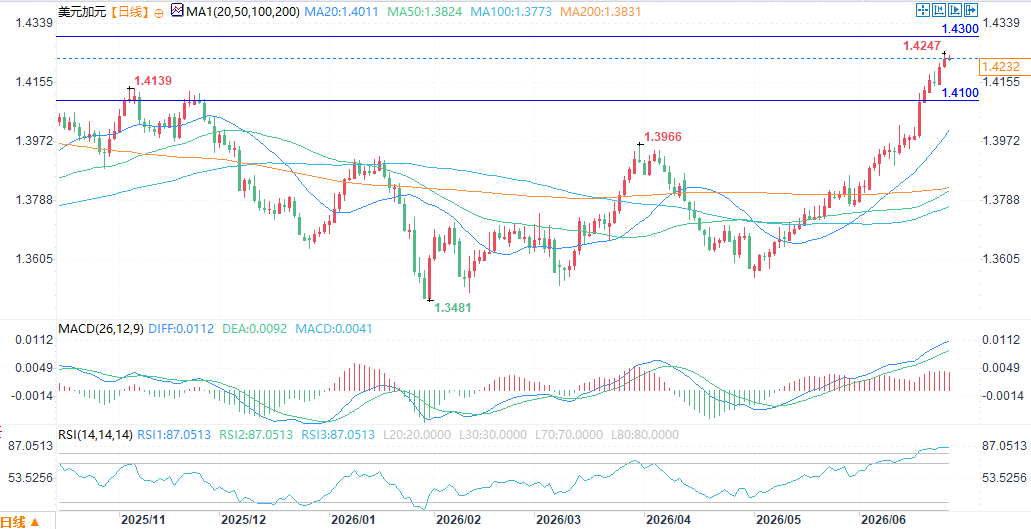
(USD to CAD, Source: EasyForex)
At 11:17 Beijing time on June 25, the USD/CAD exchange rate was 1.4230/31.
Despite rising market expectations for a Federal Reserve rate hike this year, the US dollar experienced a technical pullback after a period of continuous gains, providing the Canadian dollar with a brief respite.
However, the easing of tensions between the US and Iran has put pressure on oil prices, and coupled with weak domestic economic data in Canada, the upside potential of the Canadian dollar has been significantly limited.
Fed rate hike expectations rise: 83.1% probability in December, PCE data becomes focus.
Market expectations for a tightening of monetary policy by the Federal Reserve continue to strengthen. Fed Chairman Kevin Warsh recently signaled a clear focus on curbing inflation and noted that the overall U.S. economy remains stable. Driven by this hawkish stance, the CME FedWatch tool shows that the market is pricing in an 83.1% probability of a Fed rate hike in December.
Market focus is shifting to the upcoming release of the US Personal Consumption Expenditures (PCE) price index. The market expects the overall PCE year-on-year growth rate to rise to 4.1% in May from 3.8% in April, while the core PCE year-on-year growth rate is projected to rise slightly to 3.4% from 3.3%. If the data exceeds expectations, it will further solidify the necessity for the Federal Reserve to raise interest rates, potentially driving the dollar higher again. However, ahead of the data release, some bullish positions chose to take profits, leading to a temporary pullback in the dollar.
Improved crude oil supply: Progress in US-Iran peace talks weighs on oil prices and puts pressure on the Canadian dollar.
As one of the world's major crude oil exporters, Canada's economy is highly dependent on oil price movements. Recent breakthroughs in the US-Iran peace talks have significantly improved the global crude oil supply outlook, putting sustained pressure on oil prices.
U.S. Energy Secretary Chris Wright stated at the Global Energy Forum in New York that approximately 20 million barrels of crude oil left the Strait of Hormuz within 24 hours, marking a return to normal shipping operations. Shipping data corroborates this assessment—three oil tankers carrying approximately 5 million barrels of crude oil, previously stranded under the interim peace agreement, departed the Gulf region on Wednesday. Simultaneously, the U.S. granted temporary waivers for the purchase of already loaded Iranian crude oil, which is expected to further inject more supply into the market.
The continued weakness in crude oil prices has directly impacted the fundamentals of the Canadian economy. As the largest supplier of crude oil to the United States, Canada's export revenue is highly correlated with oil prices. Falling oil prices mean deteriorating terms of trade, which in turn puts downward pressure on the Canadian dollar.
Domestic factors: Cooling inflation strengthens expectations that the Bank of Canada will hold rates steady.
Another source of pressure on the Canadian dollar comes from domestic factors. In late June, the yield on 10-year Canadian government bonds fell to a three-month low of 3.36%, reflecting market expectations of cooling domestic inflation. Signs of slowing core inflation data further reinforced market expectations that the Bank of Canada will not raise interest rates for the remainder of the year.
In stark contrast to the likely interest rate hike path in the United States, the divergence in monetary policy directions between the US and Canada is widening—the Federal Reserve faces pressure to raise rates, while the Bank of Canada may maintain its current interest rate or even consider easing. This expectation of policy divergence is putting downward pressure on the Canadian dollar in the medium term.
Technical Analysis
According to the daily chart, the USD/CAD pair continues its strong bullish trend, reaching a new high of 1.4247. The moving average system is in a complete bullish alignment, with the price firmly holding above the 20-day, 50-day, 100-day, and 200-day moving averages. The short-term 20-day moving average (1.4011) provides strong dynamic support, and multiple moving averages are diverging upwards in tandem, solidifying the foundation of the upward trend.
The MACD indicator's DIFF (0.0112) remains above the DEA (0.0092), with the red momentum bars steadily expanding, indicating continued bullish momentum and no signs of a top divergence or reversal. The RSI indicator has risen to 87.05, significantly exceeding the 70 overbought threshold, suggesting a short-term technical pullback to correct the overbought indicator, but the overall upward structure remains intact.
The overall market is dominated by bulls, but the short-term RSI is severely overbought, suggesting a potential for a slight pullback. Buying on dips to the short-term moving average support level is a good opportunity. If the price breaks through 1.4300 with increased volume, the upside potential will expand further. Only a decisive break below the 20-day moving average (MA20) would reverse the bullish trend in the short term.
(USD to CAD, Source: EasyForex)
At 11:17 Beijing time on June 25, the USD/CAD exchange rate was 1.4230/31.
- Risk Warning and Disclaimer
- The market involves risk, and trading may not be suitable for all investors. This article is for reference only and does not constitute personal investment advice, nor does it take into account certain users’ specific investment objectives, financial situation, or other needs. Any investment decisions made based on this information are at your own risk.