Expectations of Japanese intervention limited the yen's decline, and the GBP/JPY pair remained range-bound.
2026-06-25 16:43:39
On Thursday morning in Asian and European trading sessions, the British pound against the Japanese yen (GBP/JPY) rebounded to around 213.40 , recovering from Wednesday's low of 212.50. However, the market remains highly focused on the yen's movements, especially as the USD/JPY pair continues to approach the key level of 162, with expectations of Japanese government intervention once again becoming a focus of market discussion.

The fundamental reason for the recent continued pressure on the yen remains the significant interest rate differential between Japan and major global economies. Although the Bank of Japan has gradually withdrawn some of its ultra-loose policies, its overall interest rate level remains far lower than that of the US, UK, and major European economies. Meanwhile, the Federal Reserve's policy expectations have shifted significantly towards hawkishness. With renewed inflationary pressures in the US, market bets on further interest rate hikes have increased significantly, pushing US Treasury yields to remain high and further widening the US-Japan interest rate differential.
Based on current market pricing, the probability of further interest rate hikes by the Federal Reserve this year remains high, while the likelihood of a significant interest rate increase by the Bank of Japan in the short term remains limited. This policy divergence has led to a continued flow of international funds into high-yield assets, thus putting long-term pressure on the yen. However, the Japanese government has recently been frequently signaling its intention to stabilize the exchange rate. Japanese Finance Minister Satsuki Katayama and US Treasury Secretary Scott Bessant held an online meeting this week to discuss recent fluctuations in the exchange rate market. The market believes that if the USD/JPY exchange rate breaks through the previous 40-year high of 162.95 , Japan and the United States may coordinate a response to the abnormal exchange rate fluctuations.
In fact, since the USD/JPY exchange rate broke through 160, the Japanese government has repeatedly emphasized that it will take appropriate measures to address speculative exchange rate fluctuations. Although no actual intervention has yet occurred, the market generally believes that the 162-163 range is close to the upper limit of the Japanese authorities' tolerance range. For GBP/JPY, the weakness of the yen remains an important factor supporting the exchange rate. While facing political uncertainty in the UK, UK interest rates are significantly higher than Japan's, and the Bank of England's overall policy stance remains tight, allowing the pound to continue to enjoy a certain interest rate advantage.
However, due to the persistent risk of Japanese intervention, investors remain cautious about chasing higher GBP/JPY levels. If Japanese authorities take concrete action, the yen could rebound rapidly in the short term, leading to a sharp correction in GBP/JPY. The market is currently closely watching the USD/JPY exchange rate and subsequent statements from Japanese government officials, as these factors will directly influence the future direction of the GBP/JPY exchange rate.
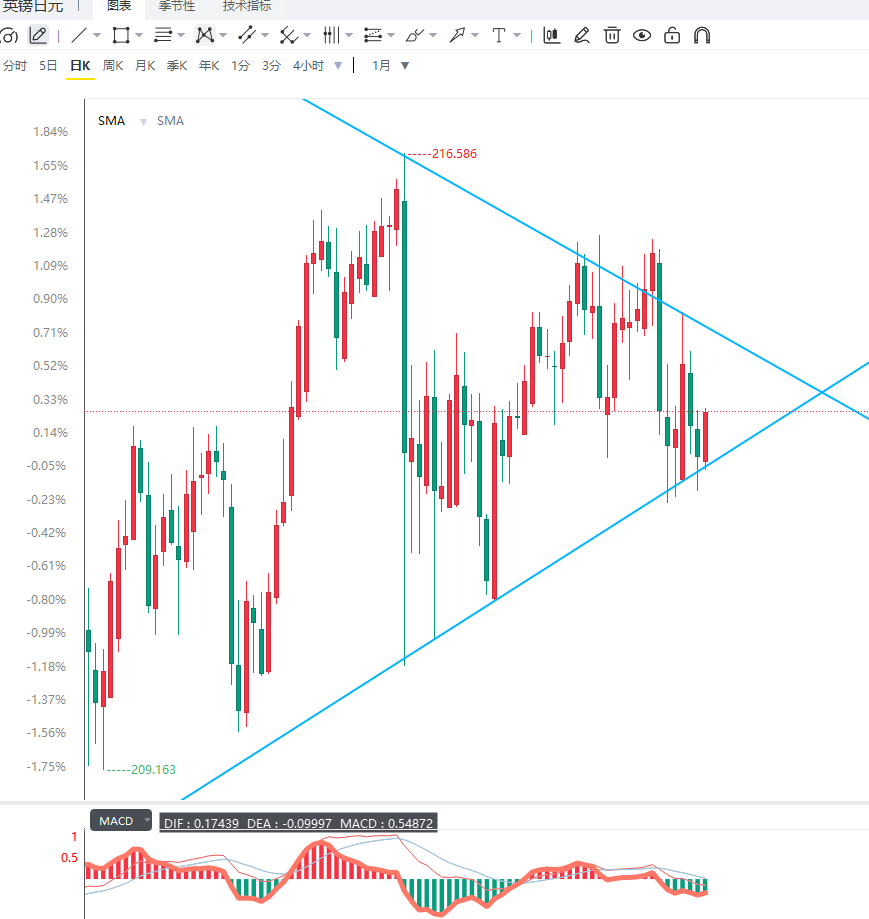
From a daily chart perspective, GBP/JPY remains in a high-level trading pattern, currently hovering around 213.40 . Although there has been some pullback recently, the price remains within the main upward trend channel. The key support level is currently around 212.50 , which also corresponds to the recent lows; further support levels to watch are around 211.30 and 210.00. Resistance levels are located at 213.50 , 214.68 , and 215.61 . A break above 215.61 could open up further upside potential.
From a 4-hour chart perspective, GBP/JPY has recently maintained a consolidation trend. The Relative Strength Index (RSI) is hovering around 50, indicating neutral market momentum and a temporary balance between bulls and bears. Meanwhile, the MACD indicator has just rebounded to near the zero line and turned slightly positive, suggesting some short-term rebound potential, but the trend strength remains limited. If the exchange rate breaks through the 213.50 resistance, it may further challenge the 214.68 area; conversely, if it falls below the 212.50 support again, it may retest the 211.30 low. Overall, the short-term market exhibits high-level consolidation characteristics, and with rising expectations of Japanese intervention, the risk of chasing the rally has increased.
Editor's Summary
The GBP/JPY exchange rate is currently influenced by two forces. On the one hand, hawkish expectations from the Federal Reserve and global interest rate differentials continue to suppress the yen, providing medium- to long-term support for the exchange rate. On the other hand, the USD/JPY exchange rate is approaching the key 162 level, and the risk of potential intervention by the Japanese government is escalating, limiting further depreciation of the yen. In the short term, the market will focus on official statements from Japan and whether the USD/JPY exchange rate approaches or breaks through the historical high of 162.95. If intervention expectations strengthen further, GBP/JPY may face significant downward pressure; if the yen continues to weaken, the exchange rate may still have a chance to test the resistance areas above 214.68 and 215.61.
The fundamental reason for the recent continued pressure on the yen remains the significant interest rate differential between Japan and major global economies. Although the Bank of Japan has gradually withdrawn some of its ultra-loose policies, its overall interest rate level remains far lower than that of the US, UK, and major European economies. Meanwhile, the Federal Reserve's policy expectations have shifted significantly towards hawkishness. With renewed inflationary pressures in the US, market bets on further interest rate hikes have increased significantly, pushing US Treasury yields to remain high and further widening the US-Japan interest rate differential.
Based on current market pricing, the probability of further interest rate hikes by the Federal Reserve this year remains high, while the likelihood of a significant interest rate increase by the Bank of Japan in the short term remains limited. This policy divergence has led to a continued flow of international funds into high-yield assets, thus putting long-term pressure on the yen. However, the Japanese government has recently been frequently signaling its intention to stabilize the exchange rate. Japanese Finance Minister Satsuki Katayama and US Treasury Secretary Scott Bessant held an online meeting this week to discuss recent fluctuations in the exchange rate market. The market believes that if the USD/JPY exchange rate breaks through the previous 40-year high of 162.95 , Japan and the United States may coordinate a response to the abnormal exchange rate fluctuations.
In fact, since the USD/JPY exchange rate broke through 160, the Japanese government has repeatedly emphasized that it will take appropriate measures to address speculative exchange rate fluctuations. Although no actual intervention has yet occurred, the market generally believes that the 162-163 range is close to the upper limit of the Japanese authorities' tolerance range. For GBP/JPY, the weakness of the yen remains an important factor supporting the exchange rate. While facing political uncertainty in the UK, UK interest rates are significantly higher than Japan's, and the Bank of England's overall policy stance remains tight, allowing the pound to continue to enjoy a certain interest rate advantage.
However, due to the persistent risk of Japanese intervention, investors remain cautious about chasing higher GBP/JPY levels. If Japanese authorities take concrete action, the yen could rebound rapidly in the short term, leading to a sharp correction in GBP/JPY. The market is currently closely watching the USD/JPY exchange rate and subsequent statements from Japanese government officials, as these factors will directly influence the future direction of the GBP/JPY exchange rate.
From a daily chart perspective, GBP/JPY remains in a high-level trading pattern, currently hovering around 213.40 . Although there has been some pullback recently, the price remains within the main upward trend channel. The key support level is currently around 212.50 , which also corresponds to the recent lows; further support levels to watch are around 211.30 and 210.00. Resistance levels are located at 213.50 , 214.68 , and 215.61 . A break above 215.61 could open up further upside potential.
From a 4-hour chart perspective, GBP/JPY has recently maintained a consolidation trend. The Relative Strength Index (RSI) is hovering around 50, indicating neutral market momentum and a temporary balance between bulls and bears. Meanwhile, the MACD indicator has just rebounded to near the zero line and turned slightly positive, suggesting some short-term rebound potential, but the trend strength remains limited. If the exchange rate breaks through the 213.50 resistance, it may further challenge the 214.68 area; conversely, if it falls below the 212.50 support again, it may retest the 211.30 low. Overall, the short-term market exhibits high-level consolidation characteristics, and with rising expectations of Japanese intervention, the risk of chasing the rally has increased.
Editor's Summary
The GBP/JPY exchange rate is currently influenced by two forces. On the one hand, hawkish expectations from the Federal Reserve and global interest rate differentials continue to suppress the yen, providing medium- to long-term support for the exchange rate. On the other hand, the USD/JPY exchange rate is approaching the key 162 level, and the risk of potential intervention by the Japanese government is escalating, limiting further depreciation of the yen. In the short term, the market will focus on official statements from Japan and whether the USD/JPY exchange rate approaches or breaks through the historical high of 162.95. If intervention expectations strengthen further, GBP/JPY may face significant downward pressure; if the yen continues to weaken, the exchange rate may still have a chance to test the resistance areas above 214.68 and 215.61.
- Risk Warning and Disclaimer
- The market involves risk, and trading may not be suitable for all investors. This article is for reference only and does not constitute personal investment advice, nor does it take into account certain users’ specific investment objectives, financial situation, or other needs. Any investment decisions made based on this information are at your own risk.