The Australian dollar continues its decline; the Reserve Bank of Australia's minutes indicate that further interest rate hikes are not ruled out.
2026-06-30 12:11:48
On Tuesday (June 30) during the Asian session, the Australian dollar fluctuated at low levels against the US dollar, currently trading around 0.6865.
The Reserve Bank of Australia's June meeting minutes revealed that policymakers chose to keep the cash rate unchanged at 4.35%, not because the battle against inflation had been won, but because they wanted to more fully assess the transmission effects of previous tightening policies and recent Middle East oil supply disruptions on the economy before taking further action.
The Council unanimously agreed to keep interest rates unchanged, believing that this was the best path to balance inflation and employment goals in an environment of high uncertainty.
The minutes clearly conveyed the signal that "the pause is for clearer observation, not a policy shift," and the Council also emphasized that further interest rate hikes in the future are possible if economic data warrants it.
The minutes reiterated that inflation remains a core concern for the central bank.
Council members noted that "inflation remains significantly above the Council's target range," and staff continue to expect "underlying inflation to rise in the June quarter."
Labor and non-labor cost pressures remain widespread, and monetary policy "needs to remain restrictive in order to absorb the current excess demand through a period of below-trend growth."
Although the council acknowledged that Australia’s financial conditions had become “somewhat restrictive,” they judged that it was too early to assess the cumulative effects of the policy tightening since February.
This indicates that the Reserve Bank of Australia remains cautious about the speed and magnitude of the decline in inflation, and does not rule out the possibility that inflation may be more sticky than expected.
The council devoted a significant portion of its discussion to developments in the Middle East.
While members acknowledged that "potential paths to a solution to the conflict have begun to emerge," they also warned that even if peace is sustained, easing bottlenecks in commodity supply will take time.
Therefore, the Council judged that the Middle East conflict still poses "significant upside risks to inflation and downside risks to growth," and warned that persistently high oil prices could continue to influence corporate pricing decisions and wage-setting behavior even after fuel prices have fallen. This assessment suggests that the transmission effect of external supply shocks on inflation may be more persistent than the market expects.
The minutes clearly stated that the tightening cycle may not have ended. The Council members believed it was valuable to assess the economic adjustment by “using the space created by previous decisions,” but reiterated that the Council would “take all necessary measures to achieve price stability and full employment, including raising the cash rate target if necessary.”
This statement reinforces the market's interpretation of the June pause—that it was not the beginning of a policy shift, but rather a "wait-and-see" strategy chosen by policymakers amidst high uncertainty.
The minutes also emphasized that economic data released in the coming months will determine whether another interest rate hike is necessary.
According to the daily chart, the Australian dollar against the US dollar is in a medium-term downtrend channel. The price has been declining steadily since the April high of 0.7277, recently finding some support after testing a low of 0.6864. The moving average system is entirely bearish, with the 20-day (0.7000), 50-day, and 100-day moving averages forming layers of resistance from top to bottom. The price continues to trade below all short-term and medium-term moving averages, finding only weak support at the 200-day (0.6860) long-term moving average, clearly indicating a downtrend.
In terms of indicators, the MACD lines are running below the zero axis, the DIFF is -0.0064 and below the DEA is -0.0050, and the green bars continue to diverge, indicating that the bearish momentum is still being released; the RSI value is 26.91, close to the 20 oversold zone, indicating a short-term technical oversold rebound demand, but no effective bottom divergence reversal signal has appeared.
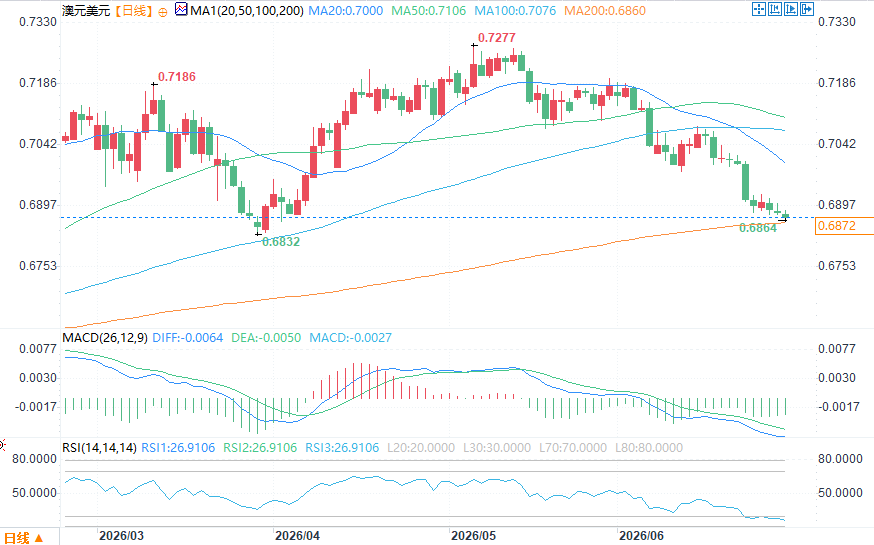
(AUD/USD daily chart, source: FX678)
At 12:11 Beijing time on June 30, the Australian dollar was trading at 0.6868/69 against the US dollar.
The Reserve Bank of Australia's June meeting minutes revealed that policymakers chose to keep the cash rate unchanged at 4.35%, not because the battle against inflation had been won, but because they wanted to more fully assess the transmission effects of previous tightening policies and recent Middle East oil supply disruptions on the economy before taking further action.
The Council unanimously agreed to keep interest rates unchanged, believing that this was the best path to balance inflation and employment goals in an environment of high uncertainty.
The minutes clearly conveyed the signal that "the pause is for clearer observation, not a policy shift," and the Council also emphasized that further interest rate hikes in the future are possible if economic data warrants it.
Inflation remains a core concern, and price pressures persist across the board.
The minutes reiterated that inflation remains a core concern for the central bank.
Council members noted that "inflation remains significantly above the Council's target range," and staff continue to expect "underlying inflation to rise in the June quarter."
Labor and non-labor cost pressures remain widespread, and monetary policy "needs to remain restrictive in order to absorb the current excess demand through a period of below-trend growth."
Although the council acknowledged that Australia’s financial conditions had become “somewhat restrictive,” they judged that it was too early to assess the cumulative effects of the policy tightening since February.
This indicates that the Reserve Bank of Australia remains cautious about the speed and magnitude of the decline in inflation, and does not rule out the possibility that inflation may be more sticky than expected.
The situation in the Middle East is a key variable, and supply shocks may prolong inflationary pressures.
The council devoted a significant portion of its discussion to developments in the Middle East.
While members acknowledged that "potential paths to a solution to the conflict have begun to emerge," they also warned that even if peace is sustained, easing bottlenecks in commodity supply will take time.
Therefore, the Council judged that the Middle East conflict still poses "significant upside risks to inflation and downside risks to growth," and warned that persistently high oil prices could continue to influence corporate pricing decisions and wage-setting behavior even after fuel prices have fallen. This assessment suggests that the transmission effect of external supply shocks on inflation may be more persistent than the market expects.
Forward guidance: The tightening cycle may not be over, and patience does not equate to a change in direction.
The minutes clearly stated that the tightening cycle may not have ended. The Council members believed it was valuable to assess the economic adjustment by “using the space created by previous decisions,” but reiterated that the Council would “take all necessary measures to achieve price stability and full employment, including raising the cash rate target if necessary.”
This statement reinforces the market's interpretation of the June pause—that it was not the beginning of a policy shift, but rather a "wait-and-see" strategy chosen by policymakers amidst high uncertainty.
The minutes also emphasized that economic data released in the coming months will determine whether another interest rate hike is necessary.
Technical Analysis
According to the daily chart, the Australian dollar against the US dollar is in a medium-term downtrend channel. The price has been declining steadily since the April high of 0.7277, recently finding some support after testing a low of 0.6864. The moving average system is entirely bearish, with the 20-day (0.7000), 50-day, and 100-day moving averages forming layers of resistance from top to bottom. The price continues to trade below all short-term and medium-term moving averages, finding only weak support at the 200-day (0.6860) long-term moving average, clearly indicating a downtrend.
In terms of indicators, the MACD lines are running below the zero axis, the DIFF is -0.0064 and below the DEA is -0.0050, and the green bars continue to diverge, indicating that the bearish momentum is still being released; the RSI value is 26.91, close to the 20 oversold zone, indicating a short-term technical oversold rebound demand, but no effective bottom divergence reversal signal has appeared.
(AUD/USD daily chart, source: FX678)
At 12:11 Beijing time on June 30, the Australian dollar was trading at 0.6868/69 against the US dollar.
- Risk Warning and Disclaimer
- The market involves risk, and trading may not be suitable for all investors. This article is for reference only and does not constitute personal investment advice, nor does it take into account certain users’ specific investment objectives, financial situation, or other needs. Any investment decisions made based on this information are at your own risk.