Conflicting signals from Trump and Iran regarding the Qatar talks drive up international oil prices.
2026-06-30 20:16:14
International oil prices rose on Tuesday (June 30), as energy market participants closely watched developments that the US and Iran might restart a new round of negotiations in Qatar, while remaining wary of recurring geopolitical risks. Brent crude futures rose 1.13% to $74.44 a barrel. West Texas Intermediate (WTI) crude rose 0.43% to $71.18 a barrel.
The recent rise in oil prices is attributed to oil traders closely watching the possibility of talks between the US and Iran in Doha on Tuesday.
US President Donald Trump announced on Monday that the US and Iran would hold talks in the Qatari capital on Tuesday. He stated on social media that Tehran had initiated the meeting after the two sides launched mutual attacks over the weekend. However, an Iranian Foreign Ministry spokesperson stated on Monday that no such negotiations were scheduled for the coming days, adding that the Iranian technical delegation's visit to Qatar this week was unrelated to the US delegation's trip to Qatar.
The starkly contrasting statements from both sides further highlight the extreme instability of the interim peace agreement reached between the US and Iran earlier this month. On June 17, the two countries signed a 14-point memorandum of understanding, agreeing to a temporary ceasefire. Previously, the conflict had severely disrupted global oil shipping through the strategically vital Strait of Hormuz.
The Strait of Hormuz, located in the Gulf waters between Oman and Iran, is one of the world's most important energy shipping chokepoints. This narrow waterway handles approximately 20% of global seaborne crude oil trade. Any news of disruptions or restrictions to shipping through the strait immediately triggers market concerns about supply shortages, causing short-term fluctuations in oil prices.
Analyst's opinion: The situation is changing rapidly.
Energy analysts say the current sell-off in the crude oil market has been faster and more severe than most institutions had predicted. Oil prices have fallen sharply in recent weeks, reflecting the market's rapid pricing in geopolitical risks, but the fragile ceasefire agreement could trigger a rebound at any time.
ING's strategy team released a research report on Monday stating, "Recent oil price movements reflect the market's misinterpretation of the temporary ceasefire agreement between the US and Iran as a permanent peace agreement. This is clearly not the case. The price action over the past four months has demonstrated that the regional situation can change rapidly." The team added, " Reaching a temporary ceasefire has already taken a significant amount of time; expecting a permanent agreement to completely resolve the nuclear issue within 60 days is overly optimistic. While there is a possibility of an extension, this is essentially just a temporary reprieve and a delaying tactic. "
Latest market analysis indicates that although oil prices rebounded slightly after the weekend clashes, the overall decline in June could still widen to around 20%, primarily due to optimistic market expectations regarding the progress of negotiations and signals of slowing global demand growth. Traders are currently weighing short-term geopolitical premiums against the possibility of long-term supply recovery. If the Doha talks fail to achieve a substantial breakthrough, oil prices may face further downward pressure; conversely, if positive signals emerge, Brent crude could rebound quickly to the $75-78 range.
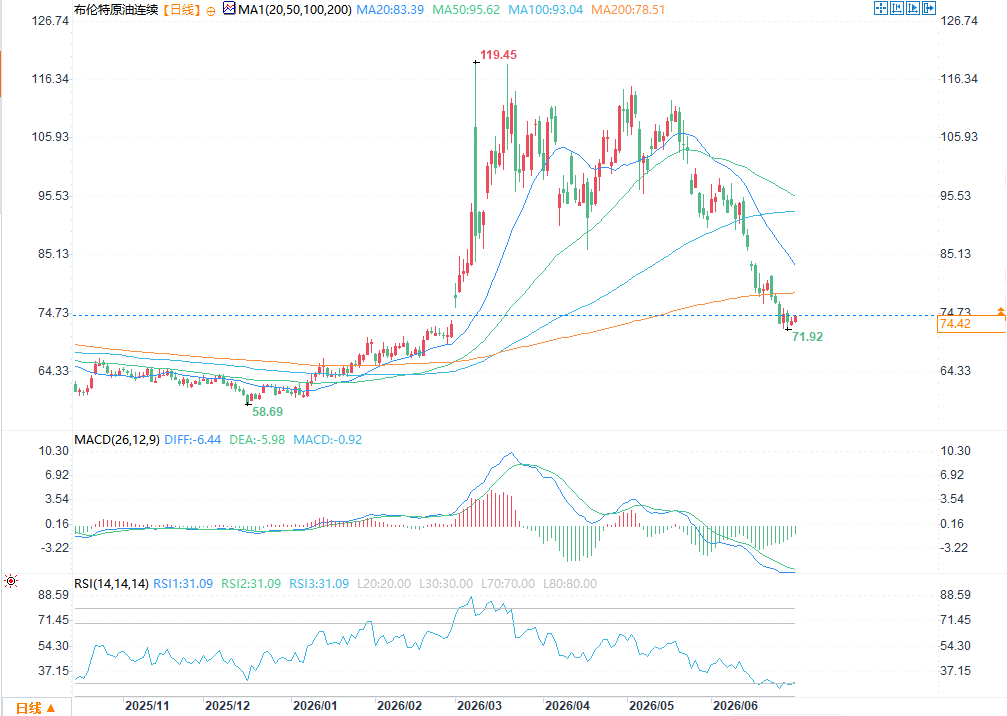
(Brent crude oil daily chart source: FX678)
Furthermore, Qatar's role as a neutral mediator is crucial. US envoys Steve Witkov and Jared Kushner have departed for Doha to meet with Qatari officials, while Iran has emphasized that discussions are purely technical and not high-level negotiations. This further exacerbates market uncertainty.
Analysts believe that current oil prices have fully priced in optimistic ceasefire expectations, but the structural differences in the US-Iran negotiations (especially the nuclear issue and the lifting of sanctions) are far from being resolved. In the short term, the slow recovery of traffic in the Strait of Hormuz will support the floor for oil prices, while any signs of a breakdown in negotiations could push Brent crude oil quickly back above $80.
This round of oil price decline reflects the market's over-discounting of geopolitical risks. The fragility of the interim agreement means that any military friction or delays in technical negotiations within the next 60 days will reignite the premium. Energy companies are advised to hedge downside risks while preparing for potential supply disruptions. Overall, the fragility of US-Iran relations will continue to dominate short-term oil market movements. Investors need to closely monitor subsequent statements from both sides and actual shipping traffic changes in the Strait of Hormuz to seize potential trading opportunities. Energy analysts generally believe that oil price volatility will remain high until a permanent agreement is reached.
Despite Trump's announcement of the Doha talks, short-term market optimism remains dominant, but Iran's denials highlight the uncertainty surrounding the implementation of the agreement. Current oil prices have fully priced in expectations of a rapid reconciliation; however, structural differences regarding the nuclear issue and the lifting of sanctions are far from resolved. Slow recovery in traffic flow in the Strait of Hormuz will provide a floor for oil prices, while any breakdown in negotiations or signs of new friction could push Brent crude back quickly to the $78-82 range.
The recent rise in oil prices is attributed to oil traders closely watching the possibility of talks between the US and Iran in Doha on Tuesday.
US President Donald Trump announced on Monday that the US and Iran would hold talks in the Qatari capital on Tuesday. He stated on social media that Tehran had initiated the meeting after the two sides launched mutual attacks over the weekend. However, an Iranian Foreign Ministry spokesperson stated on Monday that no such negotiations were scheduled for the coming days, adding that the Iranian technical delegation's visit to Qatar this week was unrelated to the US delegation's trip to Qatar.
The starkly contrasting statements from both sides further highlight the extreme instability of the interim peace agreement reached between the US and Iran earlier this month. On June 17, the two countries signed a 14-point memorandum of understanding, agreeing to a temporary ceasefire. Previously, the conflict had severely disrupted global oil shipping through the strategically vital Strait of Hormuz.
The Strait of Hormuz, located in the Gulf waters between Oman and Iran, is one of the world's most important energy shipping chokepoints. This narrow waterway handles approximately 20% of global seaborne crude oil trade. Any news of disruptions or restrictions to shipping through the strait immediately triggers market concerns about supply shortages, causing short-term fluctuations in oil prices.
Analyst's opinion: The situation is changing rapidly.
Energy analysts say the current sell-off in the crude oil market has been faster and more severe than most institutions had predicted. Oil prices have fallen sharply in recent weeks, reflecting the market's rapid pricing in geopolitical risks, but the fragile ceasefire agreement could trigger a rebound at any time.
ING's strategy team released a research report on Monday stating, "Recent oil price movements reflect the market's misinterpretation of the temporary ceasefire agreement between the US and Iran as a permanent peace agreement. This is clearly not the case. The price action over the past four months has demonstrated that the regional situation can change rapidly." The team added, " Reaching a temporary ceasefire has already taken a significant amount of time; expecting a permanent agreement to completely resolve the nuclear issue within 60 days is overly optimistic. While there is a possibility of an extension, this is essentially just a temporary reprieve and a delaying tactic. "
Latest market analysis indicates that although oil prices rebounded slightly after the weekend clashes, the overall decline in June could still widen to around 20%, primarily due to optimistic market expectations regarding the progress of negotiations and signals of slowing global demand growth. Traders are currently weighing short-term geopolitical premiums against the possibility of long-term supply recovery. If the Doha talks fail to achieve a substantial breakthrough, oil prices may face further downward pressure; conversely, if positive signals emerge, Brent crude could rebound quickly to the $75-78 range.
(Brent crude oil daily chart source: FX678)
Furthermore, Qatar's role as a neutral mediator is crucial. US envoys Steve Witkov and Jared Kushner have departed for Doha to meet with Qatari officials, while Iran has emphasized that discussions are purely technical and not high-level negotiations. This further exacerbates market uncertainty.
Analysts believe that current oil prices have fully priced in optimistic ceasefire expectations, but the structural differences in the US-Iran negotiations (especially the nuclear issue and the lifting of sanctions) are far from being resolved. In the short term, the slow recovery of traffic in the Strait of Hormuz will support the floor for oil prices, while any signs of a breakdown in negotiations could push Brent crude oil quickly back above $80.
This round of oil price decline reflects the market's over-discounting of geopolitical risks. The fragility of the interim agreement means that any military friction or delays in technical negotiations within the next 60 days will reignite the premium. Energy companies are advised to hedge downside risks while preparing for potential supply disruptions. Overall, the fragility of US-Iran relations will continue to dominate short-term oil market movements. Investors need to closely monitor subsequent statements from both sides and actual shipping traffic changes in the Strait of Hormuz to seize potential trading opportunities. Energy analysts generally believe that oil price volatility will remain high until a permanent agreement is reached.
Despite Trump's announcement of the Doha talks, short-term market optimism remains dominant, but Iran's denials highlight the uncertainty surrounding the implementation of the agreement. Current oil prices have fully priced in expectations of a rapid reconciliation; however, structural differences regarding the nuclear issue and the lifting of sanctions are far from resolved. Slow recovery in traffic flow in the Strait of Hormuz will provide a floor for oil prices, while any breakdown in negotiations or signs of new friction could push Brent crude back quickly to the $78-82 range.
- Risk Warning and Disclaimer
- The market involves risk, and trading may not be suitable for all investors. This article is for reference only and does not constitute personal investment advice, nor does it take into account certain users’ specific investment objectives, financial situation, or other needs. Any investment decisions made based on this information are at your own risk.