Supply delays and rising costs, yet businesses are still hiring and expanding production—why is the Australian dollar "unmoved" by the improvement in the PMI?
2026-07-01 10:57:48
On Wednesday (July 1) during the Asian session, the Australian dollar fluctuated at low levels against the US dollar, currently trading around 0.6890.
However, Australia's June manufacturing PMI sent a positive signal regarding the real economy.
Data released by S&P Global on Wednesday showed that Australia's final manufacturing purchasing managers' index (PMI) rose to 51.5 in June from 50.7 in May, above the 50.0 threshold separating expansion from contraction, and was the highest level since January this year.
This marks the third consecutive month that the index has remained in expansion territory, indicating that Australian factory activity continues to improve steadily despite ongoing external disturbances.
Despite the signing of a memorandum of understanding between the United States and Iran aimed at ending hostilities, the Middle East conflict continues to put significant pressure on Australian manufacturers this month.
S&P Global Economics Director Andrew Harker pointed out that supplier delivery times have "extended significantly" and input costs have "risen rapidly again."
The ongoing disruptions to the supply chain did not immediately dissipate with the signing of the ceasefire agreement. Extended supplier delivery times mean that logistical bottlenecks continue to constrain production, while rapidly rising input costs are squeezing manufacturers' profit margins.
However, Harker also pointed out that the price increase of manufactured goods has slowed significantly, suggesting that inflationary pressures may begin to ease if geopolitical tensions continue to stabilize.
Despite supply chain disruptions and cost pressures, Australian manufacturers remain optimistic about future demand prospects.
Surveys show that companies are actively hiring more staff and increasing raw material procurement and inventory, both to prepare for upcoming projects and to build a buffer against potential further supply disruptions.
Hacker stated that the company is "fully prepared to rapidly increase production once new orders resume growth."
This statement reflects manufacturers' confidence in the demand recovery – current capacity reserves are sufficient to support a rapid release of output once supply conditions normalize and end-user demand improves.
In summary, the June PMI data conveyed three key signals.
First, the foundation for the recovery of Australia's manufacturing sector is relatively solid. Three consecutive months of expansion and a five-month high indicate that even against the backdrop of continued pressure on global supply chains, Australian factory activity maintains its inherent upward momentum.
Second, supply chain pressures are shifting from "acute" to "chronic." Extended supplier delivery times and rising input costs indicate that the disruptions from the Middle East situation are still impacting Australian manufacturing, but this impact is more reflected in ongoing cost and efficiency pressures rather than precipitous supply disruptions.
Third, businesses are optimistic about the future. Their hiring and inventory buildup are forward-looking – they are preparing for future order growth, not just meeting current production demands. This aligns with the improved confidence implied in the outlook index.
According to the daily chart, the Australian dollar against the US dollar weakened after reaching a high of 0.7277, and the current trend has clearly turned bearish. The moving average system is in a bearish alignment, with the price breaking below all short-term and medium-term moving averages (MA20, MA50, and MA100), finding only weak support at the long-term MA200 (0.6861). Short-term moving averages continue to exert downward pressure, forming a significant resistance zone.
In terms of indicators, the MACD remains below the zero line, the DIFF (-0.0061) is below the DEA (-0.0052), and the green bars continue to diverge, indicating that the bearish momentum is still being released; the RSI value is 31.97, close to the oversold zone of 30, indicating a short-term need for a slight technical rebound and repair, but no clear bottom reversal signal has been formed.
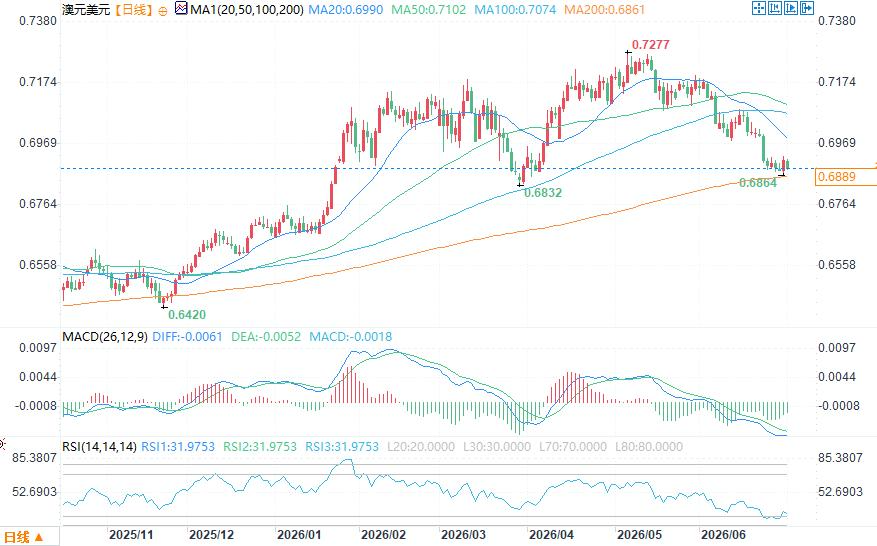
(AUD/USD daily chart, source: FX678)
At 10:57 Beijing time on July 1, the Australian dollar was trading at 0.6890/91 against the US dollar.
However, Australia's June manufacturing PMI sent a positive signal regarding the real economy.
Data released by S&P Global on Wednesday showed that Australia's final manufacturing purchasing managers' index (PMI) rose to 51.5 in June from 50.7 in May, above the 50.0 threshold separating expansion from contraction, and was the highest level since January this year.
This marks the third consecutive month that the index has remained in expansion territory, indicating that Australian factory activity continues to improve steadily despite ongoing external disturbances.
Middle East unrest: Supply delays and cost pressures coexist.
Despite the signing of a memorandum of understanding between the United States and Iran aimed at ending hostilities, the Middle East conflict continues to put significant pressure on Australian manufacturers this month.
S&P Global Economics Director Andrew Harker pointed out that supplier delivery times have "extended significantly" and input costs have "risen rapidly again."
The ongoing disruptions to the supply chain did not immediately dissipate with the signing of the ceasefire agreement. Extended supplier delivery times mean that logistical bottlenecks continue to constrain production, while rapidly rising input costs are squeezing manufacturers' profit margins.
However, Harker also pointed out that the price increase of manufactured goods has slowed significantly, suggesting that inflationary pressures may begin to ease if geopolitical tensions continue to stabilize.
Businesses are responding by hiring more staff and expanding inventory to prepare for increased production.
Despite supply chain disruptions and cost pressures, Australian manufacturers remain optimistic about future demand prospects.
Surveys show that companies are actively hiring more staff and increasing raw material procurement and inventory, both to prepare for upcoming projects and to build a buffer against potential further supply disruptions.
Hacker stated that the company is "fully prepared to rapidly increase production once new orders resume growth."
This statement reflects manufacturers' confidence in the demand recovery – current capacity reserves are sufficient to support a rapid release of output once supply conditions normalize and end-user demand improves.
Data Meaning and Outlook
In summary, the June PMI data conveyed three key signals.
First, the foundation for the recovery of Australia's manufacturing sector is relatively solid. Three consecutive months of expansion and a five-month high indicate that even against the backdrop of continued pressure on global supply chains, Australian factory activity maintains its inherent upward momentum.
Second, supply chain pressures are shifting from "acute" to "chronic." Extended supplier delivery times and rising input costs indicate that the disruptions from the Middle East situation are still impacting Australian manufacturing, but this impact is more reflected in ongoing cost and efficiency pressures rather than precipitous supply disruptions.
Third, businesses are optimistic about the future. Their hiring and inventory buildup are forward-looking – they are preparing for future order growth, not just meeting current production demands. This aligns with the improved confidence implied in the outlook index.
Technical Analysis
According to the daily chart, the Australian dollar against the US dollar weakened after reaching a high of 0.7277, and the current trend has clearly turned bearish. The moving average system is in a bearish alignment, with the price breaking below all short-term and medium-term moving averages (MA20, MA50, and MA100), finding only weak support at the long-term MA200 (0.6861). Short-term moving averages continue to exert downward pressure, forming a significant resistance zone.
In terms of indicators, the MACD remains below the zero line, the DIFF (-0.0061) is below the DEA (-0.0052), and the green bars continue to diverge, indicating that the bearish momentum is still being released; the RSI value is 31.97, close to the oversold zone of 30, indicating a short-term need for a slight technical rebound and repair, but no clear bottom reversal signal has been formed.
(AUD/USD daily chart, source: FX678)
At 10:57 Beijing time on July 1, the Australian dollar was trading at 0.6890/91 against the US dollar.
- Risk Warning and Disclaimer
- The market involves risk, and trading may not be suitable for all investors. This article is for reference only and does not constitute personal investment advice, nor does it take into account certain users’ specific investment objectives, financial situation, or other needs. Any investment decisions made based on this information are at your own risk.