The market is asking "Will Japan intervene?", but the real question should be "What will Japan sell?"
2026-07-01 11:21:51
On Wednesday (July 1) in early Asian trading, the US dollar continued its upward trend against the Japanese yen, once again hitting a nearly 40-year high of 162.80, with an increase of about 0.15%.
The risk that Japan's Ministry of Finance will be forced to continue intervening to defend the yen may be more than just an exchange rate issue.
The CEO of global financial consulting giant deVere Group warned that the world’s most critical bond market could face new shocks if Japanese authorities are forced to sell large amounts of U.S. Treasury bonds to raise funds for intervention.
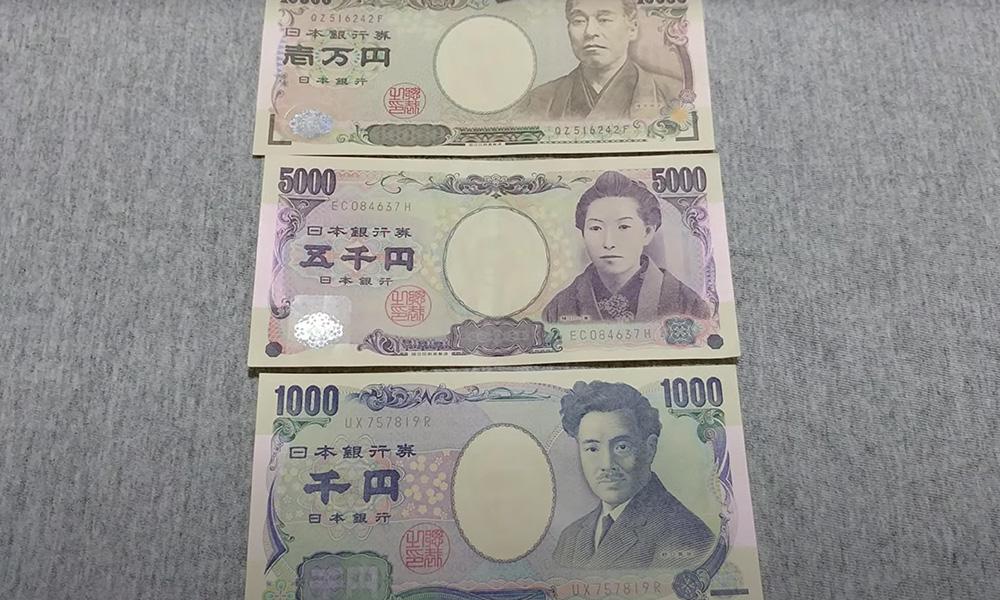
Nigel Green, CEO of deVere Group, pointed out that with the yen falling to its lowest level against the dollar since 1986, all market attention is focused on whether the Japanese Ministry of Finance will intervene in the foreign exchange market in the near future. However, he believes that this is not the core issue.
"Everyone is focused on whether Tokyo will intervene in the foreign exchange market after the yen fell to a 40-year low," Green said. "But the more important question is—how will Japan pay for the intervention?"
He further warned that if authorities are forced to continue to increase their support for the yen for an extended period, global investors may suddenly find themselves facing a completely different risk: one of the world's largest foreign holders of U.S. Treasury bonds is becoming a more significant seller of U.S. Treasuries.
Japanese officials have repeatedly stated their readiness to take decisive action against excessive exchange rate volatility. During previous periods of market stress, Japan has spent over 11 trillion yen on intervention operations. However, the funds for these earlier interventions primarily came from the Ministry of Finance's dollar deposits and short-term liquidity facilities, rather than from large-scale sales of US Treasury bonds.
However, if the pressure for yen depreciation persists—the USD/JPY exchange rate has already broken through the 162 mark—Japan's Ministry of Finance will gradually run out of available dollar liquidity. At that point, selling its holdings of US Treasury bonds will become the most direct source of dollar funds.
Japan holds over $1 trillion in U.S. Treasury bonds, making it one of the largest foreign creditors of the United States. Green points out that to support the yen, the Japanese authorities must sell their foreign exchange reserves, which are heavily invested in dollar-denominated assets, including U.S. Treasury bonds.
If this scenario comes true, its impact will extend far beyond the foreign exchange market itself.
Green argues that the fundamental challenge facing Japanese policymakers is that intervention alone is unlikely to reverse the structural forces driving the yen's weakness—most critically the persistent interest rate and yield differentials that favor dollar assets over yen assets.
"Policymakers face a harsh reality: intervention can slow market volatility, but history tells us that it rarely changes the underlying economic fundamentals," Green emphasized.
"As long as investors can borrow yen at low cost and obtain significantly higher returns elsewhere, the structural pressure on the yen will persist."
This reality means that Japanese authorities may be forced to intervene multiple times, and each intervention will gradually increase the pressure on foreign exchange reserves. As the dollar cash portion of reserves is depleted, the pressure to sell US Treasury bonds will increase accordingly.
If Japan is forced to continue selling off US Treasury bonds, the ripple effects will spread to global financial markets:
The US Treasury market is under pressure: As one of the largest foreign holders of US Treasury bonds, Japan's continued selling will push up US Treasury yields and increase the borrowing costs for the US government.
Global risk assets face revaluation: Rising US Treasury yields mean a shift in the global risk-free rate center, which will put valuation pressure on risk assets such as stocks and emerging market assets.
Rising yen funding costs: Intervention-induced tightening of yen liquidity may push up yen funding rates, impacting global carry trade strategies.
Green warns that while the market is asking "Will Japan intervene?", investors should be asking: "If Japan is forced to intervene repeatedly, what assets will it need to sell to defend the yen? If the answer increasingly points to US Treasury bonds, then what appears to be a Japanese currency crisis today could evolve into a global bond market crisis tomorrow."
For global investors, the USD/JPY exchange rate is no longer just a matter of foreign exchange trading, but is closely linked to the liquidity situation in the US Treasury market. The following indicators deserve continued attention:
The scale and funding sources of intervention by Japan's Ministry of Finance: If the frequency and scale of intervention increase, the risk of a sell-off in US Treasury bonds will rise.
The trend of the US Treasury yield curve: If long-term yields rise significantly due to selling pressure from Japan, it will have a spillover effect on global asset pricing.
The pace of unwinding carry trades: If the yen strengthens temporarily due to intervention, it may trigger large-scale unwinding of carry trades, exacerbating global market volatility.
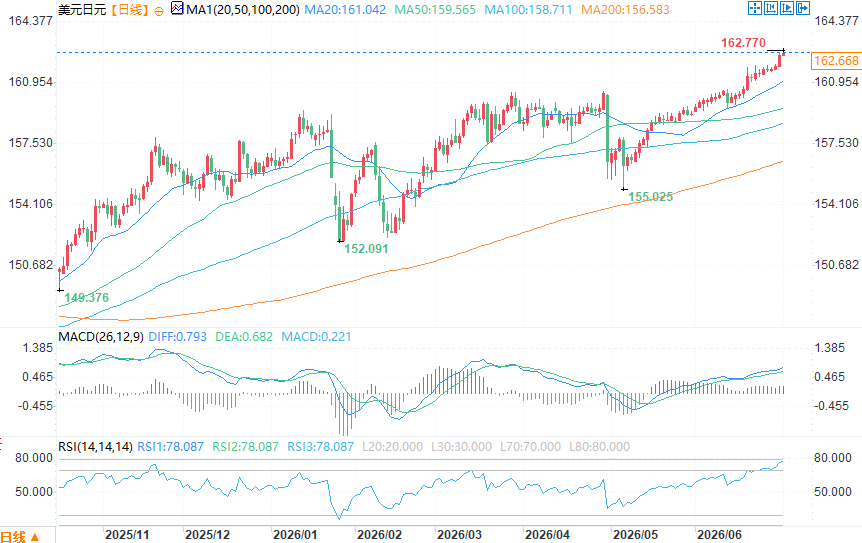
(USD/JPY daily chart, source: FX678)
At 11:20 Beijing time on July 1, the USD/JPY exchange rate was 162.77/78.
The risk that Japan's Ministry of Finance will be forced to continue intervening to defend the yen may be more than just an exchange rate issue.
The CEO of global financial consulting giant deVere Group warned that the world’s most critical bond market could face new shocks if Japanese authorities are forced to sell large amounts of U.S. Treasury bonds to raise funds for intervention.
Market focus misalignment: The real risk lies not in the yen, but in US Treasury bonds.
Nigel Green, CEO of deVere Group, pointed out that with the yen falling to its lowest level against the dollar since 1986, all market attention is focused on whether the Japanese Ministry of Finance will intervene in the foreign exchange market in the near future. However, he believes that this is not the core issue.
"Everyone is focused on whether Tokyo will intervene in the foreign exchange market after the yen fell to a 40-year low," Green said. "But the more important question is—how will Japan pay for the intervention?"
He further warned that if authorities are forced to continue to increase their support for the yen for an extended period, global investors may suddenly find themselves facing a completely different risk: one of the world's largest foreign holders of U.S. Treasury bonds is becoming a more significant seller of U.S. Treasuries.
Sources of funding for intervention: Selling US Treasury bonds is a reluctant but realistic choice.
Japanese officials have repeatedly stated their readiness to take decisive action against excessive exchange rate volatility. During previous periods of market stress, Japan has spent over 11 trillion yen on intervention operations. However, the funds for these earlier interventions primarily came from the Ministry of Finance's dollar deposits and short-term liquidity facilities, rather than from large-scale sales of US Treasury bonds.
However, if the pressure for yen depreciation persists—the USD/JPY exchange rate has already broken through the 162 mark—Japan's Ministry of Finance will gradually run out of available dollar liquidity. At that point, selling its holdings of US Treasury bonds will become the most direct source of dollar funds.
Japan holds over $1 trillion in U.S. Treasury bonds, making it one of the largest foreign creditors of the United States. Green points out that to support the yen, the Japanese authorities must sell their foreign exchange reserves, which are heavily invested in dollar-denominated assets, including U.S. Treasury bonds.
If this scenario comes true, its impact will extend far beyond the foreign exchange market itself.
Fundamental contradiction: Intervention cannot reverse structural forces.
Green argues that the fundamental challenge facing Japanese policymakers is that intervention alone is unlikely to reverse the structural forces driving the yen's weakness—most critically the persistent interest rate and yield differentials that favor dollar assets over yen assets.
"Policymakers face a harsh reality: intervention can slow market volatility, but history tells us that it rarely changes the underlying economic fundamentals," Green emphasized.
"As long as investors can borrow yen at low cost and obtain significantly higher returns elsewhere, the structural pressure on the yen will persist."
This reality means that Japanese authorities may be forced to intervene multiple times, and each intervention will gradually increase the pressure on foreign exchange reserves. As the dollar cash portion of reserves is depleted, the pressure to sell US Treasury bonds will increase accordingly.
Potential impact on global financial markets
If Japan is forced to continue selling off US Treasury bonds, the ripple effects will spread to global financial markets:
The US Treasury market is under pressure: As one of the largest foreign holders of US Treasury bonds, Japan's continued selling will push up US Treasury yields and increase the borrowing costs for the US government.
Global risk assets face revaluation: Rising US Treasury yields mean a shift in the global risk-free rate center, which will put valuation pressure on risk assets such as stocks and emerging market assets.
Rising yen funding costs: Intervention-induced tightening of yen liquidity may push up yen funding rates, impacting global carry trade strategies.
Green warns that while the market is asking "Will Japan intervene?", investors should be asking: "If Japan is forced to intervene repeatedly, what assets will it need to sell to defend the yen? If the answer increasingly points to US Treasury bonds, then what appears to be a Japanese currency crisis today could evolve into a global bond market crisis tomorrow."
Market Focus
For global investors, the USD/JPY exchange rate is no longer just a matter of foreign exchange trading, but is closely linked to the liquidity situation in the US Treasury market. The following indicators deserve continued attention:
The scale and funding sources of intervention by Japan's Ministry of Finance: If the frequency and scale of intervention increase, the risk of a sell-off in US Treasury bonds will rise.
The trend of the US Treasury yield curve: If long-term yields rise significantly due to selling pressure from Japan, it will have a spillover effect on global asset pricing.
The pace of unwinding carry trades: If the yen strengthens temporarily due to intervention, it may trigger large-scale unwinding of carry trades, exacerbating global market volatility.
(USD/JPY daily chart, source: FX678)
At 11:20 Beijing time on July 1, the USD/JPY exchange rate was 162.77/78.
- Risk Warning and Disclaimer
- The market involves risk, and trading may not be suitable for all investors. This article is for reference only and does not constitute personal investment advice, nor does it take into account certain users’ specific investment objectives, financial situation, or other needs. Any investment decisions made based on this information are at your own risk.