With the Hormuz alarm still in effect, US data is sounding the alarm for a cooling economy—where is the euro going against the dollar next?
2026-07-06 12:03:55
On Monday (July 6) during the Asian session, the euro traded in a narrow range against the US dollar around 1.1435, consolidating near its two-week high.
Tensions in the Strait of Hormuz continued to escalate, supporting the safe-haven dollar and limiting the euro's upside potential. However, weak US jobs data last week dampened market expectations for a Federal Reserve rate hike, limiting the dollar's gains.
Meanwhile, weaker-than-expected eurozone inflation data cooled bets on a European Central Bank rate hike, keeping euro bulls cautious. The market is now focused on data such as German factory orders, the eurozone Sentix investor confidence index, and the US ISM services PMI for new direction.

Despite the fragility of the interim US-Iran agreement, tensions remain high in the Strait of Hormuz as Iran attempts to strengthen its control over this strategic waterway. This situation perpetuates geopolitical risk premiums, providing some support for the safe-haven dollar and thus putting downward pressure on the euro against the dollar.
Against this backdrop, the euro traded narrowly against the dollar during the Asian session, remaining below but not far from the near two-week high reached last Thursday. Market sentiment was cautious, with investors hesitant to build large positions in the absence of new catalysts.
Dollar bulls are hesitant at current levels, primarily due to weaker-than-expected US jobs data released last week. The closely watched June non-farm payroll report showed that the US economy added only 57,000 jobs, far below market expectations of 110,000.
Meanwhile, the previous month's figure was revised down from 172,000 to 129,000. Although the unemployment rate fell slightly to 4.2%, signs of slowing hiring still raised concerns about an economic slowdown.
The recent drop in oil prices has eased inflation concerns, leading the market to lower its expectation for the number of Federal Reserve rate hikes in 2026 from 1-2 to 0-1. This shift in expectations has limited the upside potential of the US dollar and provided some support for the euro against the dollar. Furthermore, the overall positive tone in global stock markets has further dampened safe-haven demand for the US dollar.
Regarding the euro, recent eurozone inflation data showed a moderate trend, prompting investors to reduce their bets on further interest rate hikes by the European Central Bank. This backdrop has kept euro bulls cautious, especially as the euro struggles to gain sustained upward momentum in the absence of strong economic data.
Analysts point out that the divergence between the ECB and the Fed on policy paths is narrowing – both central banks face the dual challenges of economic slowdown and declining inflation, making it difficult for the euro to form a clear one-sided trend against the dollar in the short term.
Monday's economic calendar is packed with key data releases: German factory orders, the Eurozone Sentix investor confidence index, the monthly producer price index (PPI), and retail sales figures will all be released.
Once the North American trading session begins, the US ISM Services PMI data and speeches by influential Federal Reserve officials may provide a new short-term direction for the euro against the dollar.
According to the daily chart, the euro is in a medium-term downtrend against the US dollar, with the price falling continuously from the high of 1.2081 in January 2026, and recently rebounding slightly after bottoming out at 1.1324.
The moving average system is in a bearish alignment, with the price trading below the short-term moving averages (MA20, MA30, MA50), indicating that the downtrend remains intact. Key support lies at the previous low of 1.1324, followed by the historically densely traded area of 1.1410-1.1505. Resistance levels are at the MA20 (1.1464) and the support level near 1.1505, with stronger resistance around 1.1671.
The MACD indicator shows that the DIFF line (-0.0050) crossed above the DEA line (-0.0056), and the histogram turned red to 0.0012, forming a golden cross at a low level, releasing a short-term rebound signal. However, the overall trend is still running below the 0 axis, and the bearish dominance has not yet reversed.
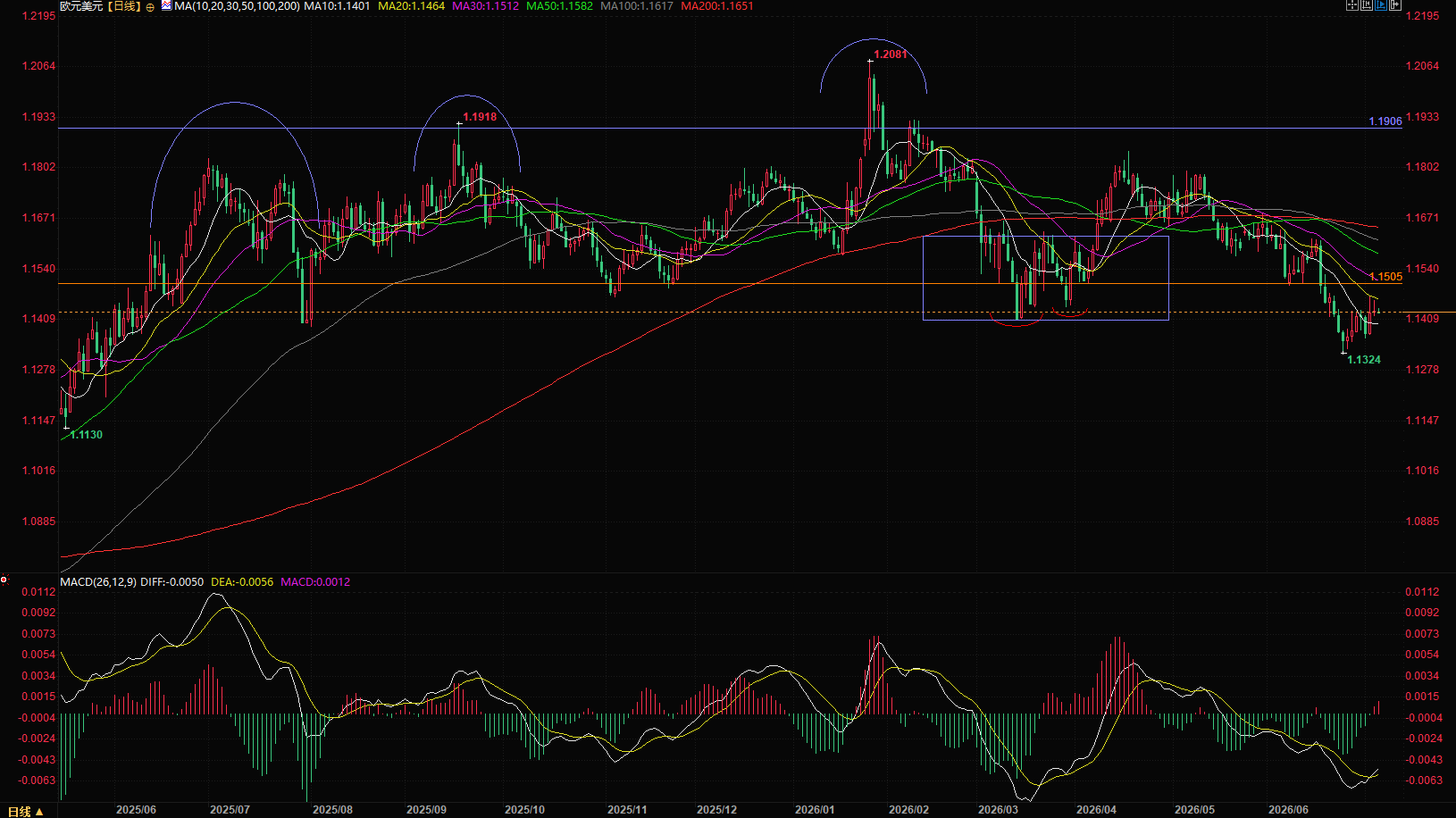
(Euro/USD daily chart, source: FX678)
At 12:03 Beijing time on July 6, the euro was trading at 1.1432/33 against the US dollar.
Tensions in the Strait of Hormuz continued to escalate, supporting the safe-haven dollar and limiting the euro's upside potential. However, weak US jobs data last week dampened market expectations for a Federal Reserve rate hike, limiting the dollar's gains.
Meanwhile, weaker-than-expected eurozone inflation data cooled bets on a European Central Bank rate hike, keeping euro bulls cautious. The market is now focused on data such as German factory orders, the eurozone Sentix investor confidence index, and the US ISM services PMI for new direction.
Geopolitical risks supported the US dollar, while the euro was constrained by risk aversion.
Despite the fragility of the interim US-Iran agreement, tensions remain high in the Strait of Hormuz as Iran attempts to strengthen its control over this strategic waterway. This situation perpetuates geopolitical risk premiums, providing some support for the safe-haven dollar and thus putting downward pressure on the euro against the dollar.
Against this backdrop, the euro traded narrowly against the dollar during the Asian session, remaining below but not far from the near two-week high reached last Thursday. Market sentiment was cautious, with investors hesitant to build large positions in the absence of new catalysts.
Weak US jobs data weakens further upward momentum for the dollar.
Dollar bulls are hesitant at current levels, primarily due to weaker-than-expected US jobs data released last week. The closely watched June non-farm payroll report showed that the US economy added only 57,000 jobs, far below market expectations of 110,000.
Meanwhile, the previous month's figure was revised down from 172,000 to 129,000. Although the unemployment rate fell slightly to 4.2%, signs of slowing hiring still raised concerns about an economic slowdown.
The recent drop in oil prices has eased inflation concerns, leading the market to lower its expectation for the number of Federal Reserve rate hikes in 2026 from 1-2 to 0-1. This shift in expectations has limited the upside potential of the US dollar and provided some support for the euro against the dollar. Furthermore, the overall positive tone in global stock markets has further dampened safe-haven demand for the US dollar.
Eurozone inflation slows, bets on ECB rate hikes cool.
Regarding the euro, recent eurozone inflation data showed a moderate trend, prompting investors to reduce their bets on further interest rate hikes by the European Central Bank. This backdrop has kept euro bulls cautious, especially as the euro struggles to gain sustained upward momentum in the absence of strong economic data.
Analysts point out that the divergence between the ECB and the Fed on policy paths is narrowing – both central banks face the dual challenges of economic slowdown and declining inflation, making it difficult for the euro to form a clear one-sided trend against the dollar in the short term.
This week is packed with data; the market awaits new catalysts.
Monday's economic calendar is packed with key data releases: German factory orders, the Eurozone Sentix investor confidence index, the monthly producer price index (PPI), and retail sales figures will all be released.
Once the North American trading session begins, the US ISM Services PMI data and speeches by influential Federal Reserve officials may provide a new short-term direction for the euro against the dollar.
Technical Analysis
According to the daily chart, the euro is in a medium-term downtrend against the US dollar, with the price falling continuously from the high of 1.2081 in January 2026, and recently rebounding slightly after bottoming out at 1.1324.
The moving average system is in a bearish alignment, with the price trading below the short-term moving averages (MA20, MA30, MA50), indicating that the downtrend remains intact. Key support lies at the previous low of 1.1324, followed by the historically densely traded area of 1.1410-1.1505. Resistance levels are at the MA20 (1.1464) and the support level near 1.1505, with stronger resistance around 1.1671.
The MACD indicator shows that the DIFF line (-0.0050) crossed above the DEA line (-0.0056), and the histogram turned red to 0.0012, forming a golden cross at a low level, releasing a short-term rebound signal. However, the overall trend is still running below the 0 axis, and the bearish dominance has not yet reversed.
(Euro/USD daily chart, source: FX678)
At 12:03 Beijing time on July 6, the euro was trading at 1.1432/33 against the US dollar.
- Risk Warning and Disclaimer
- The market involves risk, and trading may not be suitable for all investors. This article is for reference only and does not constitute personal investment advice, nor does it take into account certain users’ specific investment objectives, financial situation, or other needs. Any investment decisions made based on this information are at your own risk.