The New Zealand dollar is caught in a three-pronged attack: a strong US dollar, dragging down commodity prices, and internal divisions within the Reserve Bank of New Zealand. The outcome will be decided on Wednesday.
2026-07-06 12:16:26
On Monday (July 6) during Asian trading hours, the New Zealand dollar fell back to around 0.5685 against the US dollar after rising for two consecutive days.
New Zealand's ANZ Commodity Price Index fell 1.0% month-on-month in June, as easing tensions in the Middle East and declining oil prices weighed on the New Zealand dollar.
Meanwhile, the New Zealand Institute of Economic Research's shadow committee was nearly evenly divided on the July policy decision, creating deep uncertainty in the market. However, the committee unanimously agreed on the medium-term outlook, believing that the official cash rate needs to rise to the 3.00%-3.25% range over the next year.
Regarding the US dollar, the market is still pricing in multiple Federal Reserve rate hikes this year, adding downward pressure to the New Zealand dollar against the US dollar. The market is awaiting the Reserve Bank of New Zealand's decision on Wednesday and the minutes of the Federal Reserve's June meeting.

The New Zealand dollar retreated against the US dollar after two consecutive days of gains, mainly due to a 1.0% month-on-month decline in New Zealand's ANZ Commodity Price Index in June. Easing tensions in the Middle East and lower oil prices weighed on the outlook for New Zealand's commodity-export-oriented economy, thus weakening the New Zealand dollar's support.
As a commodity currency, the New Zealand dollar is highly sensitive to changes in global commodity prices. While the recent decline in oil prices has helped alleviate global inflationary pressures, it has directly impacted New Zealand's export revenue, causing the New Zealand dollar to lose a key support in the short term.
The core challenge facing the New Zealand dollar lies in the uncertainty surrounding the Reserve Bank of New Zealand's policy decision next week. The New Zealand Economic Research Institute's shadow committee is almost evenly divided on the July policy decision, creating real volatility risk for the market.
Despite disagreements on short-term decisions, the Committee’s medium-term outlook was highly consistent: regardless of July’s actions, members firmly believed that the official cash rate must rise to the 3.00%-3.25% range over the next twelve months. This consensus established a solid anchor for interest rate expectations.
In line with this, ANZ expects the Reserve Bank of New Zealand (RBNZ) to raise interest rates by 25 basis points to 2.50% next Wednesday (July 15). Despite the sharp drop in global oil prices, ANZ maintains that persistent inflation risks and a weak domestic currency necessitate immediate action. The bank believes that a neutral-to-dovish rate hike would provide the RBNZ with the most comfortable tactical foothold in addressing current economic pressures, avoiding excessive market disruption while effectively managing inflation expectations.
The downward pressure on the New Zealand dollar against the US dollar also stems from the overall strengthening of the US dollar. Although global inflation concerns have eased somewhat due to the gradual normalization of oil shipments through the Strait of Hormuz, the market still expects the Federal Reserve to raise interest rates this year.
The CME FedWatch tool shows that financial markets are pricing in a 77.3% probability of a Federal Reserve rate hike before the end of the year. Investors are now eagerly awaiting the release of the minutes from the Fed's June policy meeting on Wednesday for clearer clues about the future path of interest rates.
Ahead of the release of the meeting minutes, bullish sentiment towards the US dollar remained stable, putting continued pressure on the New Zealand dollar.
This week will be crucial for the New Zealand dollar. Wednesday will see the Reserve Bank of New Zealand's interest rate decision, and the release of the Federal Reserve's June meeting minutes on the same day. The interplay of policy signals from these two central banks could trigger significant volatility in the New Zealand dollar against the US dollar.
The market will be closely watching the tone of the Reserve Bank of New Zealand's post-meeting statement—whether it will be a hawkish stance with a clear path for interest rate hikes, or a more cautious wait-and-see approach.
Meanwhile, any details in the Federal Reserve meeting minutes regarding the assessment of inflation and the pace of interest rate hikes could provide new direction for the US dollar, thereby indirectly affecting the exchange rate of the New Zealand dollar against the US dollar.
According to the daily chart, the New Zealand dollar is in a medium-term downtrend against the US dollar. The price has fallen from the previous high of 0.6091 and recently rebounded slightly after bottoming out at 0.5625.
The moving average system is in a bearish alignment, with the price trading below the 20-day, 30-day, and 50-day moving averages (MA20, MA30, MA50), indicating that the downtrend structure remains intact. Key support lies at the recent low of 0.5625, followed by 0.5674. Resistance levels are at the 20-day moving average (MA20) at 0.5728, the 0.5783 level, and stronger resistance in the previous consolidation range of 0.5948-0.6007.
The MACD indicator shows that the DIFF line (-0.0046) crossed above the DEA line (-0.0049), and the histogram turned red to 0.0006, forming a golden cross at a low level, releasing a short-term rebound signal. However, the overall trend is still running below the 0 axis, and the bearish dominance has not yet reversed.
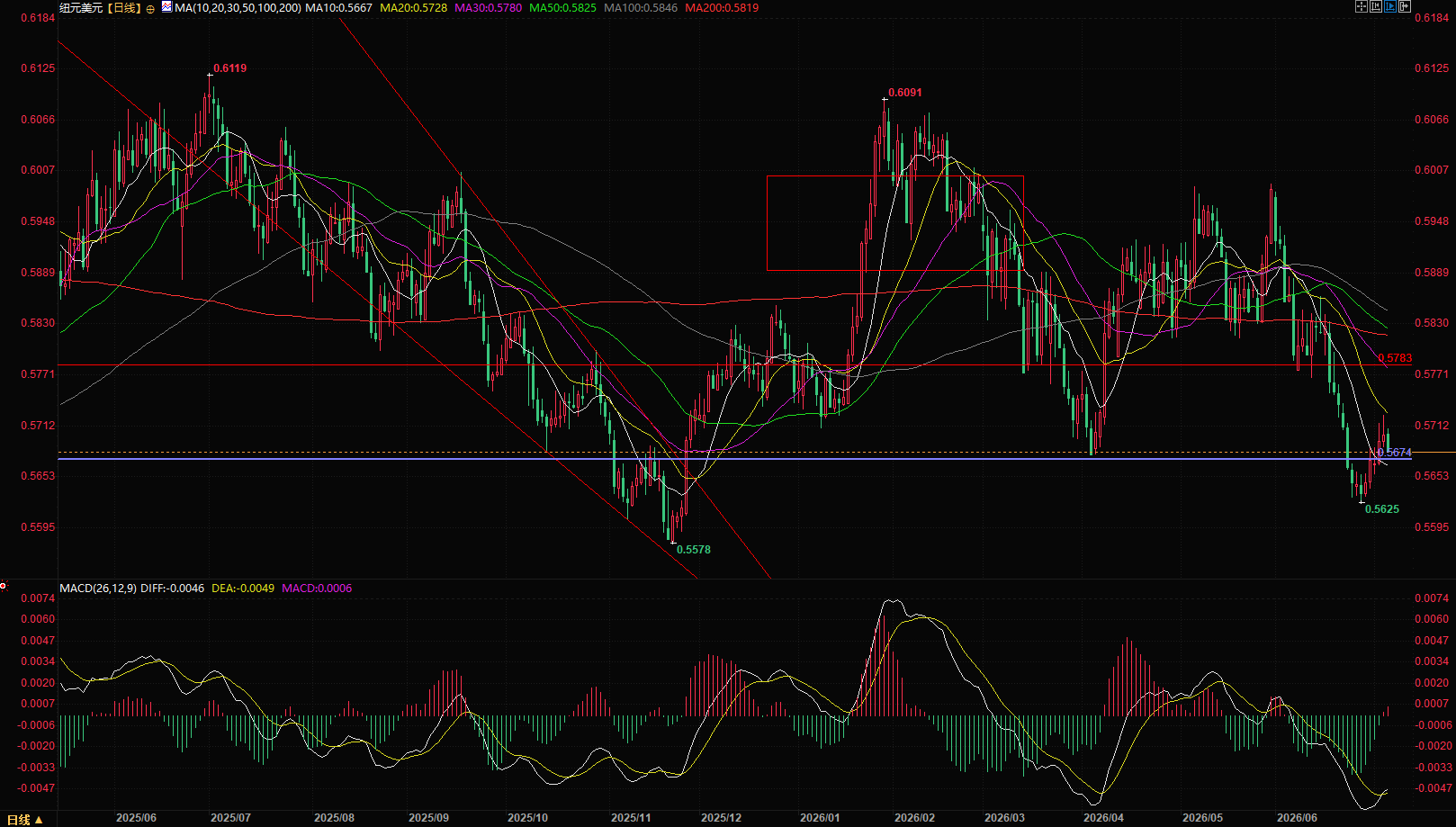
(NZD/USD daily chart, source: FX678)
At 12:15 Beijing time on July 6, the New Zealand dollar was trading at 0.5689/90 against the US dollar.
New Zealand's ANZ Commodity Price Index fell 1.0% month-on-month in June, as easing tensions in the Middle East and declining oil prices weighed on the New Zealand dollar.
Meanwhile, the New Zealand Institute of Economic Research's shadow committee was nearly evenly divided on the July policy decision, creating deep uncertainty in the market. However, the committee unanimously agreed on the medium-term outlook, believing that the official cash rate needs to rise to the 3.00%-3.25% range over the next year.
Regarding the US dollar, the market is still pricing in multiple Federal Reserve rate hikes this year, adding downward pressure to the New Zealand dollar against the US dollar. The market is awaiting the Reserve Bank of New Zealand's decision on Wednesday and the minutes of the Federal Reserve's June meeting.
Commodity prices weakened, and the New Zealand dollar lost support.
The New Zealand dollar retreated against the US dollar after two consecutive days of gains, mainly due to a 1.0% month-on-month decline in New Zealand's ANZ Commodity Price Index in June. Easing tensions in the Middle East and lower oil prices weighed on the outlook for New Zealand's commodity-export-oriented economy, thus weakening the New Zealand dollar's support.
As a commodity currency, the New Zealand dollar is highly sensitive to changes in global commodity prices. While the recent decline in oil prices has helped alleviate global inflationary pressures, it has directly impacted New Zealand's export revenue, causing the New Zealand dollar to lose a key support in the short term.
With the Reserve Bank of New Zealand's decision imminent, disagreements within the shadow committee have heightened uncertainty.
The core challenge facing the New Zealand dollar lies in the uncertainty surrounding the Reserve Bank of New Zealand's policy decision next week. The New Zealand Economic Research Institute's shadow committee is almost evenly divided on the July policy decision, creating real volatility risk for the market.
Despite disagreements on short-term decisions, the Committee’s medium-term outlook was highly consistent: regardless of July’s actions, members firmly believed that the official cash rate must rise to the 3.00%-3.25% range over the next twelve months. This consensus established a solid anchor for interest rate expectations.
In line with this, ANZ expects the Reserve Bank of New Zealand (RBNZ) to raise interest rates by 25 basis points to 2.50% next Wednesday (July 15). Despite the sharp drop in global oil prices, ANZ maintains that persistent inflation risks and a weak domestic currency necessitate immediate action. The bank believes that a neutral-to-dovish rate hike would provide the RBNZ with the most comfortable tactical foothold in addressing current economic pressures, avoiding excessive market disruption while effectively managing inflation expectations.
The US dollar remains strong, supported by expectations of a Federal Reserve rate hike.
The downward pressure on the New Zealand dollar against the US dollar also stems from the overall strengthening of the US dollar. Although global inflation concerns have eased somewhat due to the gradual normalization of oil shipments through the Strait of Hormuz, the market still expects the Federal Reserve to raise interest rates this year.
The CME FedWatch tool shows that financial markets are pricing in a 77.3% probability of a Federal Reserve rate hike before the end of the year. Investors are now eagerly awaiting the release of the minutes from the Fed's June policy meeting on Wednesday for clearer clues about the future path of interest rates.
Ahead of the release of the meeting minutes, bullish sentiment towards the US dollar remained stable, putting continued pressure on the New Zealand dollar.
This week is packed with key events, putting the New Zealand dollar under double pressure.
This week will be crucial for the New Zealand dollar. Wednesday will see the Reserve Bank of New Zealand's interest rate decision, and the release of the Federal Reserve's June meeting minutes on the same day. The interplay of policy signals from these two central banks could trigger significant volatility in the New Zealand dollar against the US dollar.
The market will be closely watching the tone of the Reserve Bank of New Zealand's post-meeting statement—whether it will be a hawkish stance with a clear path for interest rate hikes, or a more cautious wait-and-see approach.
Meanwhile, any details in the Federal Reserve meeting minutes regarding the assessment of inflation and the pace of interest rate hikes could provide new direction for the US dollar, thereby indirectly affecting the exchange rate of the New Zealand dollar against the US dollar.
Technical Analysis
According to the daily chart, the New Zealand dollar is in a medium-term downtrend against the US dollar. The price has fallen from the previous high of 0.6091 and recently rebounded slightly after bottoming out at 0.5625.
The moving average system is in a bearish alignment, with the price trading below the 20-day, 30-day, and 50-day moving averages (MA20, MA30, MA50), indicating that the downtrend structure remains intact. Key support lies at the recent low of 0.5625, followed by 0.5674. Resistance levels are at the 20-day moving average (MA20) at 0.5728, the 0.5783 level, and stronger resistance in the previous consolidation range of 0.5948-0.6007.
The MACD indicator shows that the DIFF line (-0.0046) crossed above the DEA line (-0.0049), and the histogram turned red to 0.0006, forming a golden cross at a low level, releasing a short-term rebound signal. However, the overall trend is still running below the 0 axis, and the bearish dominance has not yet reversed.
(NZD/USD daily chart, source: FX678)
At 12:15 Beijing time on July 6, the New Zealand dollar was trading at 0.5689/90 against the US dollar.
- Risk Warning and Disclaimer
- The market involves risk, and trading may not be suitable for all investors. This article is for reference only and does not constitute personal investment advice, nor does it take into account certain users’ specific investment objectives, financial situation, or other needs. Any investment decisions made based on this information are at your own risk.