Falling oil prices eased inflationary pressures, and cooling expectations of a Fed rate hike caused silver to rise and then fall back, maintaining a high-level consolidation.
2026-07-06 13:22:28
Silver prices edged lower in Asian trading on Monday, falling about 1% to around $61.80 , ending a four-day winning streak. Profit-taking pressure emerged after a short-term correction, but the overall trend has not yet reversed significantly.
One of the key drivers of the recent precious metals market has been changes in the crude oil market. With the recovery of global crude oil supply and the gradual normalization of shipping in the Strait of Hormuz, oil prices have continued to decline, which has alleviated expectations of global inflationary pressures to some extent, thus weakening the short-term support for silver as an inflation hedge. However, historically, lower oil prices often mean lower industrial cost pressures, which can also affect the risk premium structure of precious metals, causing the market to reassess the pricing logic of silver.
Multiple institutions predict that Brent crude oil may fall further to around $60 by the end of the year. This expectation reinforces the downward trend in inflation and has a complex impact on silver in the medium term: on the one hand, it suppresses the safe-haven premium, and on the other hand, it increases expectations of monetary policy easing.
Regarding monetary policy, weak US non-farm payroll data cooled market expectations for further interest rate hikes by the Federal Reserve. According to interest rate futures, the market's expectation of at least one rate hike this year has fallen from approximately 59% a week ago to about 53.2% . This change provides some support for precious metals as a whole, because a slower interest rate path typically reduces the opportunity cost of non-interest-bearing assets.
The market will also be watching the upcoming release of the Federal Reserve meeting minutes this week to gauge policymakers' stance on the trade-off between economic slowdown and declining inflation. Overall, the silver market is currently in a two-way game structure: "falling oil prices suppressing inflation + cooling interest rate expectations supporting precious metals." Short-term directional momentum is limited, and prices are more likely to consolidate after a pullback from higher levels.
From a daily chart perspective, silver entered a high-level consolidation phase after a rapid surge. The price encountered resistance near the 20-day exponential moving average (EMA) and has since retreated, currently trading within the $61-$62 range. The overall trend has shifted from a strong upward movement to consolidation. The 20-day EMA, located around $63.50, forms a key short-term resistance area, which the price has tested multiple times without a decisive breakout, indicating continued strong selling pressure. The RSI indicator has fallen to around 40, suggesting that momentum has cooled significantly from the overbought zone but has not yet entered the oversold zone, indicating that while bearish forces are dominant, an extreme trend has not yet formed.
From a 4-hour chart perspective, the price structure has shifted from a one-sided upward trend to a pullback and consolidation, with short-term moving averages beginning to flatten and momentum indicators gradually converging. If the price fails to regain a foothold above $63.50, it may continue its weak consolidation in the short term; if it breaks below the $61 support level, it may further retreat towards the $58 area; conversely, if it breaks through and holds above $63.50, it could potentially reopen the upside potential towards the $67 area.
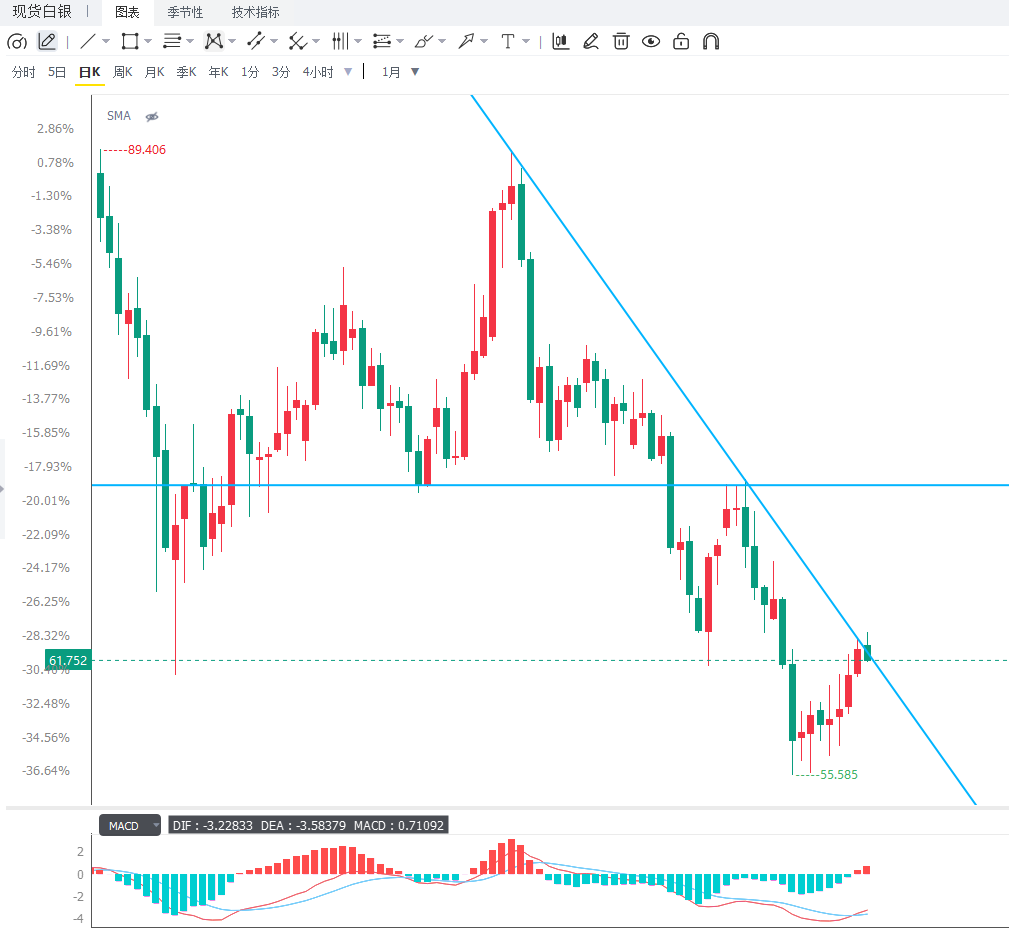
The overall technical structure indicates that silver is in a technical correction phase after its rise; the trend remains intact, but the momentum has clearly slowed down.
Editor's Summary : The current trend in silver is essentially a result of a shift in macroeconomic expectations: falling oil prices have weakened inflation expectations, while cooling expectations of a Fed rate hike have provided some support, bringing the market into a state of equilibrium between bulls and bears. In the short term, silver is more likely to maintain a high-level consolidation pattern, lacking a clear trend driver. The medium-term trend will depend on two major variables: firstly, whether crude oil prices continue to decline, leading to a further drop in inflation; and secondly, whether the Fed's policy will further shift towards a dovish stance. If the interest rate path continues to slow, silver still has the basis for another upward move; however, if industrial demand and risk appetite weaken simultaneously, further pullbacks cannot be ruled out. Overall, the market is in a rebalancing phase after a trend correction.
One of the key drivers of the recent precious metals market has been changes in the crude oil market. With the recovery of global crude oil supply and the gradual normalization of shipping in the Strait of Hormuz, oil prices have continued to decline, which has alleviated expectations of global inflationary pressures to some extent, thus weakening the short-term support for silver as an inflation hedge. However, historically, lower oil prices often mean lower industrial cost pressures, which can also affect the risk premium structure of precious metals, causing the market to reassess the pricing logic of silver.
Multiple institutions predict that Brent crude oil may fall further to around $60 by the end of the year. This expectation reinforces the downward trend in inflation and has a complex impact on silver in the medium term: on the one hand, it suppresses the safe-haven premium, and on the other hand, it increases expectations of monetary policy easing.
Regarding monetary policy, weak US non-farm payroll data cooled market expectations for further interest rate hikes by the Federal Reserve. According to interest rate futures, the market's expectation of at least one rate hike this year has fallen from approximately 59% a week ago to about 53.2% . This change provides some support for precious metals as a whole, because a slower interest rate path typically reduces the opportunity cost of non-interest-bearing assets.
The market will also be watching the upcoming release of the Federal Reserve meeting minutes this week to gauge policymakers' stance on the trade-off between economic slowdown and declining inflation. Overall, the silver market is currently in a two-way game structure: "falling oil prices suppressing inflation + cooling interest rate expectations supporting precious metals." Short-term directional momentum is limited, and prices are more likely to consolidate after a pullback from higher levels.
From a daily chart perspective, silver entered a high-level consolidation phase after a rapid surge. The price encountered resistance near the 20-day exponential moving average (EMA) and has since retreated, currently trading within the $61-$62 range. The overall trend has shifted from a strong upward movement to consolidation. The 20-day EMA, located around $63.50, forms a key short-term resistance area, which the price has tested multiple times without a decisive breakout, indicating continued strong selling pressure. The RSI indicator has fallen to around 40, suggesting that momentum has cooled significantly from the overbought zone but has not yet entered the oversold zone, indicating that while bearish forces are dominant, an extreme trend has not yet formed.
From a 4-hour chart perspective, the price structure has shifted from a one-sided upward trend to a pullback and consolidation, with short-term moving averages beginning to flatten and momentum indicators gradually converging. If the price fails to regain a foothold above $63.50, it may continue its weak consolidation in the short term; if it breaks below the $61 support level, it may further retreat towards the $58 area; conversely, if it breaks through and holds above $63.50, it could potentially reopen the upside potential towards the $67 area.
The overall technical structure indicates that silver is in a technical correction phase after its rise; the trend remains intact, but the momentum has clearly slowed down.
Editor's Summary : The current trend in silver is essentially a result of a shift in macroeconomic expectations: falling oil prices have weakened inflation expectations, while cooling expectations of a Fed rate hike have provided some support, bringing the market into a state of equilibrium between bulls and bears. In the short term, silver is more likely to maintain a high-level consolidation pattern, lacking a clear trend driver. The medium-term trend will depend on two major variables: firstly, whether crude oil prices continue to decline, leading to a further drop in inflation; and secondly, whether the Fed's policy will further shift towards a dovish stance. If the interest rate path continues to slow, silver still has the basis for another upward move; however, if industrial demand and risk appetite weaken simultaneously, further pullbacks cannot be ruled out. Overall, the market is in a rebalancing phase after a trend correction.
- Risk Warning and Disclaimer
- The market involves risk, and trading may not be suitable for all investors. This article is for reference only and does not constitute personal investment advice, nor does it take into account certain users’ specific investment objectives, financial situation, or other needs. Any investment decisions made based on this information are at your own risk.