A stronger US dollar coupled with supply and demand dynamics in the crude oil market kept the USD/CAD pair in a bullish consolidation phase.
2026-07-06 13:18:29
The USD/CAD pair continued its upward trend during Monday's Asian session, rising for the second consecutive trading day to around 1.4210 . In the short term, the US dollar remains generally strong, while the Canadian dollar is influenced by fluctuations in the oil market, resulting in a volatile upward trend.

Regarding the US dollar, the market continues to price in the possibility that the Federal Reserve will maintain a relatively tight policy path. There is still a 77.3% probability of further interest rate hikes expected this year, keeping the dollar index at a relatively high level. This expectation, to some extent, supports the upward trend of USD/CAD.
However, the upside potential for the US dollar is not a one-sided expansion. Recent weak US employment data has fueled discussions about the peak of interest rates, and investors are awaiting the Fed meeting minutes for further confirmation of the policy path. While interest rate expectations are hawkish, the marginal momentum is weakening, resulting in a "strong but not extreme" oscillating structure for the dollar with a slightly bullish bias.
For the Canadian dollar, the core driver remains the crude oil market. With the gradual recovery of shipping in the Strait of Hormuz, global energy transport stability has improved. Meanwhile, OPEC+ announced a moderate production increase of approximately 188,000 barrels per day, reinforcing expectations of ample supply in the medium term. The oil market is entering a rebalancing phase under the dual influence of "transportation recovery + increased supply."
However, oil prices have shown some resilience, mainly due to geopolitical uncertainties and fluctuating supply patterns, which have provided some support for the Canadian dollar, thus limiting the upward slope of USD/CAD. The current market is caught in a tug-of-war between "US dollar interest rate support + oil price volatility support for the Canadian dollar," with the exchange rate lacking momentum for a unilateral breakout.
In the short term, market focus is on the US ISM services data and the Federal Reserve meeting minutes. If the data continues to reinforce expectations of an economic slowdown, the US dollar may face a period of correction; conversely, if the data remains resilient, USD/CAD still has a basis for continued upward movement.
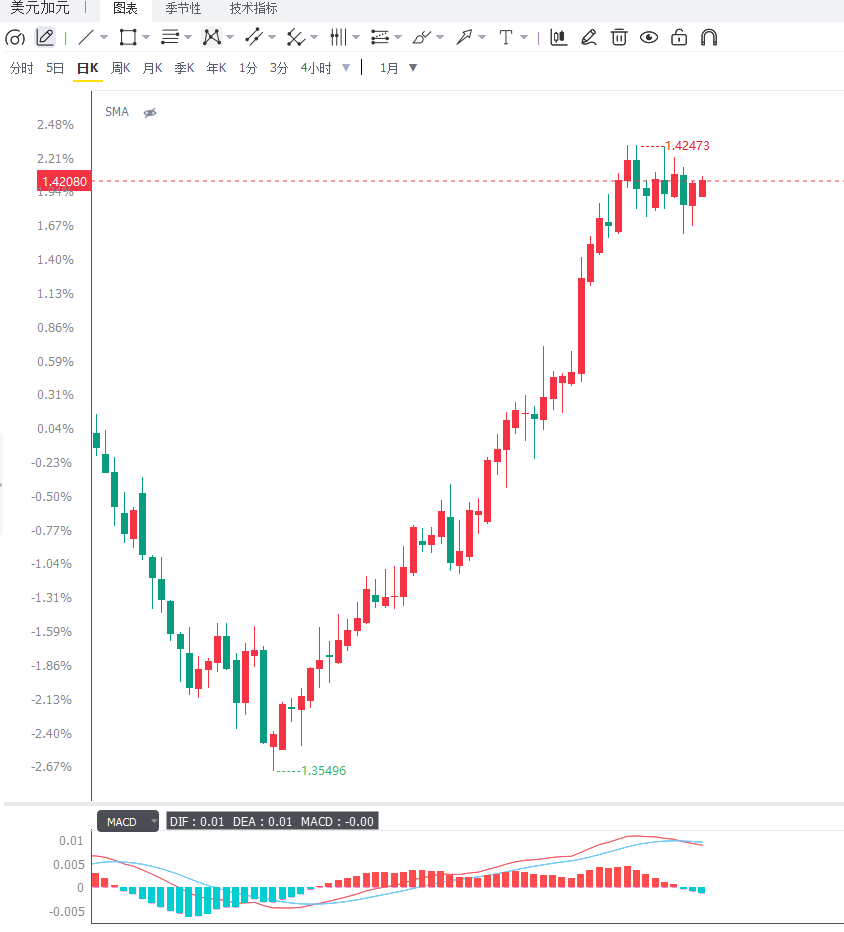
From a daily chart perspective, USD/CAD continues its upward trend, with the price steadily trading above 1.4100, and the overall trend remains bullish. After breaking out of the previous consolidation range, the price has gradually moved higher, currently forming a short-term resistance zone around 1.4200. If it can effectively hold above this area, it may further test the 1.4300 level.
The moving average structure shows that the short-term moving averages are still diverging upwards, but the medium and long-term moving averages are still slowly flattening out, indicating that the trend is still in a transitional phase and has not yet formed a strong one-sided trend.
From a 4-hour chart perspective, the price is consolidating within a narrow range between 1.4150 and 1.4250, with short-term momentum slowing. The MACD indicator is overbought, with the red bars converging, indicating weakening upward momentum but not yet a clear downtrend. The RSI is in the neutral-to-strong zone, not yet in overbought territory, suggesting further upside potential but awaiting new catalysts.
If the exchange rate breaks through and holds above 1.4250, it may open up further upside potential towards the 1.4350 area; conversely, a break below 1.4150 could see a pullback to support around 1.4050. Overall, USD/CAD is currently in a high-level consolidation phase within an uptrend.
Editor's Summary
The current USD/CAD movement is essentially a result of the combined effects of support from US interest rates and the rebalancing of oil supply and demand. The US dollar remains relatively strong but its marginal momentum is weakening, while the Canadian dollar is showing temporary resilience due to fluctuations in oil prices. In the short term, the exchange rate is likely to remain within the 1.41–1.43 range, with its upward movement constrained by both the rebound in oil prices and expectations of Federal Reserve policy. In the medium term, if expectations for US interest rates remain high and oil prices enter an easing cycle, USD/CAD still has a basis for upward movement; however, if the US economy slows further, the exchange rate may enter a period of high-level correction. Overall, the market is in a structurally volatile market driven by multiple intertwined factors.
Regarding the US dollar, the market continues to price in the possibility that the Federal Reserve will maintain a relatively tight policy path. There is still a 77.3% probability of further interest rate hikes expected this year, keeping the dollar index at a relatively high level. This expectation, to some extent, supports the upward trend of USD/CAD.
However, the upside potential for the US dollar is not a one-sided expansion. Recent weak US employment data has fueled discussions about the peak of interest rates, and investors are awaiting the Fed meeting minutes for further confirmation of the policy path. While interest rate expectations are hawkish, the marginal momentum is weakening, resulting in a "strong but not extreme" oscillating structure for the dollar with a slightly bullish bias.
For the Canadian dollar, the core driver remains the crude oil market. With the gradual recovery of shipping in the Strait of Hormuz, global energy transport stability has improved. Meanwhile, OPEC+ announced a moderate production increase of approximately 188,000 barrels per day, reinforcing expectations of ample supply in the medium term. The oil market is entering a rebalancing phase under the dual influence of "transportation recovery + increased supply."
However, oil prices have shown some resilience, mainly due to geopolitical uncertainties and fluctuating supply patterns, which have provided some support for the Canadian dollar, thus limiting the upward slope of USD/CAD. The current market is caught in a tug-of-war between "US dollar interest rate support + oil price volatility support for the Canadian dollar," with the exchange rate lacking momentum for a unilateral breakout.
In the short term, market focus is on the US ISM services data and the Federal Reserve meeting minutes. If the data continues to reinforce expectations of an economic slowdown, the US dollar may face a period of correction; conversely, if the data remains resilient, USD/CAD still has a basis for continued upward movement.
From a daily chart perspective, USD/CAD continues its upward trend, with the price steadily trading above 1.4100, and the overall trend remains bullish. After breaking out of the previous consolidation range, the price has gradually moved higher, currently forming a short-term resistance zone around 1.4200. If it can effectively hold above this area, it may further test the 1.4300 level.
The moving average structure shows that the short-term moving averages are still diverging upwards, but the medium and long-term moving averages are still slowly flattening out, indicating that the trend is still in a transitional phase and has not yet formed a strong one-sided trend.
From a 4-hour chart perspective, the price is consolidating within a narrow range between 1.4150 and 1.4250, with short-term momentum slowing. The MACD indicator is overbought, with the red bars converging, indicating weakening upward momentum but not yet a clear downtrend. The RSI is in the neutral-to-strong zone, not yet in overbought territory, suggesting further upside potential but awaiting new catalysts.
If the exchange rate breaks through and holds above 1.4250, it may open up further upside potential towards the 1.4350 area; conversely, a break below 1.4150 could see a pullback to support around 1.4050. Overall, USD/CAD is currently in a high-level consolidation phase within an uptrend.
Editor's Summary
The current USD/CAD movement is essentially a result of the combined effects of support from US interest rates and the rebalancing of oil supply and demand. The US dollar remains relatively strong but its marginal momentum is weakening, while the Canadian dollar is showing temporary resilience due to fluctuations in oil prices. In the short term, the exchange rate is likely to remain within the 1.41–1.43 range, with its upward movement constrained by both the rebound in oil prices and expectations of Federal Reserve policy. In the medium term, if expectations for US interest rates remain high and oil prices enter an easing cycle, USD/CAD still has a basis for upward movement; however, if the US economy slows further, the exchange rate may enter a period of high-level correction. Overall, the market is in a structurally volatile market driven by multiple intertwined factors.
- Risk Warning and Disclaimer
- The market involves risk, and trading may not be suitable for all investors. This article is for reference only and does not constitute personal investment advice, nor does it take into account certain users’ specific investment objectives, financial situation, or other needs. Any investment decisions made based on this information are at your own risk.