A weaker yen and policy divergence within the European Central Bank have pushed the euro/yen pair near its upper consolidation level, awaiting a breakout.
2026-07-08 16:38:36
The euro rose about 0.1% against the yen in European trading on Wednesday, trading around 185.20. The recent weakness of the yen against most major currencies provided support for the euro/yen pair. However, the market remains focused on the future policy direction of the Japanese government and the Bank of Japan, as well as the European Central Bank's assessment of inflation trends.

The yen's weakness was primarily driven by changes in policy expectations. Japan's Minister for Growth Strategy, Minoru Kiuchi, stated that previous market reports suggesting the government intended to maintain a low-interest-rate environment through fiscal expansion were inaccurate, and emphasized that the Japanese government had not relaxed fiscal discipline. This statement attempted to alleviate market concerns about the direction of Japanese policy.
Meanwhile, uncertainty remains regarding the outlook for Japan's monetary policy. Toichiro Asada, a Bank of Japan board member appointed by Prime Minister Sanae Takaichi, stated that he is not opposed to future interest rate hikes, but believes it is necessary to confirm whether inflation growth is driven by endogenous economic drivers such as wage increases and improved domestic demand. He pointed out that the current economic conditions supporting continued interest rate hikes are still insufficient.
The market believes that the pace of future policy adjustments by the Bank of Japan will depend on wage growth, consumer demand, and the persistence of inflation. If Japanese economic data continues to improve, the market may raise its expectations for further tightening by the Bank of Japan, thus providing support for the yen; however, until the policy path becomes clear, the yen remains vulnerable to external factors.
From the euro's perspective, there is disagreement in the market regarding the European Central Bank's (ECB) policy direction. Recent differing views among ECB officials on the inflation outlook have made it difficult for investors to form a clear trading direction. Italian central bank governor Fabio Panetta stated that eurozone inflation still faces upside risks, especially given the uncertainty surrounding shipping security in the Strait of Hormuz. Since the region handles approximately 20% of global energy transportation, any supply risks could drive up energy prices and reignite inflationary pressures.
However, Belgian central bank governor Pierre Winsch holds a relatively cautious stance. He previously stated that if inflation unexpectedly changes before the ECB's July meeting, it is more likely to be lower than expected. This indicates that there is still a significant divergence of opinion within the ECB regarding future inflation trends. Currently, the euro/yen exchange rate is influenced by two factors: firstly, uncertainty surrounding Japanese policy is putting pressure on the yen; secondly, differing assessments of inflation and interest rate paths by the ECB limit the euro's upside potential.
Furthermore, changes in global risk sentiment will also influence the cross-currency pair's movement. If market risk aversion intensifies, the yen typically receives support from safe-haven flows, potentially limiting the euro's rise against the yen; conversely, if risk appetite remains stable while concerns about European energy risks escalate, the euro may continue to maintain relative strength. Currently, the focus is on speeches by Bank of Japan officials, policy signals from the European Central Bank, and changes in the global energy market to determine the next direction of the euro/yen pair.
From a daily chart perspective, the EUR/JPY pair has maintained a slightly bullish trend recently, with bullish momentum recovering after the price climbed back above the 185.00 level. The overall trend remains high, but due to the significant gains previously, there is technical pressure for a correction. The MACD indicator shows that bullish momentum remains, but the pace of increase has slowed. Key resistance to watch is around 186.00; a break above this level could lead to a further test of the 187.50 area. Support is seen around 184.00; a break below this level could lead to a pullback to around 182.50.
From a 4-hour chart perspective, the EUR/JPY pair is showing a short-term upward trend with the price trading above short-term moving averages, indicating improved buying sentiment. The RSI indicator remains in a bullish zone, suggesting that bulls still have the upper hand in the short term, but profit-taking should be watched out for as it approaches overbought territory. If the exchange rate breaks through the 185.80-186.00 area, the short-term upward trend may continue; if it fails to break through, it may retrace to the 184.00 support level. Currently, the market is still in a phase of tug-of-war between bulls and bears, and expectations for Japanese policy and signals from the European Central Bank will determine the short-term direction.
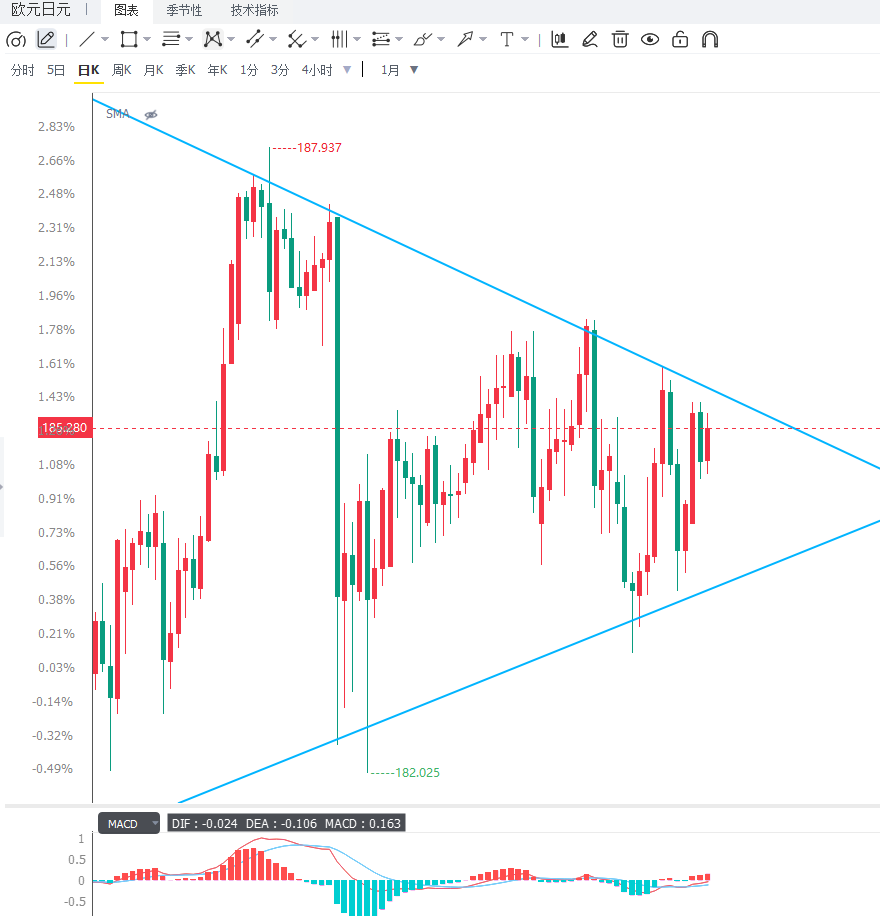
Editor's Summary : The recent rise in the euro/yen exchange rate has been primarily driven by the yen's weakness, but its medium- to long-term direction still depends on the progress of Japan's monetary policy normalization and the European Central Bank's inflation assessment. While Japan has emphasized that it is not pursuing a low-interest-rate policy, the market is still awaiting more economic data to confirm the conditions for a rate hike. In the short term, the euro/yen exchange rate may maintain a slightly bullish trend, but its upside potential will be tested as it approaches key resistance levels. If the Bank of Japan releases clearer tightening signals, the yen may rebound and limit the exchange rate's rise; if European energy risks push up inflation expectations, the euro may find support. Investors should pay close attention to the resistance level of 186.00 and the support level of 184.00.
The yen's weakness was primarily driven by changes in policy expectations. Japan's Minister for Growth Strategy, Minoru Kiuchi, stated that previous market reports suggesting the government intended to maintain a low-interest-rate environment through fiscal expansion were inaccurate, and emphasized that the Japanese government had not relaxed fiscal discipline. This statement attempted to alleviate market concerns about the direction of Japanese policy.
Meanwhile, uncertainty remains regarding the outlook for Japan's monetary policy. Toichiro Asada, a Bank of Japan board member appointed by Prime Minister Sanae Takaichi, stated that he is not opposed to future interest rate hikes, but believes it is necessary to confirm whether inflation growth is driven by endogenous economic drivers such as wage increases and improved domestic demand. He pointed out that the current economic conditions supporting continued interest rate hikes are still insufficient.
The market believes that the pace of future policy adjustments by the Bank of Japan will depend on wage growth, consumer demand, and the persistence of inflation. If Japanese economic data continues to improve, the market may raise its expectations for further tightening by the Bank of Japan, thus providing support for the yen; however, until the policy path becomes clear, the yen remains vulnerable to external factors.
From the euro's perspective, there is disagreement in the market regarding the European Central Bank's (ECB) policy direction. Recent differing views among ECB officials on the inflation outlook have made it difficult for investors to form a clear trading direction. Italian central bank governor Fabio Panetta stated that eurozone inflation still faces upside risks, especially given the uncertainty surrounding shipping security in the Strait of Hormuz. Since the region handles approximately 20% of global energy transportation, any supply risks could drive up energy prices and reignite inflationary pressures.
However, Belgian central bank governor Pierre Winsch holds a relatively cautious stance. He previously stated that if inflation unexpectedly changes before the ECB's July meeting, it is more likely to be lower than expected. This indicates that there is still a significant divergence of opinion within the ECB regarding future inflation trends. Currently, the euro/yen exchange rate is influenced by two factors: firstly, uncertainty surrounding Japanese policy is putting pressure on the yen; secondly, differing assessments of inflation and interest rate paths by the ECB limit the euro's upside potential.
Furthermore, changes in global risk sentiment will also influence the cross-currency pair's movement. If market risk aversion intensifies, the yen typically receives support from safe-haven flows, potentially limiting the euro's rise against the yen; conversely, if risk appetite remains stable while concerns about European energy risks escalate, the euro may continue to maintain relative strength. Currently, the focus is on speeches by Bank of Japan officials, policy signals from the European Central Bank, and changes in the global energy market to determine the next direction of the euro/yen pair.
From a daily chart perspective, the EUR/JPY pair has maintained a slightly bullish trend recently, with bullish momentum recovering after the price climbed back above the 185.00 level. The overall trend remains high, but due to the significant gains previously, there is technical pressure for a correction. The MACD indicator shows that bullish momentum remains, but the pace of increase has slowed. Key resistance to watch is around 186.00; a break above this level could lead to a further test of the 187.50 area. Support is seen around 184.00; a break below this level could lead to a pullback to around 182.50.
From a 4-hour chart perspective, the EUR/JPY pair is showing a short-term upward trend with the price trading above short-term moving averages, indicating improved buying sentiment. The RSI indicator remains in a bullish zone, suggesting that bulls still have the upper hand in the short term, but profit-taking should be watched out for as it approaches overbought territory. If the exchange rate breaks through the 185.80-186.00 area, the short-term upward trend may continue; if it fails to break through, it may retrace to the 184.00 support level. Currently, the market is still in a phase of tug-of-war between bulls and bears, and expectations for Japanese policy and signals from the European Central Bank will determine the short-term direction.
Editor's Summary : The recent rise in the euro/yen exchange rate has been primarily driven by the yen's weakness, but its medium- to long-term direction still depends on the progress of Japan's monetary policy normalization and the European Central Bank's inflation assessment. While Japan has emphasized that it is not pursuing a low-interest-rate policy, the market is still awaiting more economic data to confirm the conditions for a rate hike. In the short term, the euro/yen exchange rate may maintain a slightly bullish trend, but its upside potential will be tested as it approaches key resistance levels. If the Bank of Japan releases clearer tightening signals, the yen may rebound and limit the exchange rate's rise; if European energy risks push up inflation expectations, the euro may find support. Investors should pay close attention to the resistance level of 186.00 and the support level of 184.00.
- Risk Warning and Disclaimer
- The market involves risk, and trading may not be suitable for all investors. This article is for reference only and does not constitute personal investment advice, nor does it take into account certain users’ specific investment objectives, financial situation, or other needs. Any investment decisions made based on this information are at your own risk.