Oil prices surged 10% in two days as geopolitical risks escalated across the board.
2026-07-08 18:09:52
On Wednesday (July 8), during the Asian and European sessions, international oil prices surged again, with WTI oil prices currently up more than 6%. Yesterday's article reminded readers that the US was likely to take action when oil prices were at 1%. Previously, we had been warning that oil prices could rise at any time, and in less than two trading days, oil prices have rebounded by more than 10%.
Iran unilaterally claims complete control over the Strait of Hormuz. In order to implement its maritime control claims, the Iranian Revolutionary Guard recently launched an attack on three ships passing through the strait via Omani waters.
Iran's move has a clear strategic purpose: to exert continuous pressure on the United States through maritime harassment and force the US to make more concessions in bilateral negotiations.
Within just 24 hours, geopolitical tensions in the Strait of Hormuz escalated rapidly, and market risk aversion directly pushed Brent crude oil prices to $76 per barrel.
The immediate trigger for this round of conflict was the Iranian Revolutionary Guard opening fire on three oil tankers attempting to sail out of Omani territorial waters south of the Strait of Hormuz.
Before the escalation of the conflict between the US and Iran this year, in accordance with the established rules of separation of traffic of the International Maritime Organization, ships entering the Persian Gulf took the one-way channel on the south side of the strait, and ships leaving took the channel on the north side closer to Iran.
Due to their deep draft, most ocean-going oil tankers must strictly follow these two deep-water channels and cannot deviate from them at will.
Iran has now introduced new control rules, requiring all transit vessels to obtain a passage permit and pay the corresponding fees, otherwise passage will be prohibited.
The Iranian government has proposed a standard to charge each passing oil tanker a $2 million passage fee. If this fee mechanism is implemented, it could generate nearly $10 billion in stable revenue annually. However, opening the Omani side of the waterway to foreign shipping diverts shipping capacity and directly erodes this maritime revenue channel planned by Iran. This is the core reason why Iran has taken the initiative to attack ships in the Omani waterway.
Beni Sabti, an Iranian geopolitical expert at the Israeli National Security Institute, pointed out that Iranian leaders are convinced that by relying on continued maritime pressure, they can extract more benefits from the United States at the negotiating table.
Ironically, Iran is now replicating the "war between wars" strategy that Israel used against Syria over the past decade. The core of this strategy is to avoid launching a full-scale declaration of war and a large-scale decisive battle, relying on long-term, low-intensity, and controllable sporadic strikes to continuously wear down the opponent.
Israel has consistently conducted precision airstrikes against Iranian military outposts and targeted eliminations of command personnel within Syria, maintaining control over the limits of conflict throughout. While engaging in confrontation, Israel has also preserved room for diplomatic maneuvering. Iran, on the other hand, has shifted the battleground to the sea, using tactics such as harassing merchant ships and unilaterally drawing red lines for maritime control as a means of exerting pressure, while consistently avoiding direct confrontation with US warships to prevent the conflict from spiraling out of control.
In Iran's view of sovereignty, any ship must obtain permission to pass through the Strait of Hormuz. The unrestricted opening of the Oman shipping lanes is tantamount to violating the implicit agreement between the two sides. Therefore, Iran has included the Strait of Hormuz and the entire Gulf of Oman under its jurisdiction and continues to create maritime friction to send probing signals.
The ongoing maritime conflict has put all countries in the Gulf region on high alert, with Bahrain and Kuwait, which have long been frequently harassed by Iran, bearing the brunt of the pressure.
In June of this year, the situation eased briefly, and the frequency of military confrontations between the US and Iran decreased simultaneously. The total daily oil exports of the five countries of Iran, Saudi Arabia, the UAE, Kuwait, and Iraq exceeded 10 million barrels, an increase of more than 3 million barrels compared to May.
However, this recovery is only a temporary fix, and the overall oil export volume of the five countries is still 40% lower than the normal level before "Operation Lion's Roar".
The sudden escalation of geopolitical conflicts has put Trump in a policy dilemma as he heads to Ankara for the NATO summit. His current core focus is entirely on the US midterm elections in November.
Former Israeli Consul in New York, Yaki Dayan, analyzed that the United States has no intention of getting involved in a protracted, attrition-driven Middle East war and prefers to restart formal negotiations. Iran also accurately grasped Trump's timing, knowing that the US does not want to ignite a large-scale Middle East conflict before the election. Previously, Trump had successfully brought oil prices back to the stable range before the outbreak of the conflict by signing a memorandum of understanding with Iran.
Dayan stated that the midterm elections are Trump's highest priority right now, and the US government is doing everything it can to avoid the situation escalating into a full-scale war.
There is a possibility that the conflict could escalate again, but it is by no means the US's preferred option. The key variable going forward is whether Trump's aides can dissuade him from issuing a military strike order.
Reports from the scene indicate that Trump took a hard line when discussing the US-Iran memorandum of understanding at the NATO summit, which stipulated 60 days of consultations. He stated that the agreement was now worthless, that he was unwilling to engage in any further negotiations with Iran, and that the Iranian leadership was acting in an extreme manner, making bilateral negotiations a complete waste of time.
From the perspective of the crude oil market, this round of conflict in the Taiwan Strait has directly increased the global geopolitical risk premium for crude oil.
The Strait of Hormuz carries over 30% of the world's seaborne crude oil. Attacks on ships would drive up shipping war insurance costs, and some ship owners would choose to take longer routes, which would indirectly lengthen the crude oil transportation cycle and tighten short-term spot supply.
The current market trading logic has shifted from traditional supply and demand data to expectations of geopolitical competition in the Middle East;
If Iran continues to escalate its maritime harassment, more oil tankers will be forced to detour, further fueling concerns about crude oil supply, and oil prices will still have room to rise. Conversely, if the US and Iran return to negotiations and maritime tensions ease, market risk premiums will quickly subside, and oil prices will fall accordingly.
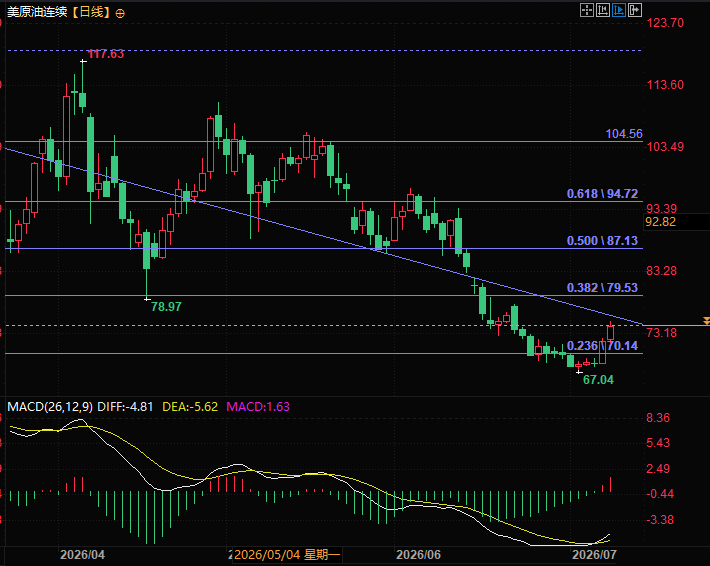
(WTI crude oil futures daily chart, source: EasyForex)
At 18:04 Beijing time, WTI crude oil futures were trading at $74.72 per barrel.
Iran unilaterally claims complete control over the Strait of Hormuz. In order to implement its maritime control claims, the Iranian Revolutionary Guard recently launched an attack on three ships passing through the strait via Omani waters.
Iran's move has a clear strategic purpose: to exert continuous pressure on the United States through maritime harassment and force the US to make more concessions in bilateral negotiations.
Within just 24 hours, geopolitical tensions in the Strait of Hormuz escalated rapidly, and market risk aversion directly pushed Brent crude oil prices to $76 per barrel.
The immediate trigger for this round of conflict was the Iranian Revolutionary Guard opening fire on three oil tankers attempting to sail out of Omani territorial waters south of the Strait of Hormuz.
Iran's opening of a maritime toll route, diverting shipping lanes from Oman, touches upon its core interests.
Before the escalation of the conflict between the US and Iran this year, in accordance with the established rules of separation of traffic of the International Maritime Organization, ships entering the Persian Gulf took the one-way channel on the south side of the strait, and ships leaving took the channel on the north side closer to Iran.
Due to their deep draft, most ocean-going oil tankers must strictly follow these two deep-water channels and cannot deviate from them at will.
Iran has now introduced new control rules, requiring all transit vessels to obtain a passage permit and pay the corresponding fees, otherwise passage will be prohibited.
The Iranian government has proposed a standard to charge each passing oil tanker a $2 million passage fee. If this fee mechanism is implemented, it could generate nearly $10 billion in stable revenue annually. However, opening the Omani side of the waterway to foreign shipping diverts shipping capacity and directly erodes this maritime revenue channel planned by Iran. This is the core reason why Iran has taken the initiative to attack ships in the Omani waterway.
Iran is adopting the low-intensity confrontation model used by Israel and Syria, with naval harassment becoming a bargaining chip in negotiations.
Beni Sabti, an Iranian geopolitical expert at the Israeli National Security Institute, pointed out that Iranian leaders are convinced that by relying on continued maritime pressure, they can extract more benefits from the United States at the negotiating table.
Ironically, Iran is now replicating the "war between wars" strategy that Israel used against Syria over the past decade. The core of this strategy is to avoid launching a full-scale declaration of war and a large-scale decisive battle, relying on long-term, low-intensity, and controllable sporadic strikes to continuously wear down the opponent.
Israel has consistently conducted precision airstrikes against Iranian military outposts and targeted eliminations of command personnel within Syria, maintaining control over the limits of conflict throughout. While engaging in confrontation, Israel has also preserved room for diplomatic maneuvering. Iran, on the other hand, has shifted the battleground to the sea, using tactics such as harassing merchant ships and unilaterally drawing red lines for maritime control as a means of exerting pressure, while consistently avoiding direct confrontation with US warships to prevent the conflict from spiraling out of control.
In Iran's view of sovereignty, any ship must obtain permission to pass through the Strait of Hormuz. The unrestricted opening of the Oman shipping lanes is tantamount to violating the implicit agreement between the two sides. Therefore, Iran has included the Strait of Hormuz and the entire Gulf of Oman under its jurisdiction and continues to create maritime friction to send probing signals.
Gulf oil-producing countries are in a state of panic, and crude oil exports have only partially recovered.
The ongoing maritime conflict has put all countries in the Gulf region on high alert, with Bahrain and Kuwait, which have long been frequently harassed by Iran, bearing the brunt of the pressure.
In June of this year, the situation eased briefly, and the frequency of military confrontations between the US and Iran decreased simultaneously. The total daily oil exports of the five countries of Iran, Saudi Arabia, the UAE, Kuwait, and Iraq exceeded 10 million barrels, an increase of more than 3 million barrels compared to May.
However, this recovery is only a temporary fix, and the overall oil export volume of the five countries is still 40% lower than the normal level before "Operation Lion's Roar".
Trump is constrained by the midterm elections, and the United States is making every effort to avoid a full-scale war.
The sudden escalation of geopolitical conflicts has put Trump in a policy dilemma as he heads to Ankara for the NATO summit. His current core focus is entirely on the US midterm elections in November.
Former Israeli Consul in New York, Yaki Dayan, analyzed that the United States has no intention of getting involved in a protracted, attrition-driven Middle East war and prefers to restart formal negotiations. Iran also accurately grasped Trump's timing, knowing that the US does not want to ignite a large-scale Middle East conflict before the election. Previously, Trump had successfully brought oil prices back to the stable range before the outbreak of the conflict by signing a memorandum of understanding with Iran.
Dayan stated that the midterm elections are Trump's highest priority right now, and the US government is doing everything it can to avoid the situation escalating into a full-scale war.
There is a possibility that the conflict could escalate again, but it is by no means the US's preferred option. The key variable going forward is whether Trump's aides can dissuade him from issuing a military strike order.
Reports from the scene indicate that Trump took a hard line when discussing the US-Iran memorandum of understanding at the NATO summit, which stipulated 60 days of consultations. He stated that the agreement was now worthless, that he was unwilling to engage in any further negotiations with Iran, and that the Iranian leadership was acting in an extreme manner, making bilateral negotiations a complete waste of time.
Geopolitical risks dominate crude oil pricing, and the situation in the Taiwan Strait will determine the future direction of oil prices.
From the perspective of the crude oil market, this round of conflict in the Taiwan Strait has directly increased the global geopolitical risk premium for crude oil.
The Strait of Hormuz carries over 30% of the world's seaborne crude oil. Attacks on ships would drive up shipping war insurance costs, and some ship owners would choose to take longer routes, which would indirectly lengthen the crude oil transportation cycle and tighten short-term spot supply.
The current market trading logic has shifted from traditional supply and demand data to expectations of geopolitical competition in the Middle East;
If Iran continues to escalate its maritime harassment, more oil tankers will be forced to detour, further fueling concerns about crude oil supply, and oil prices will still have room to rise. Conversely, if the US and Iran return to negotiations and maritime tensions ease, market risk premiums will quickly subside, and oil prices will fall accordingly.
(WTI crude oil futures daily chart, source: EasyForex)
At 18:04 Beijing time, WTI crude oil futures were trading at $74.72 per barrel.
- Risk Warning and Disclaimer
- The market involves risk, and trading may not be suitable for all investors. This article is for reference only and does not constitute personal investment advice, nor does it take into account certain users’ specific investment objectives, financial situation, or other needs. Any investment decisions made based on this information are at your own risk.