Big signal! US-Iran memorandum ends, gold rally over?
2026-07-08 16:39:44
On Wednesday (July 8) during the Asian and European sessions, spot gold initially resisted the negative news, but then experienced a significant pullback as the situation between the US and Iran deteriorated, currently down 0.5%, after rising as much as 0.5% during the session, trading around 4090.
Last night, the United States expressed a tough stance regarding the attack on three ships near the Oman shipping lanes. According to senior officials, the United States will revoke the general license for the sale of Iranian oil. As a result, gold prices plunged by more than 1% in the evening. Later this morning, the US military attacked Iran, but gold prices did not continue to fall but instead rose slightly. This is because Iran did not block the shipping lanes in the face of the US attack. The market believes that this is still a mutual test for negotiations and remains within the scope of negotiations.
However, US President Trump later said at the NATO summit on the 8th that he believed the US-Iran memorandum of understanding was "over," marking a major turning point in the US-Iran peace talks.
Previously, US officials made it clear that the provisional memorandum of understanding was contingent on Iran's continued cooperation. Iran's recent attacks on ships in the Strait of Hormuz have completely crossed the US's bottom line, making further sanctions inevitable.
However, the US negotiating team still maintains its willingness to negotiate and has not completely closed the window for negotiating a final agreement.
Meanwhile, a senior U.S. official issued a stern warning that if Iran continues to obstruct the passage of oil tankers and disrupt normal shipping in the Strait, the current fragile temporary ceasefire agreement may completely collapse.

According to Axios, the military strikes launched by the United States against Iran on Tuesday were four to five times larger in scale and intensity than the first strike ten days earlier, significantly escalating the punitive measures.
The U.S. Central Command stated that the core objective of this large-scale airstrike was to make Iran pay a substantial geopolitical price for its attacks on civilian merchant ships in key international shipping lanes.
The strike precisely targeted Iranian air defense radars and systems, as well as over sixty Iranian Revolutionary Guard's coastal assault boats. These small speedboats are the core operational vehicles for Iran's long-term harassment of international oil tankers and liquefied natural gas carriers in the Strait of Hormuz, and are also a key tool for its control over the waterway.
The US emphasized that the US military will maintain a high state of alert in the long term, and that it will continue to take punitive measures as long as Iran violates the ceasefire framework. It also confirmed that the current round of airstrikes has ended.
Iranian officials confirmed that their territory was hit by a US airstrike, but did not disclose specific figures on casualties or equipment damage.
Iranian state media simultaneously reported that massive explosions occurred at the three major coastal hubs of Bandar Abbas, Qeshm Island, and Sirik.
According to Iranian port workers, a fire broke out at a fishing wharf behind the fish market in Bandar Abbas, caused by a precise hit from enemy artillery. The fire spread and ignited several civilian fishing boats, causing damage to civilian facilities.
Subsequently, the Iranian Revolutionary Guard officially announced its retaliation, launching missile strikes against permanent US military bases in Bahrain and Kuwait.
Bahrain, home to the U.S. Navy's Fifth Fleet, and Kuwait, home to U.S. Army troops, immediately sounded missile and air defense alarms across their territories. Bahrain triggered air defense warnings three times in a row that morning, with regional risk aversion sentiment repeatedly rising and fluctuating dramatically.
The Iranian Revolutionary Guard issued a statement accusing the US military of unilaterally breaking the ceasefire agreement and the consensus reached in bilateral consultations in Islamabad, and wantonly launching airstrikes on Iranian coastal military and civilian facilities, which it described as terrorist military operations, while deliberately avoiding the core fact that the US had previously attacked merchant ships.
This round of confrontation is not accidental. In late last month, the Middle East witnessed a completely identical chain of conflict: Iran attacked ships, the US retaliated with airstrikes, and Iran retaliated against US military bases in Bahrain and Kuwait.
The key moment for the outbreak of this round of conflict coincided with Trump's trip to Türkiye to attend the NATO summit. The superposition of external geopolitical variables has made the situation in the Middle East even more complicated.
UAE senior diplomat Gargash publicly commented on the current situation, stating bluntly that Iran's repeated military strikes against Bahrain and Kuwait are sufficient proof that Tehran has no real intention to implement the terms of de-escalation and completely end the regional confrontation.
He emphasized that the Gulf Arab states cannot withstand Iran's indiscriminate attacks caused by its repeated vacillations between the two lines of conflict escalation and rational stability maintenance for long, and the regional stability has been continuously disrupted.
The UK maritime trade watchdog has released details of the attack on the merchant ships: a Qatari liquefied natural gas carrier was attacked and caught fire while sailing off the coast of Oman, while the other two vessels involved suffered only minor hull damage and no crew injuries. Both vessels subsequently continued their voyages along the Strait of Hormuz as normal.
Iranian state television responded, stating that the LNG carrier ignored prior navigational warnings issued by Iran and deliberately violated navigation rules, which led to the attack, but did not directly claim responsibility for the attack.
Since the outbreak of this round of Middle East conflict, Iran has maintained a firm grip on the discourse on shipping in the Strait of Hormuz, unilaterally designating the northern route of the strait as the only legal and safe waterway, and has repeatedly issued public warnings that all ships that detour around the southern coast of Oman will face the risk of military strikes. The three ships attacked this time all chose the Omani coastal route that is prohibited by Iran.
Qatari Foreign Ministry spokesman Ansari stated unequivocally that the attack on Qatar's LNG carrier "Al-Rekiat" was a heinous act that seriously disrupted international shipping order and impacted global energy security, and was completely unacceptable.
As a key mediator in the US-Iran negotiations, working with Pakistan, Qatar has made it clear that Iran must bear full legal responsibility for the illegal attack on the ship.
The temporary ceasefire memorandum previously reached between the US and Iran stipulated that the Strait of Hormuz would be open to free navigation for ships for sixty days.
However, Iran subsequently unilaterally put forward two hard demands: first, to have full control over the allocation of all shipping routes in the strait; and second, to levy passage fees on all transit vessels after the transition period ends.
This new set of rules will completely overturn the decades-old commercial practice of free navigation along this core global energy route.
In response to Iran's demands, the United States, together with the vast majority of Gulf Arab states, has formed a unified position, explicitly rejecting all of Iran's demands for transit fees in the Strait of Hormuz and monopolization of control over the waterway. The core differences between the two sides are difficult to bridge, sowing the seeds for continued conflict.
The Iranian Foreign Ministry also publicly stated that Iran's established passage arrangements in the Strait of Hormuz continue to be violated, and coupled with Israel's continued military strikes in Lebanon, multiple negative factors are constantly undermining the effectiveness of the temporary ceasefire agreement.
Yesterday's article on crude oil and gold mentioned that the US was likely to retaliate, and gold and oil prices would fluctuate. Gold prices subsequently corrected as expected, but the market did not react much in the morning. The fact that the Strait of Hormuz was not blocked again in the face of such a large-scale military attack by the US indicates that blocking the Strait is not in Iran's interest at present. The US and Iran are still in the framework of negotiations and have not yet overturned the table. Iran just hopes to take this opportunity to control the Strait.
Secondly, Federal Reserve Chairman Williams recently expressed a dovish view, which, combined with US domestic employment data and the market's general desensitization to the US-Iran war, is generally conducive to a rebound in gold prices.
But Trump's statement that the memorandum of understanding had ended directly punctured the market's fragile nerves.
Meanwhile, gold is generally in a downward trend, and with the situation between the US and Iran deteriorating beyond expectations, gold prices are still likely to bottom out or continue to fall.
We continue to focus on the Fed meeting minutes tomorrow morning. If the main logic behind the dot plot is strong employment, then the weaker-than-expected non-farm payroll data could directly change the FOMC's overall interest rate stance.
From a technical perspective, gold prices are still being suppressed by the downtrend line and the upper rail of the downtrend channel. If there is no clear positive progress between the US and Iran in the near future, gold prices will likely test the bottom again, with support around 4004 points.
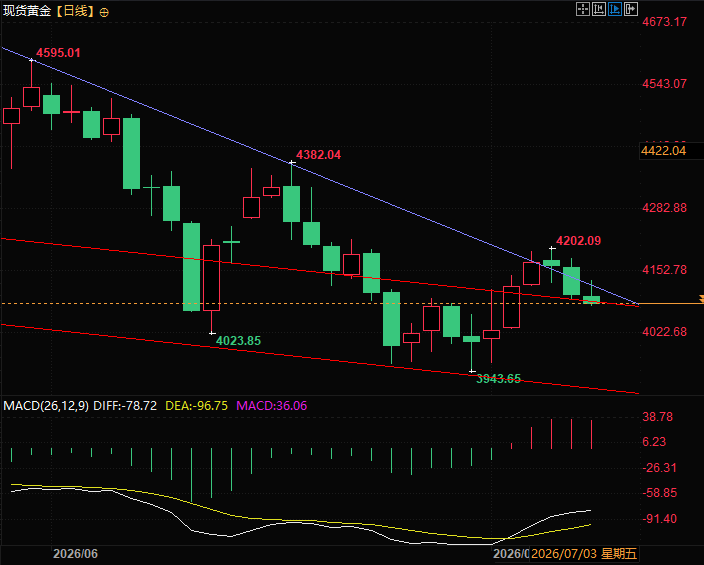
(Spot gold daily chart, source: FX678)
At 16:36 Beijing time, spot gold was trading at $4,074 per ounce.
Last night, the United States expressed a tough stance regarding the attack on three ships near the Oman shipping lanes. According to senior officials, the United States will revoke the general license for the sale of Iranian oil. As a result, gold prices plunged by more than 1% in the evening. Later this morning, the US military attacked Iran, but gold prices did not continue to fall but instead rose slightly. This is because Iran did not block the shipping lanes in the face of the US attack. The market believes that this is still a mutual test for negotiations and remains within the scope of negotiations.
However, US President Trump later said at the NATO summit on the 8th that he believed the US-Iran memorandum of understanding was "over," marking a major turning point in the US-Iran peace talks.
Previously, US officials made it clear that the provisional memorandum of understanding was contingent on Iran's continued cooperation. Iran's recent attacks on ships in the Strait of Hormuz have completely crossed the US's bottom line, making further sanctions inevitable.
However, the US negotiating team still maintains its willingness to negotiate and has not completely closed the window for negotiating a final agreement.
Meanwhile, a senior U.S. official issued a stern warning that if Iran continues to obstruct the passage of oil tankers and disrupt normal shipping in the Strait, the current fragile temporary ceasefire agreement may completely collapse.
The US military is escalating its strikes, targeting Iran's core naval forces precisely.
According to Axios, the military strikes launched by the United States against Iran on Tuesday were four to five times larger in scale and intensity than the first strike ten days earlier, significantly escalating the punitive measures.
The U.S. Central Command stated that the core objective of this large-scale airstrike was to make Iran pay a substantial geopolitical price for its attacks on civilian merchant ships in key international shipping lanes.
The strike precisely targeted Iranian air defense radars and systems, as well as over sixty Iranian Revolutionary Guard's coastal assault boats. These small speedboats are the core operational vehicles for Iran's long-term harassment of international oil tankers and liquefied natural gas carriers in the Strait of Hormuz, and are also a key tool for its control over the waterway.
The US emphasized that the US military will maintain a high state of alert in the long term, and that it will continue to take punitive measures as long as Iran violates the ceasefire framework. It also confirmed that the current round of airstrikes has ended.
Iran retaliates strongly, prompting air defense alerts in the waters of several countries.
Iranian officials confirmed that their territory was hit by a US airstrike, but did not disclose specific figures on casualties or equipment damage.
Iranian state media simultaneously reported that massive explosions occurred at the three major coastal hubs of Bandar Abbas, Qeshm Island, and Sirik.
According to Iranian port workers, a fire broke out at a fishing wharf behind the fish market in Bandar Abbas, caused by a precise hit from enemy artillery. The fire spread and ignited several civilian fishing boats, causing damage to civilian facilities.
Subsequently, the Iranian Revolutionary Guard officially announced its retaliation, launching missile strikes against permanent US military bases in Bahrain and Kuwait.
Bahrain, home to the U.S. Navy's Fifth Fleet, and Kuwait, home to U.S. Army troops, immediately sounded missile and air defense alarms across their territories. Bahrain triggered air defense warnings three times in a row that morning, with regional risk aversion sentiment repeatedly rising and fluctuating dramatically.
The Iranian Revolutionary Guard issued a statement accusing the US military of unilaterally breaking the ceasefire agreement and the consensus reached in bilateral consultations in Islamabad, and wantonly launching airstrikes on Iranian coastal military and civilian facilities, which it described as terrorist military operations, while deliberately avoiding the core fact that the US had previously attacked merchant ships.
The conflict is repeating itself, with several Gulf states expressing doubts about Iran's sincerity in seeking de-escalation.
This round of confrontation is not accidental. In late last month, the Middle East witnessed a completely identical chain of conflict: Iran attacked ships, the US retaliated with airstrikes, and Iran retaliated against US military bases in Bahrain and Kuwait.
The key moment for the outbreak of this round of conflict coincided with Trump's trip to Türkiye to attend the NATO summit. The superposition of external geopolitical variables has made the situation in the Middle East even more complicated.
UAE senior diplomat Gargash publicly commented on the current situation, stating bluntly that Iran's repeated military strikes against Bahrain and Kuwait are sufficient proof that Tehran has no real intention to implement the terms of de-escalation and completely end the regional confrontation.
He emphasized that the Gulf Arab states cannot withstand Iran's indiscriminate attacks caused by its repeated vacillations between the two lines of conflict escalation and rational stability maintenance for long, and the regional stability has been continuously disrupted.
Details of the attack on the ship revealed: Disagreements over navigation rules were the core of the conflict.
The UK maritime trade watchdog has released details of the attack on the merchant ships: a Qatari liquefied natural gas carrier was attacked and caught fire while sailing off the coast of Oman, while the other two vessels involved suffered only minor hull damage and no crew injuries. Both vessels subsequently continued their voyages along the Strait of Hormuz as normal.
Iranian state television responded, stating that the LNG carrier ignored prior navigational warnings issued by Iran and deliberately violated navigation rules, which led to the attack, but did not directly claim responsibility for the attack.
Since the outbreak of this round of Middle East conflict, Iran has maintained a firm grip on the discourse on shipping in the Strait of Hormuz, unilaterally designating the northern route of the strait as the only legal and safe waterway, and has repeatedly issued public warnings that all ships that detour around the southern coast of Oman will face the risk of military strikes. The three ships attacked this time all chose the Omani coastal route that is prohibited by Iran.
Qatari Foreign Ministry spokesman Ansari stated unequivocally that the attack on Qatar's LNG carrier "Al-Rekiat" was a heinous act that seriously disrupted international shipping order and impacted global energy security, and was completely unacceptable.
As a key mediator in the US-Iran negotiations, working with Pakistan, Qatar has made it clear that Iran must bear full legal responsibility for the illegal attack on the ship.
The ceasefire agreement reveals contradictions, and the core demands of both sides are difficult to reconcile.
The temporary ceasefire memorandum previously reached between the US and Iran stipulated that the Strait of Hormuz would be open to free navigation for ships for sixty days.
However, Iran subsequently unilaterally put forward two hard demands: first, to have full control over the allocation of all shipping routes in the strait; and second, to levy passage fees on all transit vessels after the transition period ends.
This new set of rules will completely overturn the decades-old commercial practice of free navigation along this core global energy route.
In response to Iran's demands, the United States, together with the vast majority of Gulf Arab states, has formed a unified position, explicitly rejecting all of Iran's demands for transit fees in the Strait of Hormuz and monopolization of control over the waterway. The core differences between the two sides are difficult to bridge, sowing the seeds for continued conflict.
The Iranian Foreign Ministry also publicly stated that Iran's established passage arrangements in the Strait of Hormuz continue to be violated, and coupled with Israel's continued military strikes in Lebanon, multiple negative factors are constantly undermining the effectiveness of the temporary ceasefire agreement.
Summary and Technical Analysis:
Yesterday's article on crude oil and gold mentioned that the US was likely to retaliate, and gold and oil prices would fluctuate. Gold prices subsequently corrected as expected, but the market did not react much in the morning. The fact that the Strait of Hormuz was not blocked again in the face of such a large-scale military attack by the US indicates that blocking the Strait is not in Iran's interest at present. The US and Iran are still in the framework of negotiations and have not yet overturned the table. Iran just hopes to take this opportunity to control the Strait.
Secondly, Federal Reserve Chairman Williams recently expressed a dovish view, which, combined with US domestic employment data and the market's general desensitization to the US-Iran war, is generally conducive to a rebound in gold prices.
But Trump's statement that the memorandum of understanding had ended directly punctured the market's fragile nerves.
Meanwhile, gold is generally in a downward trend, and with the situation between the US and Iran deteriorating beyond expectations, gold prices are still likely to bottom out or continue to fall.
We continue to focus on the Fed meeting minutes tomorrow morning. If the main logic behind the dot plot is strong employment, then the weaker-than-expected non-farm payroll data could directly change the FOMC's overall interest rate stance.
From a technical perspective, gold prices are still being suppressed by the downtrend line and the upper rail of the downtrend channel. If there is no clear positive progress between the US and Iran in the near future, gold prices will likely test the bottom again, with support around 4004 points.
(Spot gold daily chart, source: FX678)
At 16:36 Beijing time, spot gold was trading at $4,074 per ounce.
- Risk Warning and Disclaimer
- The market involves risk, and trading may not be suitable for all investors. This article is for reference only and does not constitute personal investment advice, nor does it take into account certain users’ specific investment objectives, financial situation, or other needs. Any investment decisions made based on this information are at your own risk.