The Bank of Japan's easing signals pressured the yen, pushing the pound/yen exchange rate close to the 217 level and challenging a record high.
2026-07-08 16:46:16
The pound continued its strong performance against the yen on Wednesday, gradually approaching the 217.00 level and testing the historical high near 217.22. The recent weakness of the yen has been a key factor driving the cross's rise, while internal disagreements within the Bank of Japan regarding further interest rate hikes have further weakened market confidence in the yen.
Bank of Japan board member Toichiro Asada previously stated that he needs to see evidence of demand-driven inflation before supporting further monetary tightening. He emphasized that he is not always opposed to interest rate hikes, but believes the current economic environment is insufficient to support sustained increases in interest rates. Asada is one of the latest appointees to the Bank of Japan's board of directors, nominated by Prime Minister Sanae Takaichi. Takaichi has repeatedly expressed her desire to maintain a low-interest-rate environment to promote economic growth. Therefore, the market believes that the official's remarks reflect ongoing disagreements within the Bank of Japan regarding the pace of policy normalization.
The Bank of Japan has already begun to gradually adjust its monetary policy direction, but if there are differing assessments internally regarding the sustainability of inflation and the drivers of economic growth, the market may lower its expectations for future interest rate hikes, thus continuing to suppress the yen's performance. Currently, the rise in the pound against the yen is mainly driven by two factors. On the one hand, cooling expectations for Japanese interest rates are putting pressure on the yen; on the other hand, the pound's recent relatively stable performance has allowed the currency pair to maintain its upward trend.
However, the GBP/JPY pair is a highly volatile cross-currency pair, heavily influenced by global risk sentiment. If market demand for safe-haven assets suddenly surges, the yen may find support due to its safe-haven status, thus limiting further appreciation. Currently, the market is focused on subsequent policy signals from the Bank of Japan, UK economic data, and changes in global risk sentiment. If the Bank of Japan releases clearer tightening signals, the yen may rebound; if its policy stance remains cautious, the GBP/JPY pair is likely to maintain its strength.
From a daily chart perspective, the GBP/JPY pair maintains an upward trend, with prices continuing to trade in a high-level area, and short-term moving averages still supporting the bulls. However, the current exchange rate is approaching the historical high of around 217.22, and there is some profit-taking pressure in the market. The MACD indicator remains bullish, indicating that the upward trend has not been broken. The key resistance level to watch is 217.22; a successful break above this level could open up further upside potential and test the 218.00 area. Support is seen around 216.00; a break below this level could lead to a pullback to the 214.70-214.80 area.
From a 4-hour chart perspective, the GBP/JPY pair remains strong in the short term, with limited price pullbacks and bulls controlling the market pace. The RSI indicator is around 66, indicating strong market momentum, but it's approaching high levels, requiring attention to the risk of a short-term correction. The MACD indicator hasn't shown a clear strengthening signal yet, meaning further upward movement requires confirmation from new catalysts. If the exchange rate breaks through 217.22, the short-term target could be 218.00; if the breakout fails, it may first retrace to the 216.00 support area.
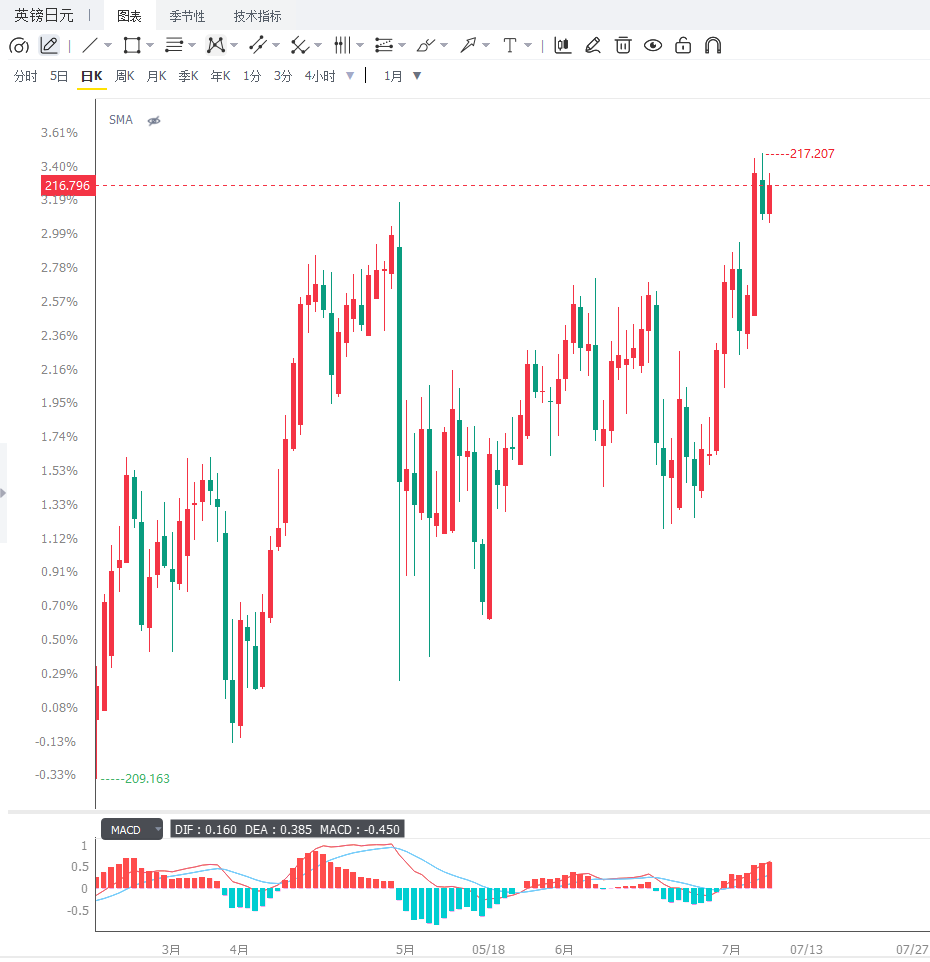
Editor's Summary : The recent rise in GBP/JPY has been primarily driven by cooling expectations regarding the Bank of Japan's policy stance, with the yen's weakness being the core factor behind the exchange rate's strength. Internal disagreements within the Bank of Japan regarding the pace of interest rate hikes have lowered market expectations for a rapid yen appreciation. In the short term, GBP/JPY remains in an uptrend, with the historical high of 217.22 being a key technical level. A break above this area could open up further upside potential; however, if the Bank of Japan releases a more hawkish policy signal, or if global risk aversion intensifies, the yen's rebound could bring downward pressure. Investors should pay close attention to the resistance zone of 217.00-217.22 and the support level of 216.00.
Bank of Japan board member Toichiro Asada previously stated that he needs to see evidence of demand-driven inflation before supporting further monetary tightening. He emphasized that he is not always opposed to interest rate hikes, but believes the current economic environment is insufficient to support sustained increases in interest rates. Asada is one of the latest appointees to the Bank of Japan's board of directors, nominated by Prime Minister Sanae Takaichi. Takaichi has repeatedly expressed her desire to maintain a low-interest-rate environment to promote economic growth. Therefore, the market believes that the official's remarks reflect ongoing disagreements within the Bank of Japan regarding the pace of policy normalization.
The Bank of Japan has already begun to gradually adjust its monetary policy direction, but if there are differing assessments internally regarding the sustainability of inflation and the drivers of economic growth, the market may lower its expectations for future interest rate hikes, thus continuing to suppress the yen's performance. Currently, the rise in the pound against the yen is mainly driven by two factors. On the one hand, cooling expectations for Japanese interest rates are putting pressure on the yen; on the other hand, the pound's recent relatively stable performance has allowed the currency pair to maintain its upward trend.
However, the GBP/JPY pair is a highly volatile cross-currency pair, heavily influenced by global risk sentiment. If market demand for safe-haven assets suddenly surges, the yen may find support due to its safe-haven status, thus limiting further appreciation. Currently, the market is focused on subsequent policy signals from the Bank of Japan, UK economic data, and changes in global risk sentiment. If the Bank of Japan releases clearer tightening signals, the yen may rebound; if its policy stance remains cautious, the GBP/JPY pair is likely to maintain its strength.
From a daily chart perspective, the GBP/JPY pair maintains an upward trend, with prices continuing to trade in a high-level area, and short-term moving averages still supporting the bulls. However, the current exchange rate is approaching the historical high of around 217.22, and there is some profit-taking pressure in the market. The MACD indicator remains bullish, indicating that the upward trend has not been broken. The key resistance level to watch is 217.22; a successful break above this level could open up further upside potential and test the 218.00 area. Support is seen around 216.00; a break below this level could lead to a pullback to the 214.70-214.80 area.
From a 4-hour chart perspective, the GBP/JPY pair remains strong in the short term, with limited price pullbacks and bulls controlling the market pace. The RSI indicator is around 66, indicating strong market momentum, but it's approaching high levels, requiring attention to the risk of a short-term correction. The MACD indicator hasn't shown a clear strengthening signal yet, meaning further upward movement requires confirmation from new catalysts. If the exchange rate breaks through 217.22, the short-term target could be 218.00; if the breakout fails, it may first retrace to the 216.00 support area.
Editor's Summary : The recent rise in GBP/JPY has been primarily driven by cooling expectations regarding the Bank of Japan's policy stance, with the yen's weakness being the core factor behind the exchange rate's strength. Internal disagreements within the Bank of Japan regarding the pace of interest rate hikes have lowered market expectations for a rapid yen appreciation. In the short term, GBP/JPY remains in an uptrend, with the historical high of 217.22 being a key technical level. A break above this area could open up further upside potential; however, if the Bank of Japan releases a more hawkish policy signal, or if global risk aversion intensifies, the yen's rebound could bring downward pressure. Investors should pay close attention to the resistance zone of 217.00-217.22 and the support level of 216.00.
- Risk Warning and Disclaimer
- The market involves risk, and trading may not be suitable for all investors. This article is for reference only and does not constitute personal investment advice, nor does it take into account certain users’ specific investment objectives, financial situation, or other needs. Any investment decisions made based on this information are at your own risk.