Gold prices rebounded above $4,100, influenced by the release of the Federal Reserve meeting minutes and the situation in the Strait of Hormuz, which pushed up US Treasury yields.
2026-07-09 22:07:34
Gold and silver prices rose ahead of the North American open on Thursday (July 9), as traders partially recovered losses from Wednesday's gold price decline. Meanwhile, US Treasury yields, the dollar index, and crude oil prices remained firm due to renewed tensions between the US and Iran. At the time of writing, spot gold was trading at $4,113.84 per ounce, up 0.88%; spot silver was near $59.39, up 1.80% on the day.

Gold traded between $4053.60 and $4121 per ounce in early trading, returning to the $4100 level but remaining capped by the $4162-$4214 resistance zone, which had previously suppressed further rebounds. Silver traded between $57.47 and $59.60 in early trading; after Wednesday's decline, silver stabilized but failed to break through the $60.00-$62.80 resistance zone.
Following the release of June's employment data last Thursday and the Fed's meeting minutes on Wednesday, market sentiment regarding gold holdings was highly divided. June's non-farm payrolls increased by only 57,000, with the unemployment rate remaining at 4.2%; the combined downward revisions for April and May's non-farm payrolls totaled 74,000. Initially, the employment data lowered market expectations for further Fed rate hikes in the near term, which was positive for gold. However, after the release of the Fed minutes, the market's focus shifted back to inflation risks: Fed officials held differing views on the future direction of interest rates, with 9 out of 18 policymakers believing the Fed would raise rates at least once more before December. The 10-year US Treasury yield was 4.579%, slightly lower than the 7-week high of 4.597% reached on Wednesday; the US dollar index (DXY) hovered around 100.96. The overall picture is that the cooling employment data provided support for gold prices, but persistently high US Treasury yields and the continued strength of the US dollar after the release of the minutes limited the upside potential for gold.
For the week ending July 4, initial jobless claims in the U.S. fell by 1,000 to 215,000, below market expectations of 220,000-225,000; continuing jobless claims totaled approximately 1.81 million. This data suggests limited corporate layoffs, but combined with last week's non-farm payrolls data of only 57,000 new jobs, the cooling of the U.S. job market is primarily reflected in slower hiring rather than large-scale layoffs.
The current situation in the Strait of Hormuz can be summarized as follows: ships can pass, but face military conflict and shipping risks; the strait is not completely blocked. Following a series of attacks on ships within the strait, the US launched a new round of airstrikes against Iran; Iran retaliated, striking targets in US allies Kuwait and Qatar. Brent crude briefly broke through $80 on Wednesday and is currently trading at around $78.66; West Texas Intermediate (WTI) crude is around $74.06. The situation has a dual impact on gold: continued geopolitical tensions in the Strait of Hormuz are driving safe-haven buying; however, rising oil prices are exacerbating inflation concerns, pushing up US Treasury yields, which in turn limits gold's upward movement. Looking at the overall market: crude oil is in demand, bonds are under pressure, stock markets are showing mixed performance, and the US dollar remains stable.
Traders are continuously interpreting the minutes of Wednesday's Federal Reserve meeting, closely watching the CPI inflation data released at 8:30 AM ET on July 14th, and further developments in the Strait of Hormuz. If Brent crude oil rises above $80 again, the market will once again focus on inflation concerns; only if employment data is weak or inflation falls will precious metals have sufficient room to continue their rebound.
Overview of external markets: WTI crude oil on the New York Mercantile Exchange is around $74.06 per barrel, and Brent crude oil is close to $78.66; the US dollar index remains at 100.96; the benchmark 10-year US Treasury yield is around 4.58%.
Technical Analysis
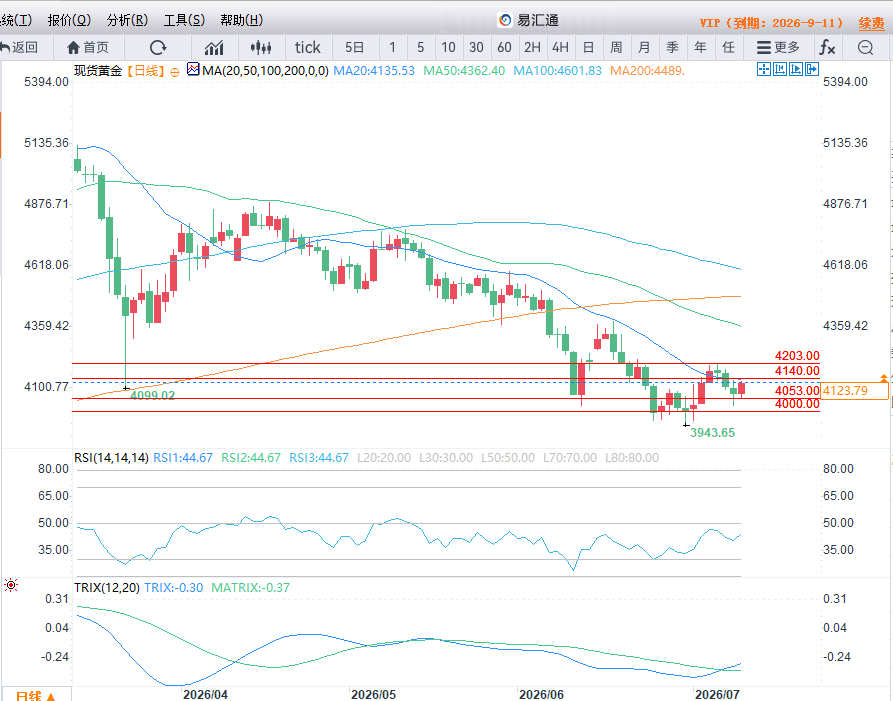
Gold: Gold prices are targeting $4140, with a subsequent test of $4203. The short-term bearish target is to break below $4000; deeper downside targets are $3959 and $3942. First resistance is at $4091, followed by $4103; first support is at $4053.60, with key support at $4000.
Silver: The bulls' target is to break through the $59.36-$62.81 range, and after stabilizing above that level, the target is $64, followed by a push towards $65. The bears' target is a break below $57, with further downside targets at $55.60 and even $50. The first resistance level is $59.36, followed by $62.81; the first support level is $57.47, and the next support level is $55.60.
Gold traded between $4053.60 and $4121 per ounce in early trading, returning to the $4100 level but remaining capped by the $4162-$4214 resistance zone, which had previously suppressed further rebounds. Silver traded between $57.47 and $59.60 in early trading; after Wednesday's decline, silver stabilized but failed to break through the $60.00-$62.80 resistance zone.
Following the release of June's employment data last Thursday and the Fed's meeting minutes on Wednesday, market sentiment regarding gold holdings was highly divided. June's non-farm payrolls increased by only 57,000, with the unemployment rate remaining at 4.2%; the combined downward revisions for April and May's non-farm payrolls totaled 74,000. Initially, the employment data lowered market expectations for further Fed rate hikes in the near term, which was positive for gold. However, after the release of the Fed minutes, the market's focus shifted back to inflation risks: Fed officials held differing views on the future direction of interest rates, with 9 out of 18 policymakers believing the Fed would raise rates at least once more before December. The 10-year US Treasury yield was 4.579%, slightly lower than the 7-week high of 4.597% reached on Wednesday; the US dollar index (DXY) hovered around 100.96. The overall picture is that the cooling employment data provided support for gold prices, but persistently high US Treasury yields and the continued strength of the US dollar after the release of the minutes limited the upside potential for gold.
For the week ending July 4, initial jobless claims in the U.S. fell by 1,000 to 215,000, below market expectations of 220,000-225,000; continuing jobless claims totaled approximately 1.81 million. This data suggests limited corporate layoffs, but combined with last week's non-farm payrolls data of only 57,000 new jobs, the cooling of the U.S. job market is primarily reflected in slower hiring rather than large-scale layoffs.
The current situation in the Strait of Hormuz can be summarized as follows: ships can pass, but face military conflict and shipping risks; the strait is not completely blocked. Following a series of attacks on ships within the strait, the US launched a new round of airstrikes against Iran; Iran retaliated, striking targets in US allies Kuwait and Qatar. Brent crude briefly broke through $80 on Wednesday and is currently trading at around $78.66; West Texas Intermediate (WTI) crude is around $74.06. The situation has a dual impact on gold: continued geopolitical tensions in the Strait of Hormuz are driving safe-haven buying; however, rising oil prices are exacerbating inflation concerns, pushing up US Treasury yields, which in turn limits gold's upward movement. Looking at the overall market: crude oil is in demand, bonds are under pressure, stock markets are showing mixed performance, and the US dollar remains stable.
Traders are continuously interpreting the minutes of Wednesday's Federal Reserve meeting, closely watching the CPI inflation data released at 8:30 AM ET on July 14th, and further developments in the Strait of Hormuz. If Brent crude oil rises above $80 again, the market will once again focus on inflation concerns; only if employment data is weak or inflation falls will precious metals have sufficient room to continue their rebound.
Overview of external markets: WTI crude oil on the New York Mercantile Exchange is around $74.06 per barrel, and Brent crude oil is close to $78.66; the US dollar index remains at 100.96; the benchmark 10-year US Treasury yield is around 4.58%.
Technical Analysis
Gold: Gold prices are targeting $4140, with a subsequent test of $4203. The short-term bearish target is to break below $4000; deeper downside targets are $3959 and $3942. First resistance is at $4091, followed by $4103; first support is at $4053.60, with key support at $4000.
Silver: The bulls' target is to break through the $59.36-$62.81 range, and after stabilizing above that level, the target is $64, followed by a push towards $65. The bears' target is a break below $57, with further downside targets at $55.60 and even $50. The first resistance level is $59.36, followed by $62.81; the first support level is $57.47, and the next support level is $55.60.
- Risk Warning and Disclaimer
- The market involves risk, and trading may not be suitable for all investors. This article is for reference only and does not constitute personal investment advice, nor does it take into account certain users’ specific investment objectives, financial situation, or other needs. Any investment decisions made based on this information are at your own risk.