Reserve Bank of New Zealand's "further tightening" policy versus internal divisions within the Federal Reserve; New Zealand dollar rises for the third consecutive day, hitting a three-week high.
2026-07-10 11:31:59
On Friday (July 10) during the Asian session, the New Zealand dollar saw strong follow-up buying against the US dollar for the third consecutive trading day, continuing its upward momentum following the Reserve Bank of New Zealand's interest rate hike. As of 11:30, it had risen as much as 0.68% to reach 0.5792, a new high since June 18.
The New Zealand dollar's strength was supported by multiple positive factors: the Reserve Bank of New Zealand's hawkish outlook following its 25 basis point increase in the official cash rate to 2.50% on Wednesday continued to provide underlying support for the New Zealand dollar; the US dollar index fell to a new low for the week after the Fed minutes revealed internal divisions among policymakers, further boosting the New Zealand dollar; in addition, Trump's claim on Thursday that Iran had called to seek a deal with the United States eased geopolitical risk aversion, further weakening safe-haven buying of the US dollar.
With multiple positive factors converging, the New Zealand dollar is maintaining a positive short-term trend against the US dollar.

The New Zealand dollar's recent strength began with the Reserve Bank of New Zealand's interest rate decision on Wednesday. As widely expected, the Reserve Bank of New Zealand raised the official cash rate by 25 basis points to 2.50%, the first rate hike since May 2023.
More importantly, the central bank explicitly stated in its statement that "further reduction in monetary stimulus may be necessary" to curb inflationary pressures.
This forward guidance was more hawkish than some market participants had expected. Although institutions such as MUFG believed that the Reserve Bank of New Zealand's communication tone was generally dovish, the phrase "further reduction in stimulus" itself provided structural support for the New Zealand dollar.
The market is currently pricing in a cumulative interest rate hike of approximately 85 basis points over the next 12 months, which means there is still more to the New Zealand dollar in terms of interest rate differentials.
Coupled with similar hawkish signals released by the Reserve Bank of Australia this week—Assistant Governor Hunt warned that further tightening might be needed if oil price shocks push up inflation expectations—the hawkish policy tone of the two major central banks in Oceania is providing regional buying support for the Australian and New Zealand dollars.
In contrast to the Reserve Bank of New Zealand’s hawkish tone, there is relative uncertainty about the Federal Reserve’s policy outlook.
The minutes of the June 16-17 FOMC meeting, released Wednesday, showed that policymakers were divided on the direction of interest rates – many participants said the appropriate level for the federal funds rate would be within or slightly below the current target range by the end of the year.
This statement confirms the existence of a significant "wait-and-see" or "dovish" camp within the Federal Reserve.
As a result, the US dollar index fell to a new low for the week. The dollar index, which measures the dollar's performance against a basket of currencies, weakened on Thursday, providing additional upward momentum for the New Zealand dollar against the US dollar.
Furthermore, while the overall US economic data released on Thursday was positive (initial jobless claims were better than expected), it failed to reverse the overall weakness of the US dollar, further confirming that market disagreements on the Fed's policy path are weakening the dollar's one-sided narrative.
Geopolitically, the escalation of the conflict between the US and Iran earlier this week briefly fueled risk aversion in the markets. The US launched a new round of strikes against Iran in retaliation for Iranian attacks on merchant ships in the Strait of Hormuz, while Iran responded by striking US targets in Bahrain and Kuwait. This escalation briefly boosted safe-haven buying of the US dollar.
However, Trump's statement on Thursday that Iran had called seeking a deal with the United States eased geopolitical tensions. The waning of safe-haven demand further weakened buying support for the US dollar, providing additional upward momentum for the New Zealand dollar against the US dollar. As the material points out, "market anxiety has subsided," which indirectly confirms that geopolitical factors are shifting from being "negative for the New Zealand dollar" to "positive for the New Zealand dollar."
From a fundamental perspective, the New Zealand dollar is currently supported by several factors: the Reserve Bank of New Zealand's hawkish outlook, internal divisions within the Federal Reserve and a weakening dollar, as well as marginal changes in geopolitical risk premiums. With a light US economic data schedule on Friday, the exchange rate is likely to be primarily driven by speeches from FOMC members and news related to the Middle East situation.
From a technical perspective, if the New Zealand dollar can effectively hold above 0.5780, the next target will be the psychological level of 0.5800. On the downside, 0.5750 has become a recent support level; a break below this level could lead to a retest of the 0.5700 area.
However, risk factors also need to be considered. If a substantial diplomatic breakthrough occurs between the US and Iran, the further waning of safe-haven demand could indirectly affect the New Zealand dollar by influencing the US dollar.
Furthermore, if the US CPI data next week is stronger than expected, it could reignite expectations of a Fed rate hike and reverse the current trend of a weakening dollar.
In the current environment, the New Zealand dollar's performance will continue to be highly dependent on the divergence in global central bank policies and the evolution of geopolitical situations.
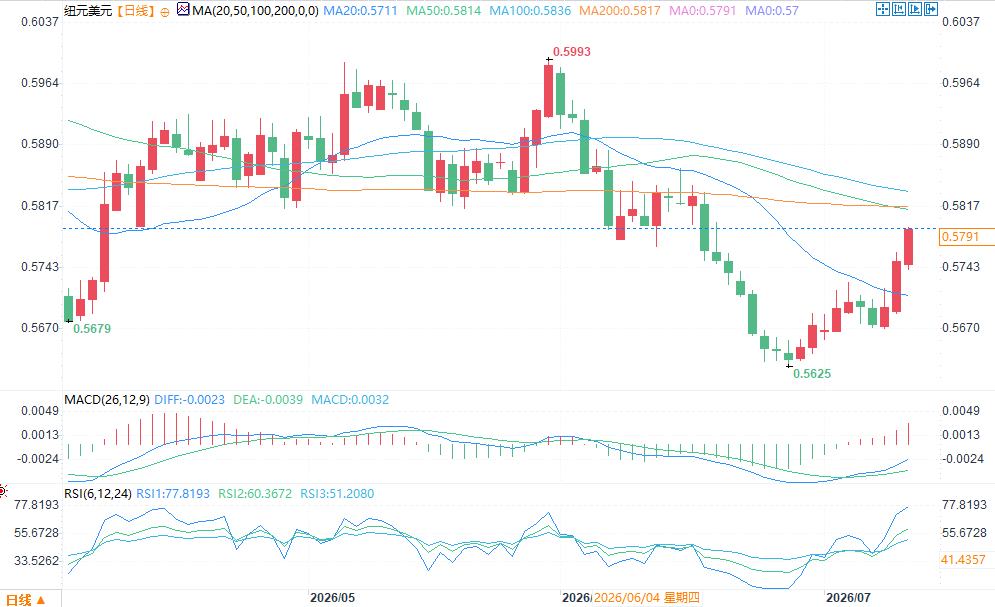
(NZD/USD daily chart, source: FX678)
At 11:31 Beijing time on July 10, the New Zealand dollar was trading at 0.5787/88 against the US dollar.
The New Zealand dollar's strength was supported by multiple positive factors: the Reserve Bank of New Zealand's hawkish outlook following its 25 basis point increase in the official cash rate to 2.50% on Wednesday continued to provide underlying support for the New Zealand dollar; the US dollar index fell to a new low for the week after the Fed minutes revealed internal divisions among policymakers, further boosting the New Zealand dollar; in addition, Trump's claim on Thursday that Iran had called to seek a deal with the United States eased geopolitical risk aversion, further weakening safe-haven buying of the US dollar.
With multiple positive factors converging, the New Zealand dollar is maintaining a positive short-term trend against the US dollar.
The Reserve Bank of New Zealand's hawkish outlook continues to support the New Zealand dollar.
The New Zealand dollar's recent strength began with the Reserve Bank of New Zealand's interest rate decision on Wednesday. As widely expected, the Reserve Bank of New Zealand raised the official cash rate by 25 basis points to 2.50%, the first rate hike since May 2023.
More importantly, the central bank explicitly stated in its statement that "further reduction in monetary stimulus may be necessary" to curb inflationary pressures.
This forward guidance was more hawkish than some market participants had expected. Although institutions such as MUFG believed that the Reserve Bank of New Zealand's communication tone was generally dovish, the phrase "further reduction in stimulus" itself provided structural support for the New Zealand dollar.
The market is currently pricing in a cumulative interest rate hike of approximately 85 basis points over the next 12 months, which means there is still more to the New Zealand dollar in terms of interest rate differentials.
Coupled with similar hawkish signals released by the Reserve Bank of Australia this week—Assistant Governor Hunt warned that further tightening might be needed if oil price shocks push up inflation expectations—the hawkish policy tone of the two major central banks in Oceania is providing regional buying support for the Australian and New Zealand dollars.
A weaker US dollar provided additional support for the New Zealand dollar.
In contrast to the Reserve Bank of New Zealand’s hawkish tone, there is relative uncertainty about the Federal Reserve’s policy outlook.
The minutes of the June 16-17 FOMC meeting, released Wednesday, showed that policymakers were divided on the direction of interest rates – many participants said the appropriate level for the federal funds rate would be within or slightly below the current target range by the end of the year.
This statement confirms the existence of a significant "wait-and-see" or "dovish" camp within the Federal Reserve.
As a result, the US dollar index fell to a new low for the week. The dollar index, which measures the dollar's performance against a basket of currencies, weakened on Thursday, providing additional upward momentum for the New Zealand dollar against the US dollar.
Furthermore, while the overall US economic data released on Thursday was positive (initial jobless claims were better than expected), it failed to reverse the overall weakness of the US dollar, further confirming that market disagreements on the Fed's policy path are weakening the dollar's one-sided narrative.
Geopolitics: Trump says Iran seeks deal, easing safe-haven demand and putting pressure on the dollar.
Geopolitically, the escalation of the conflict between the US and Iran earlier this week briefly fueled risk aversion in the markets. The US launched a new round of strikes against Iran in retaliation for Iranian attacks on merchant ships in the Strait of Hormuz, while Iran responded by striking US targets in Bahrain and Kuwait. This escalation briefly boosted safe-haven buying of the US dollar.
However, Trump's statement on Thursday that Iran had called seeking a deal with the United States eased geopolitical tensions. The waning of safe-haven demand further weakened buying support for the US dollar, providing additional upward momentum for the New Zealand dollar against the US dollar. As the material points out, "market anxiety has subsided," which indirectly confirms that geopolitical factors are shifting from being "negative for the New Zealand dollar" to "positive for the New Zealand dollar."
Outlook: Fundamentals remain supportive, but the risk of a short-term pullback should be noted.
From a fundamental perspective, the New Zealand dollar is currently supported by several factors: the Reserve Bank of New Zealand's hawkish outlook, internal divisions within the Federal Reserve and a weakening dollar, as well as marginal changes in geopolitical risk premiums. With a light US economic data schedule on Friday, the exchange rate is likely to be primarily driven by speeches from FOMC members and news related to the Middle East situation.
From a technical perspective, if the New Zealand dollar can effectively hold above 0.5780, the next target will be the psychological level of 0.5800. On the downside, 0.5750 has become a recent support level; a break below this level could lead to a retest of the 0.5700 area.
However, risk factors also need to be considered. If a substantial diplomatic breakthrough occurs between the US and Iran, the further waning of safe-haven demand could indirectly affect the New Zealand dollar by influencing the US dollar.
Furthermore, if the US CPI data next week is stronger than expected, it could reignite expectations of a Fed rate hike and reverse the current trend of a weakening dollar.
In the current environment, the New Zealand dollar's performance will continue to be highly dependent on the divergence in global central bank policies and the evolution of geopolitical situations.
(NZD/USD daily chart, source: FX678)
At 11:31 Beijing time on July 10, the New Zealand dollar was trading at 0.5787/88 against the US dollar.
- Risk Warning and Disclaimer
- The market involves risk, and trading may not be suitable for all investors. This article is for reference only and does not constitute personal investment advice, nor does it take into account certain users’ specific investment objectives, financial situation, or other needs. Any investment decisions made based on this information are at your own risk.