The fluctuating US-Iran tensions supported a rebound in the US dollar, while the British pound rose and then fell back against the dollar.
2026-07-13 13:22:55
During Monday's Asian trading session, the British pound gradually stabilized against the US dollar after a gap-down opening at the start of the week, finding support around 1.3380 . However, the overall rebound remained limited, failing to regain the 1.3400 level. Previously, the pound had risen to around 1.3450 , a near four-week high, but retreated somewhat as safe-haven demand for the dollar increased.
Changes in the UK's domestic political landscape have provided some support for the pound. Recent news indicates that former Greater Manchester Mayor Andy Burnham has secured the support of a majority of Labour MPs and is poised to succeed Keir Starmer as the next British Prime Minister. The market believes this development will help alleviate previous concerns about political uncertainty in the UK, boost investor confidence in the continuity of UK economic policies, and thus improve the overall performance of the pound.
Meanwhile, the market still expects the Bank of England to implement at least one 25 basis point rate hike before the end of 2026. The resilience of UK inflationary pressures, coupled with relatively stable wage growth, leads the market to believe that the Bank of England will maintain a tight monetary policy in the short term, which is one of the key reasons why the pound has remained relatively strong recently.
However, external factors continue to exert significant downward pressure on the pound. The escalating military conflict between the US and Iran has rapidly increased risk aversion in the market. Market surveys indicate that the US military has launched another military strike against Iranian targets, while Iran has announced the closure of the Strait of Hormuz and launched a new round of attacks on transit merchant ships and US military bases in the Middle East, leading to a significant decline in risk appetite in global financial markets.
The Strait of Hormuz handles approximately 20% of global seaborne crude oil shipments , and the deteriorating situation has pushed international oil prices even higher. Rising energy prices have reignited market concerns about global inflation and reinforced expectations that the Federal Reserve will maintain high interest rates for an extended period. As a traditional safe-haven asset, the US dollar has seen inflows, keeping US Treasury yields high and putting downward pressure on the pound against the dollar.
From a market perspective, Monday saw a lack of major economic data releases from both the UK and the US, with short-term exchange rate movements driven more by the dollar's performance and geopolitical news. During the North American session, speeches by several Federal Reserve officials are expected to provide new policy signals, with investors seeking further clues about the future path of interest rates.
The most important event affecting the market this week remains the upcoming release of the US June Consumer Price Index (CPI) . If the inflation data falls short of market expectations, it could weaken the dollar and increase market expectations of a slowdown in the Federal Reserve's tightening policy, thereby pushing the pound sterling stronger against the dollar. Conversely, if the inflation data continues to be strong, the dollar is likely to continue its upward trend, and the pound sterling may still face further downward pressure against the dollar.
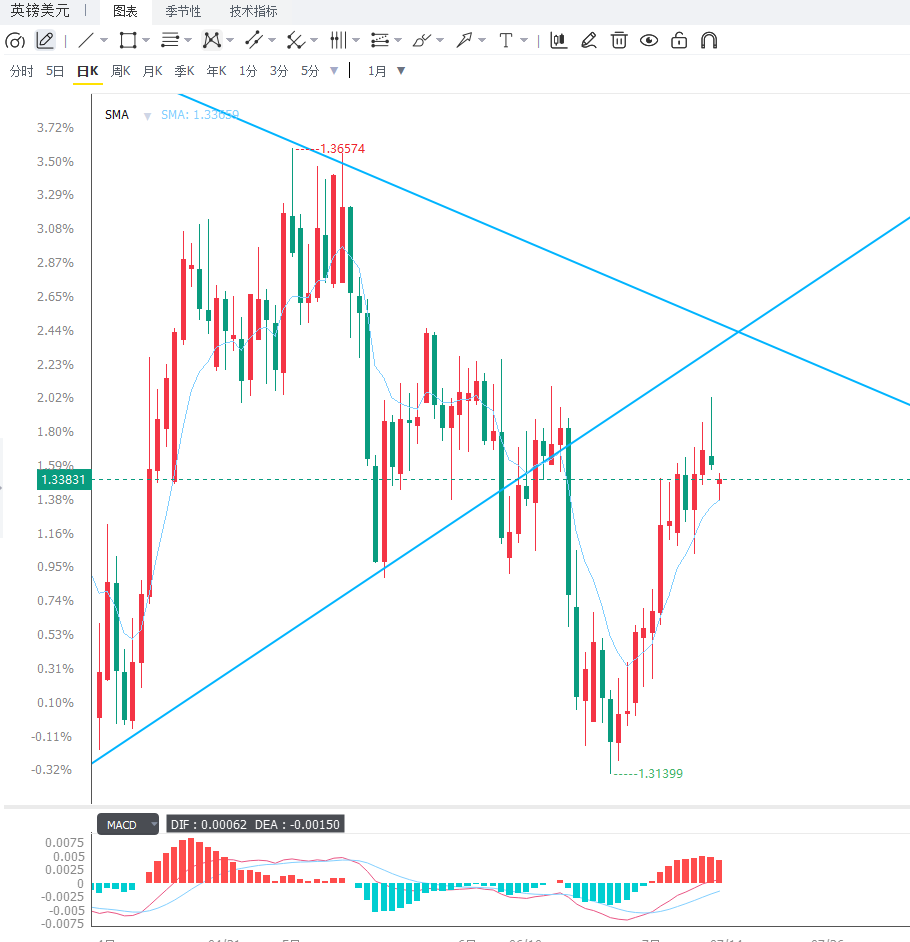
From a technical perspective, the GBP/USD pair maintains a slightly bullish structure on the daily chart. After a pullback, the exchange rate is still trading near the medium- to long-term moving averages, and the bullish trend has not been significantly broken. Although the MACD indicator's red bars have shortened, the two lines are still above the zero line, indicating that medium-term upward momentum remains. The RSI has fallen back to the neutral-to-strong zone, reflecting a slight cooling of short-term bullish strength. If the exchange rate regains a foothold above 1.3400 , it is expected to challenge the resistance areas of 1.3450 and 1.3500 again. On the downside, key support levels to watch are 1.3370 and 1.3320 . A break below these levels could lead to a further decline to around 1.3280 .
From a 4-hour chart perspective, the GBP/USD pair has entered a short-term consolidation phase, with the price fluctuating around the short-term moving average. The MACD is hovering near the zero line, and the RSI remains around 50, indicating a relatively balanced market sentiment. If US CPI data pushes the dollar lower, the pair could break through 1.3400 and continue its rebound. If the dollar continues to be supported by safe-haven buying, the GBP/USD pair may continue to test the 1.3370-1.3320 support zone, with short-term volatility expected to increase.
Editor's Summary : Improved expectations regarding the UK political situation and the possibility of further tightening by the Bank of England have provided some fundamental support for the pound. However, safe-haven demand stemming from the escalating US-Iran conflict, rising international oil prices, and expectations of high interest rates from the Federal Reserve remain key factors supporting the US dollar, limiting the pound's upside potential against the dollar. In the coming days, US June CPI data, statements from Federal Reserve officials, and developments in the Middle East will remain the core variables influencing exchange rate movements. If US inflationary pressures ease, the pound is expected to resume its upward trend against the dollar; conversely, a strong dollar may cause the exchange rate to continue its high-level, slightly weak, and volatile trading.
Changes in the UK's domestic political landscape have provided some support for the pound. Recent news indicates that former Greater Manchester Mayor Andy Burnham has secured the support of a majority of Labour MPs and is poised to succeed Keir Starmer as the next British Prime Minister. The market believes this development will help alleviate previous concerns about political uncertainty in the UK, boost investor confidence in the continuity of UK economic policies, and thus improve the overall performance of the pound.
Meanwhile, the market still expects the Bank of England to implement at least one 25 basis point rate hike before the end of 2026. The resilience of UK inflationary pressures, coupled with relatively stable wage growth, leads the market to believe that the Bank of England will maintain a tight monetary policy in the short term, which is one of the key reasons why the pound has remained relatively strong recently.
However, external factors continue to exert significant downward pressure on the pound. The escalating military conflict between the US and Iran has rapidly increased risk aversion in the market. Market surveys indicate that the US military has launched another military strike against Iranian targets, while Iran has announced the closure of the Strait of Hormuz and launched a new round of attacks on transit merchant ships and US military bases in the Middle East, leading to a significant decline in risk appetite in global financial markets.
The Strait of Hormuz handles approximately 20% of global seaborne crude oil shipments , and the deteriorating situation has pushed international oil prices even higher. Rising energy prices have reignited market concerns about global inflation and reinforced expectations that the Federal Reserve will maintain high interest rates for an extended period. As a traditional safe-haven asset, the US dollar has seen inflows, keeping US Treasury yields high and putting downward pressure on the pound against the dollar.
From a market perspective, Monday saw a lack of major economic data releases from both the UK and the US, with short-term exchange rate movements driven more by the dollar's performance and geopolitical news. During the North American session, speeches by several Federal Reserve officials are expected to provide new policy signals, with investors seeking further clues about the future path of interest rates.
The most important event affecting the market this week remains the upcoming release of the US June Consumer Price Index (CPI) . If the inflation data falls short of market expectations, it could weaken the dollar and increase market expectations of a slowdown in the Federal Reserve's tightening policy, thereby pushing the pound sterling stronger against the dollar. Conversely, if the inflation data continues to be strong, the dollar is likely to continue its upward trend, and the pound sterling may still face further downward pressure against the dollar.
From a technical perspective, the GBP/USD pair maintains a slightly bullish structure on the daily chart. After a pullback, the exchange rate is still trading near the medium- to long-term moving averages, and the bullish trend has not been significantly broken. Although the MACD indicator's red bars have shortened, the two lines are still above the zero line, indicating that medium-term upward momentum remains. The RSI has fallen back to the neutral-to-strong zone, reflecting a slight cooling of short-term bullish strength. If the exchange rate regains a foothold above 1.3400 , it is expected to challenge the resistance areas of 1.3450 and 1.3500 again. On the downside, key support levels to watch are 1.3370 and 1.3320 . A break below these levels could lead to a further decline to around 1.3280 .
From a 4-hour chart perspective, the GBP/USD pair has entered a short-term consolidation phase, with the price fluctuating around the short-term moving average. The MACD is hovering near the zero line, and the RSI remains around 50, indicating a relatively balanced market sentiment. If US CPI data pushes the dollar lower, the pair could break through 1.3400 and continue its rebound. If the dollar continues to be supported by safe-haven buying, the GBP/USD pair may continue to test the 1.3370-1.3320 support zone, with short-term volatility expected to increase.
Editor's Summary : Improved expectations regarding the UK political situation and the possibility of further tightening by the Bank of England have provided some fundamental support for the pound. However, safe-haven demand stemming from the escalating US-Iran conflict, rising international oil prices, and expectations of high interest rates from the Federal Reserve remain key factors supporting the US dollar, limiting the pound's upside potential against the dollar. In the coming days, US June CPI data, statements from Federal Reserve officials, and developments in the Middle East will remain the core variables influencing exchange rate movements. If US inflationary pressures ease, the pound is expected to resume its upward trend against the dollar; conversely, a strong dollar may cause the exchange rate to continue its high-level, slightly weak, and volatile trading.
- Risk Warning and Disclaimer
- The market involves risk, and trading may not be suitable for all investors. This article is for reference only and does not constitute personal investment advice, nor does it take into account certain users’ specific investment objectives, financial situation, or other needs. Any investment decisions made based on this information are at your own risk.