The yield on two-year US Treasury bonds plummeted; why did the July rate hike suddenly lose its support?
2026-07-14 21:30:13
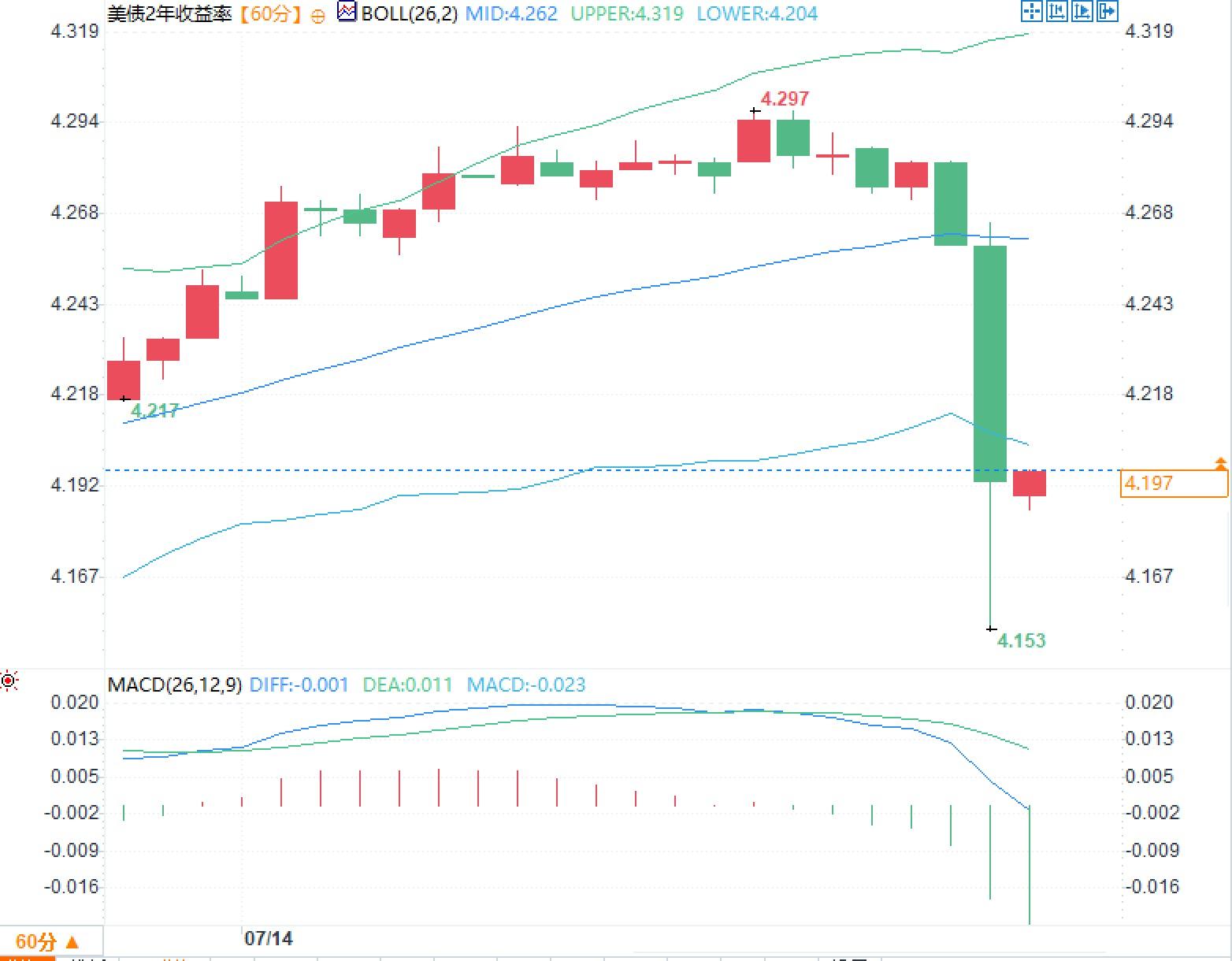
On Tuesday, July 14th, the US interest rate market experienced a typical inflation surprise repricing. After the June Consumer Price Index (CPI) fell significantly below expectations, the yield on the two-year US Treasury note fell by about 10 basis points to around 4.19%, while the ten-year yield dropped to about 4.56%, compressing the probability of a July rate hike from about 41% to less than 20%. The core of the market reaction was not a sudden improvement in risk appetite, but rather a rapid downward revision of the short-term policy interest rate path. The June CPI fell 0.4% month-on-month, the largest monthly decline since April 2020, and the year-on-year increase fell to 3.5% from 4.2% in May. The core CPI, excluding food and energy, remained flat month-on-month, and the year-on-year increase fell to 2.6% from 2.9%. Energy prices fell 5.7% month-on-month, with gasoline prices falling 9.7%, clearly the main driver of the overall index decline. What truly changed interest rate market pricing was the cooling of the core structure as well. Housing costs rose by only 0.1%, the smallest monthly increase since January 2021; service prices excluding energy remained flat month-on-month, while prices for used cars, clothing, motor vehicle insurance, and medical services all declined to varying degrees. This means that the June data was not entirely dependent on lower oil prices, and sticky service inflation has temporarily lost its upward momentum. However, energy prices still rose 15.7% year-on-year, and food prices rose 3.0% year-on-year, indicating that inflationary pressures have only shifted from a general rise to structural differentiation, and it is not yet possible to confirm that inflation has re-entered a stable downward trend.  The Federal Reserve's current policy rate target range is 3.50% to 3.75%, and the next policy meeting will be held on July 28-29. Chairman Kevin Warsh emphasized in his congressional testimony on July 14 that there is no room for persistently high inflation and that price stability remains at the core of policy. Previously, Governor Christopher Waller stated that several consecutive months of declining core inflation are needed, as single-month data is insufficient to confirm a trend. Therefore, the more accurate policy implication of this data is that the recent case for raising interest rates has weakened, rather than a restart of the easing cycle. The significant improvement in the core consumer price index in June directly negates the high inflation evidence needed for immediate tightening at the July meeting. However, the core personal consumption expenditures price index still rose 3.4% year-on-year in May, and the overall personal consumption expenditures price index rose 4.1%, both above the 2% target. The policy benchmark has shifted from "whether to raise interest rates immediately" to "how long to maintain high interest rates," which is fundamentally different from directly betting on a rate cut. After the data release, the two-year yield fell more than the ten-year yield, and the yield curve steepened in a bull market. Short-term yields primarily trade the probability of policy changes at the next few meetings, making them most sensitive to unexpected core inflation. Long-term yields, in addition to policy rates, also take into account energy price fluctuations, government bond supply, fiscal financing needs, and term premiums. Even though the probability of a rate hike in July has fallen rapidly, long-term yields have remained above 4.5%, indicating that the market has not simultaneously lowered its medium- to long-term inflation compensation and capital costs.
  This structure also has relatively restrained implications for other assets. The US dollar is under pressure from narrowing short-term interest rate differentials, and stock valuations have received some interest rate buffer, but the long-term discount rate has not decreased by the same magnitude, and the corporate financing environment has not undergone a directional reversal. This market movement is more akin to a squeeze on positions and the fading of policy tail risks, rather than a complete shift in the macro pricing framework. The June producer price index, to be released on July 15, will test whether upstream costs are cooling in tandem with consumer prices. The June personal consumption expenditure price index, to be released on July 30, is a more direct indicator for the Federal Reserve to judge inflation trends. If producer prices remain high and energy prices rise again, the cooling of consumer prices in June may be seen as a temporary fluctuation; only if core production costs and core personal consumption expenditure prices fall simultaneously will the market likely further reduce the premium for a rate hike this year. In the short term, the key variable is not whether a single data point is low, but whether the transmission of housing, core services, goods costs, and energy can slow down together for two to three consecutive months. For the interest rate market, the most important change has already occurred: an immediate rate hike in July is no longer the baseline scenario, but there is still a lack of downward signals regarding the duration of high interest rates.
The Federal Reserve's current policy rate target range is 3.50% to 3.75%, and the next policy meeting will be held on July 28-29. Chairman Kevin Warsh emphasized in his congressional testimony on July 14 that there is no room for persistently high inflation and that price stability remains at the core of policy. Previously, Governor Christopher Waller stated that several consecutive months of declining core inflation are needed, as single-month data is insufficient to confirm a trend. Therefore, the more accurate policy implication of this data is that the recent case for raising interest rates has weakened, rather than a restart of the easing cycle. The significant improvement in the core consumer price index in June directly negates the high inflation evidence needed for immediate tightening at the July meeting. However, the core personal consumption expenditures price index still rose 3.4% year-on-year in May, and the overall personal consumption expenditures price index rose 4.1%, both above the 2% target. The policy benchmark has shifted from "whether to raise interest rates immediately" to "how long to maintain high interest rates," which is fundamentally different from directly betting on a rate cut. After the data release, the two-year yield fell more than the ten-year yield, and the yield curve steepened in a bull market. Short-term yields primarily trade the probability of policy changes at the next few meetings, making them most sensitive to unexpected core inflation. Long-term yields, in addition to policy rates, also take into account energy price fluctuations, government bond supply, fiscal financing needs, and term premiums. Even though the probability of a rate hike in July has fallen rapidly, long-term yields have remained above 4.5%, indicating that the market has not simultaneously lowered its medium- to long-term inflation compensation and capital costs. This structure also has relatively restrained implications for other assets. The US dollar is under pressure from narrowing short-term interest rate differentials, and stock valuations have received some interest rate buffer, but the long-term discount rate has not decreased by the same magnitude, and the corporate financing environment has not undergone a directional reversal. This market movement is more akin to a squeeze on positions and the fading of policy tail risks, rather than a complete shift in the macro pricing framework. The June producer price index, to be released on July 15, will test whether upstream costs are cooling in tandem with consumer prices. The June personal consumption expenditure price index, to be released on July 30, is a more direct indicator for the Federal Reserve to judge inflation trends. If producer prices remain high and energy prices rise again, the cooling of consumer prices in June may be seen as a temporary fluctuation; only if core production costs and core personal consumption expenditure prices fall simultaneously will the market likely further reduce the premium for a rate hike this year. In the short term, the key variable is not whether a single data point is low, but whether the transmission of housing, core services, goods costs, and energy can slow down together for two to three consecutive months. For the interest rate market, the most important change has already occurred: an immediate rate hike in July is no longer the baseline scenario, but there is still a lack of downward signals regarding the duration of high interest rates.
- Risk Warning and Disclaimer
- The market involves risk, and trading may not be suitable for all investors. This article is for reference only and does not constitute personal investment advice, nor does it take into account certain users’ specific investment objectives, financial situation, or other needs. Any investment decisions made based on this information are at your own risk.