Crude Oil Trading Alert: Supported by easing US inflation and supply-side concerns, oil prices continue to rise, awaiting stress tests.
2026-07-15 09:28:11
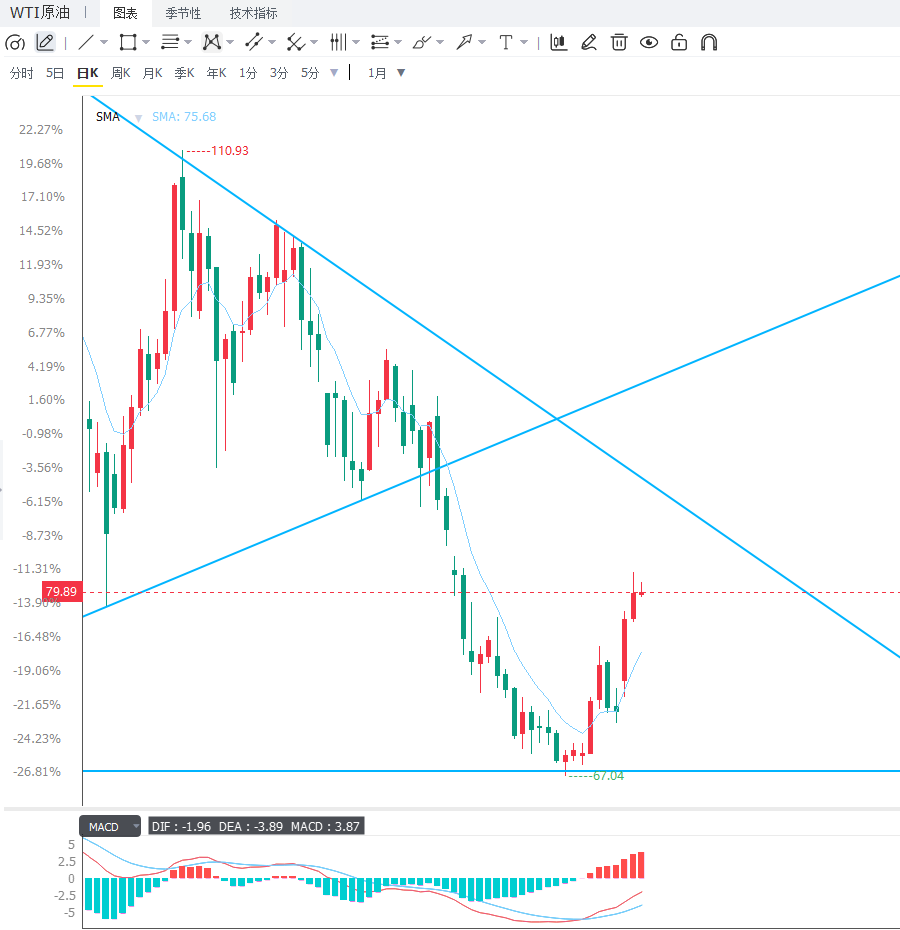
International oil prices continued their rebound in Asian trading on Wednesday, with WTI crude oil on the New York Mercantile Exchange rising for the third consecutive trading day, trading around $79.80 per barrel . The market was primarily driven by renewed tensions in the Middle East and weaker-than-expected US inflation data, prompting investors to reassess the future outlook for global oil supply and demand, leading to a significant increase in risk premiums.  Market risk aversion stemmed primarily from new developments in the Middle East. US President Trump stated that if Iran refuses to return to negotiations, the US may further escalate military operations in the coming week, potentially targeting infrastructure. This statement fueled market concerns about a possible escalation of regional tensions, creating new uncertainty for global energy supplies. Simultaneously, the US reinstated significant maritime restrictions against Iran, bringing the safety of shipping through the Strait of Hormuz back into focus. The Strait of Hormuz handles approximately 20% of global seaborne crude oil transport ; any disruption could significantly impact international crude oil supplies, thereby driving up global energy prices. While Trump stated he had abandoned his previous plan to impose a 20% fee on goods passing through the Strait of Hormuz and believed that increased investment from Gulf states in the US could offset this revenue, the market is more concerned about potential military risks than the policy adjustment itself. Recently, major Persian Gulf oil-producing countries gradually resumed exports after the interim peace agreement, initially showing signs of improvement in global crude oil supply. However, with renewed tensions in the region, the market is worried that the recovery of crude oil exports may be disrupted, pushing crude oil risk premiums back up. Analysts believe that the current rise in oil prices reflects more of a repricing of the market's expectations for future supply disruptions than a significant decrease in actual supply. In addition to supply factors, the latest US inflation data has further improved market expectations for crude oil demand. Data from the US Bureau of Labor Statistics shows that the Consumer Price Index (CPI) rose 3.5% year-on-year in June, lower than the market expectation of 3.8% and also lower than May's 4.2% ; month-on-month, it fell 0.4% , a significant decline from May's 0.5% increase. Cooling inflation means that US price pressures have eased, thus increasing market expectations for the Federal Reserve to slow its monetary tightening. Following the release of the inflation data, the US dollar index fell, and US Treasury yields declined accordingly, with the market generally believing that the necessity for further interest rate hikes by the Federal Reserve in the short term has decreased. For the crude oil market, a weaker dollar reduces procurement costs for international buyers, while expectations of easing also help improve the outlook for global economic growth and energy consumption, providing additional support for oil prices. However, the market has not completely shaken off concerns about future recurring inflation. International energy prices have remained high recently. If the situation in the Middle East deteriorates further, continued oil price increases could push up global inflation again, forcing the Federal Reserve to maintain high interest rates for a longer period. This means that while current oil prices are supported by both supply risks and expectations of improved demand, future trends will still be influenced by geopolitical tensions, US economic data, and policy changes by major central banks. From a technical perspective, WTI crude oil has closed higher for three consecutive trading days, regaining its footing above $78.50 , with the overall trend gradually shifting from a correction to a volatile upward trend. Short-term moving averages are beginning to turn upward, indicating an improvement in the medium-term trend and a continued recovery in bullish momentum. If oil prices effectively break through the $80.00 mark, they are expected to further test the $81.80 and $83.20 areas; initial support is at $78.00 , with further support around $76.80 . Overall, buying power on the daily chart has strengthened, but a breakthrough of key resistance still requires continued support from fundamentals. The 4-hour chart shows WTI crude oil steadily rising along short-term moving averages, with the moving average system maintaining a bullish alignment, indicating a relatively complete short-term uptrend and continued improvement in market momentum. However, as prices approach the psychological level of $80.00 , some profit-taking pressure may arise. A break above this level could allow bulls to extend their gains further; conversely, if the price encounters resistance and falls below $78.00 , it may retest the $76.80 to $75.50 range. Overall, the short-term trend remains one of slightly bullish consolidation.
  Editor's Summary: Tensions between the US and Iran have once again become the core driver of the international crude oil market. Increased supply risks in the Strait of Hormuz have pushed oil prices higher for the third consecutive trading day. Meanwhile, lower-than-expected US inflation data for June strengthened market expectations of a slowdown in the Federal Reserve's tightening policy, further improving the global oil demand outlook. In the short term, geopolitical risks will continue to dominate market sentiment, while US PPI, inventory data, and exports from major oil-producing countries will be important variables influencing oil price trends. If supply risks continue to escalate, WTI crude oil is expected to further challenge the $80 level; however, if the situation eases or demand expectations weaken, oil prices may still experience a period of correction.
Market risk aversion stemmed primarily from new developments in the Middle East. US President Trump stated that if Iran refuses to return to negotiations, the US may further escalate military operations in the coming week, potentially targeting infrastructure. This statement fueled market concerns about a possible escalation of regional tensions, creating new uncertainty for global energy supplies. Simultaneously, the US reinstated significant maritime restrictions against Iran, bringing the safety of shipping through the Strait of Hormuz back into focus. The Strait of Hormuz handles approximately 20% of global seaborne crude oil transport ; any disruption could significantly impact international crude oil supplies, thereby driving up global energy prices. While Trump stated he had abandoned his previous plan to impose a 20% fee on goods passing through the Strait of Hormuz and believed that increased investment from Gulf states in the US could offset this revenue, the market is more concerned about potential military risks than the policy adjustment itself. Recently, major Persian Gulf oil-producing countries gradually resumed exports after the interim peace agreement, initially showing signs of improvement in global crude oil supply. However, with renewed tensions in the region, the market is worried that the recovery of crude oil exports may be disrupted, pushing crude oil risk premiums back up. Analysts believe that the current rise in oil prices reflects more of a repricing of the market's expectations for future supply disruptions than a significant decrease in actual supply. In addition to supply factors, the latest US inflation data has further improved market expectations for crude oil demand. Data from the US Bureau of Labor Statistics shows that the Consumer Price Index (CPI) rose 3.5% year-on-year in June, lower than the market expectation of 3.8% and also lower than May's 4.2% ; month-on-month, it fell 0.4% , a significant decline from May's 0.5% increase. Cooling inflation means that US price pressures have eased, thus increasing market expectations for the Federal Reserve to slow its monetary tightening. Following the release of the inflation data, the US dollar index fell, and US Treasury yields declined accordingly, with the market generally believing that the necessity for further interest rate hikes by the Federal Reserve in the short term has decreased. For the crude oil market, a weaker dollar reduces procurement costs for international buyers, while expectations of easing also help improve the outlook for global economic growth and energy consumption, providing additional support for oil prices. However, the market has not completely shaken off concerns about future recurring inflation. International energy prices have remained high recently. If the situation in the Middle East deteriorates further, continued oil price increases could push up global inflation again, forcing the Federal Reserve to maintain high interest rates for a longer period. This means that while current oil prices are supported by both supply risks and expectations of improved demand, future trends will still be influenced by geopolitical tensions, US economic data, and policy changes by major central banks. From a technical perspective, WTI crude oil has closed higher for three consecutive trading days, regaining its footing above $78.50 , with the overall trend gradually shifting from a correction to a volatile upward trend. Short-term moving averages are beginning to turn upward, indicating an improvement in the medium-term trend and a continued recovery in bullish momentum. If oil prices effectively break through the $80.00 mark, they are expected to further test the $81.80 and $83.20 areas; initial support is at $78.00 , with further support around $76.80 . Overall, buying power on the daily chart has strengthened, but a breakthrough of key resistance still requires continued support from fundamentals. The 4-hour chart shows WTI crude oil steadily rising along short-term moving averages, with the moving average system maintaining a bullish alignment, indicating a relatively complete short-term uptrend and continued improvement in market momentum. However, as prices approach the psychological level of $80.00 , some profit-taking pressure may arise. A break above this level could allow bulls to extend their gains further; conversely, if the price encounters resistance and falls below $78.00 , it may retest the $76.80 to $75.50 range. Overall, the short-term trend remains one of slightly bullish consolidation. Editor's Summary: Tensions between the US and Iran have once again become the core driver of the international crude oil market. Increased supply risks in the Strait of Hormuz have pushed oil prices higher for the third consecutive trading day. Meanwhile, lower-than-expected US inflation data for June strengthened market expectations of a slowdown in the Federal Reserve's tightening policy, further improving the global oil demand outlook. In the short term, geopolitical risks will continue to dominate market sentiment, while US PPI, inventory data, and exports from major oil-producing countries will be important variables influencing oil price trends. If supply risks continue to escalate, WTI crude oil is expected to further challenge the $80 level; however, if the situation eases or demand expectations weaken, oil prices may still experience a period of correction.
- Risk Warning and Disclaimer
- The market involves risk, and trading may not be suitable for all investors. This article is for reference only and does not constitute personal investment advice, nor does it take into account certain users’ specific investment objectives, financial situation, or other needs. Any investment decisions made based on this information are at your own risk.