The Taiwan Strait sovereignty dispute remains unresolved, causing oil prices to rise, but the extent of the rebound has been locked in.
2026-07-15 18:20:11
On Wednesday during the Asian and European sessions, international oil prices continued their slight upward trend with a slight pullback, but the overall price center continued to rise. Currently, WTI crude oil is up 0.95% and trading around $80.09. Yesterday's article calculated that under a toll-based but permitted navigation scenario, WTI oil prices might trade in the $80-$85 range. However, given the current lack of access to the strait, oil prices may continue to fluctuate and rise. The US-Iran military standoff continues, failing to reach a clear ceasefire or negotiation outcome, resulting in a classic stalemate of "not being able to fight, and not being able to not fight," which will be explained in detail below. 
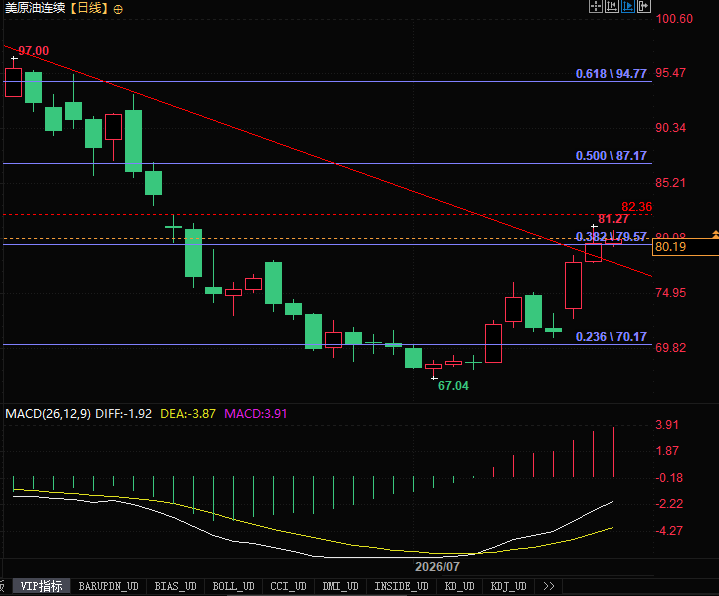 (WTI crude oil futures daily chart, source: EasyTrade) At 18:15 Beijing time, WTI crude oil futures were trading at $80.09 per barrel.
The US has reinstated port blockades, applying maximum pressure while adjusting its Middle East strategy.
The core turning point in this round of escalation began Tuesday evening when the United States officially announced the resumption of its maritime blockade covering all Iranian ports , completely ending the fragile temporary ceasefire agreement that came into effect in June, and reigniting geopolitical tensions between the US and Iran. Notably, Trump reversed his previous plans, overturning the proposed 20% toll for shipping through the Strait of Hormuz, which had only been announced a day earlier, and instead sought to secure multi-billion dollar investment agreements with Gulf states to replace the toll policy, thus avoiding international pressure and resistance from allies. Simultaneously, the US military launched a new round of precision strikes, focusing on eliminating Iranian military forces deployed along the Strait of Hormuz to harass merchant ships, weakening Iran's core capability to disrupt shipping. Furthermore, the US issued clear threats to target Iranian civilian infrastructure such as bridges and power plants, continuing its maximum pressure campaign against Iran.Iran has retaliated with a hardline, reciprocal stance, maintaining a long-term blockade of shipping lanes and refusing to compromise or negotiate.
Faced with comprehensive blockade and military pressure from the United States, Iran has revealed its hardline stance, effectively closing off any room for negotiation. On Wednesday, the Iranian Revolutionary Guard explicitly stated that it would maintain a long-term blockade of the Strait of Hormuz until the US completely ceases all provocations and acts of aggression, while also warning that other oil export routes in the Gulf region could become targets. Iran has adopted a "either fully open or completely shut down" stance on regional oil and gas exports, making it clear that its retaliatory actions will continue and it will not voluntarily lift the blockade. Following the US airstrikes on Iranian soil, Iran swiftly retaliated, launching precision strikes against US bases in Bahrain and Kuwait, and subsequently attacking US bases in Jordan. Several UAE-flagged oil tankers were also damaged in the Strait, resulting in casualties, and several Gulf states have been drawn into the conflict.The bottom line of order must not be crossed; we must strictly prevent the chaos of global shipping lane fragmentation.
The core reason for the stalemate between the US and Iran is not simply regional military confrontation, but a legal sovereignty struggle over key global waterways . This is also the deep strategic logic behind the US's uncompromising and continuous maximum pressure campaign. According to the United Nations Convention on the Law of the Sea, the Strait of Hormuz is an international navigation strait, and littoral states have only limited jurisdiction. They have no right to block international navigation or arbitrarily collect passage fees. All merchant ships worldwide enjoy unimpeded transit rights. If the US tacitly allows Iran to block the strait, arbitrarily formulate navigation rules, and collect passage fees, it would be tantamount to the international community recognizing the absolute sovereignty of littoral states over international strategic waterways, completely subverting the current global maritime order. Once this precedent is set, it will trigger a catastrophic chain reaction. Littoral states along other key global shipping routes such as the Strait of Malacca, the Bab el-Mandeb Strait, and the Strait of Gibraltar may all indirectly emulate Iran in vying for absolute control of these waterways, imposing additional restrictions and fees . The global maritime order would regress to the chaotic state of medieval "territorial sea fragmentation," dismantling the globalized shipping and trade system. This is an absolute bottom line that the US and other maritime nations cannot accept. Therefore, the US would rather continue to exert military pressure and escalate regional conflicts than compromise or back down. It firmly denies Iran's demands to control shipping in the Strait and collect tolls, but it continues to threaten to send signals of hope for peace talks, because a blockade of the Strait would cause oil prices to soar, inflation to rise again, and incidentally affect the midterm elections, ultimately creating a situation where it is neither able to fight nor not to fight.The situation has reached a deadlock: pressure has failed, and there is no consensus on a ceasefire.
It is precisely this unyielding strategic bottom line that has plunged the US-Iran situation into an intractable deadlock, making the game increasingly complex. The US has consistently exerted maximum pressure through naval blockades, precision airstrikes, and threats to strike civilian facilities, intending to force Iran to back to the negotiating table. However, this high-intensity military pressure has only further enraged Iran, leading it to resolutely refuse negotiations and further tighten the blockade of the Strait and expand the scope of its strikes. At the same time, the US has also proactively released conciliatory signals, pressuring Israel to withdraw its troops from Syria and Lebanon, actively shrinking its Middle East front, reducing the intensity of regional conflict, and demonstrating a willingness to engage in peace talks. With extreme military pressure on one hand and proactive compromise and de-escalation on the other, the US-Iran conflict has completely fallen into a stalemate of "no results from escalation, no consensus on a ceasefire," with the situation fluctuating repeatedly and proving difficult to resolve.Goldman Sachs provides an extreme two-way forecast, confirming a volatile oil price pattern.
The ongoing Middle East conflict has significantly increased global energy risk premiums, leading to substantial fluctuations in oil prices. The current US-Iran conflict has already resulted in thousands of casualties, primarily in Iran and Lebanon, with the fighting continuing to spread to several Gulf states. The International Monetary Fund previously warned that if the conflict continues beyond mid-July, systemic risks to the global energy system will escalate rapidly, and strategic oil reserves used by various countries to stabilize oil prices are largely depleted, leaving no room for maneuver. Currently, the oil market is experiencing extreme divergence between bullish and bearish expectations, with Goldman Sachs providing two extreme forecasts, clearly outlining the boundaries of future oil price movements. In a bullish scenario, if the US-Iran stalemate continues, Gulf oil and gas exports stagnate, production recovery is further delayed, and geopolitical risks continue to escalate, Brent crude oil prices are expected to break through $110/barrel in the fourth quarter of 2026. In a bearish scenario, if the US-Iran situation eases and the conflict deteriorates, coupled with high global fuel retail prices suppressing energy demand, a stronger-than-expected recovery in market capacity, and weak demand recovery, Brent crude oil prices may fall back to the $60/barrel range by the end of the year. Currently, oil prices will continue to fluctuate in tandem with the progress of US-Iran negotiations and the status of navigation in the Taiwan Strait. Every escalation and easing of geopolitical tensions will directly dominate the short-term price movements of crude oil. Technically, oil prices show a tendency to barely hold above the 0.382 Fibonacci retracement level of 79.57, and have broken through the downtrend line. If oil prices stabilize above this level, a further rebound is expected. Current resistance is near the previous downward gap at 82.36 and the 0.500 Fibonacci retracement level at 85.69. The current level of 79.57 remains to be tested. (WTI crude oil futures daily chart, source: EasyTrade) At 18:15 Beijing time, WTI crude oil futures were trading at $80.09 per barrel.
- Risk Warning and Disclaimer
- The market involves risk, and trading may not be suitable for all investors. This article is for reference only and does not constitute personal investment advice, nor does it take into account certain users’ specific investment objectives, financial situation, or other needs. Any investment decisions made based on this information are at your own risk.