The Federal Reserve's important statement suggests that geopolitical constraints have caused inflation to peak and the dollar to fall.
2026-07-15 21:04:15
On Wednesday (July 15th) during the Asian and European sessions, the US dollar index rebounded slightly after a slight dip, but continued to weaken, currently trading around 100.8. On Tuesday evening, affected by lower-than-expected US CPI, the dollar index once plummeted by more than 0.6%, and is currently continuing its decline. Trump's hasty withdrawal of the 20% toll policy in the Strait of Hormuz before its implementation directly exposes the US's strategic weakness and lack of leverage in this round of US-Iran geopolitical conflict. Meanwhile, Gulf allies are wary of indiscriminate Iranian retaliation, leaving the US unable to either fight or negotiate, repeatedly suppressing the possibility of escalating the conflict. At the same time, regarding interest rates, Warsh expressed zero tolerance for inflation and the need to maintain independence. Maintaining independence is conducive to lower interest rates, but zero tolerance for inflation does not mean a rate hike. Fed Vice Chairman Williams also reiterated today that 2% inflation must be maintained for a long time, but later added that inflation is expected to peak and is likely to decline in the future. Thus, the lack of a war and the forgetting about interest rates have jointly led to the recent weakening of the dollar. 
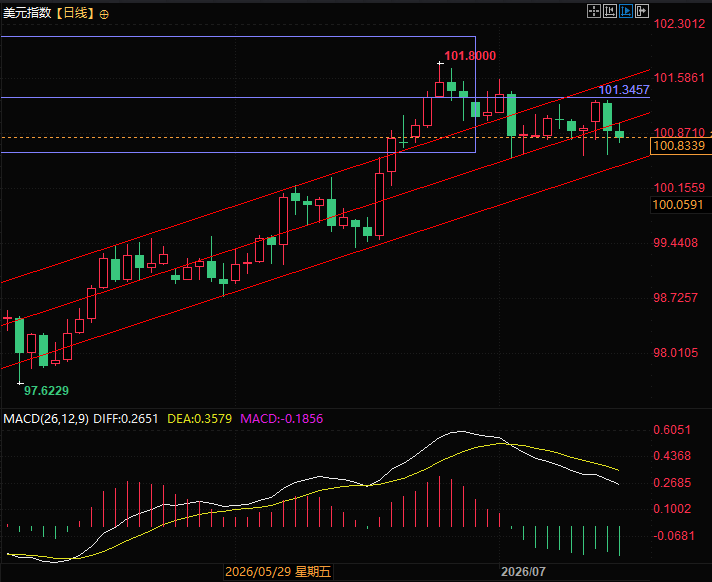 (US Dollar Index Daily Chart, Source: FX678) At 21:01 Beijing time, the US Dollar Index is currently at 100.84.
This round of turmoil began with the implementation of Trump's sudden shipping control policies.
On Monday morning, the US announced via social media the reinstatement of its maritime blockade against Iranian shipping, mandating that all vessels transiting the Strait of Hormuz, including tankers and cargo ships owned by US allies, pay a 20% passage fee to fully cover the security costs of maintaining this high-risk energy shipping route. However, just one day later, the White House completely overturned the plan, adjusting its strategy and shifting towards bilateral trade and large-scale investment cooperation with Gulf allies, using the guarantee of free passage for ships of all countries in the strait as leverage instead of the one-size-fits-all high-fee model. This policy is highly inconsistent. Domestically, public support for the ongoing Middle East conflict remains low. An escalation of the conflict would inevitably push up global energy prices and exacerbate domestic inflationary pressures. Simultaneously, the risk of cross-border retaliation from Iran against the US military and its overseas allies would increase significantly. Therefore, Trump has no intention of proactively escalating military confrontation. On the foreign front, Trump is unwilling to end the conflict abruptly. If the final negotiating terms are not as favorable as the 2015 Iran nuclear deal reached by the Obama administration, it would mean a diplomatic setback and no political achievements. Therefore, he can only passively remain in a stalemate, unable to make a sound and optimal decision. According to professional institutions, this conflict has already completely evolved into a protracted war of attrition. Rosemary Kalanick, head of the Middle East program at the Defense Priorities Institute, analyzes that the current situation is highly likely to fall into an indefinite stalemate. Such geopolitical wars of attrition are often protracted, continuously disrupting global commodity, energy, and foreign exchange market expectations, and creating long-term uncertainty for financial markets.Inflation remains too high but has peaked and may fall to 3.25% by the end of the year.
Federal Reserve Chairman Williams said on Wednesday that the current inflation rate of around 4% is undoubtedly too high and must be persistently restored to the 2% target level, but the current monetary policy stance is fully capable of achieving this goal. He expects overall inflation to fall to around 3.25% by the end of the year, continue to move towards 2% in 2027, and reach the target in 2028. He also believes that medium- and long-term inflation expectations remain well anchored, and there are good reasons to expect inflation to have peaked and will gradually decline. Regarding economic growth, he expects real GDP growth to remain between 2% and 2.25% this year, next year, and in 2028, with the unemployment rate gradually falling to 4% by 2028. He stated that economic growth is robust and in line with trends, and the labor market is also robust, stable, and resilient. He pointed out that the full impact of the surge in artificial intelligence investment on growth, employment, and inflation is difficult to predict, and supply disruptions caused by the Middle East conflict remain a source of risk to the outlook, but the US economy has so far absorbed the impact of these events quite well.Diplomatic Disorder: Double Standards in US Policy Expose Shortcomings in Public Credibility
It is noteworthy that Trump's Strait of Hormuz toll policy exhibits blatant double standards and logical contradictions . The proposed 20% toll is essentially an attempt to shift the cost of US defense spending in the Middle East and alleviate domestic public resentment towards overseas military involvement—an idea repeatedly raised during the conflict. However, just last month, US Secretary of State Rubio publicly cited international law, strongly condemning Iran's proposal to collect tolls in the Strait, explicitly stating that sovereign states are prohibited from unilaterally charging tolls on internationally recognized waterways. This highlights the arbitrariness and double standards of US foreign policy, further undermining its international credibility. This hastily issued and defunct memorandum of understanding was inherently flawed and doomed to failure. The memorandum deliberately obscured core clauses, postponing numerous key disagreements, while granting Iran the authority and responsibility to participate in the regulation of shipping in the Strait of Hormuz, explicitly stating that Iran could coordinate and ensure the free and safe passage of commercial vessels. In exchange for Iranian concessions, the US also pledged hundreds of billions of dollars in investment and the complete lifting of international sanctions. However, the US's original plan to use economic concessions and military deterrence to suppress Iran failed miserably, and all the terms of the agreement could not be implemented, rendering it a mere scrap of paper.A deadlock in the game: a stalemate in the endurance battle between the two sides.
Iran continues to suffer from multiple airstrikes by the US military, exposing its territorial defense vulnerabilities. Simultaneously, the renewed naval blockade has further disrupted its vital oil revenue stream. Trump faces a persistent dilemma: escalating the conflict would trigger a rebound in domestic inflation, a decline in voter approval ratings, and added political pressure from the November midterm elections; not escalating would leave him with no achievements to show for his administration. Elliott Abrams, a senior fellow for Middle East studies at the Council on Foreign Relations, points out that both sides have returned to the starting point of the game. The entire conflict will ultimately be a contest of endurance and bottom lines: will it be Iran, under pressure from the oil shortage, or the US and global economies, heavily reliant on Gulf oil? Technically, the US dollar index has slowly broken below the middle channel line, and a downward reversal is possible. Support lies near the lower channel line and the lower edge of the trading range around 100.64. (US Dollar Index Daily Chart, Source: FX678) At 21:01 Beijing time, the US Dollar Index is currently at 100.84.
- Risk Warning and Disclaimer
- The market involves risk, and trading may not be suitable for all investors. This article is for reference only and does not constitute personal investment advice, nor does it take into account certain users’ specific investment objectives, financial situation, or other needs. Any investment decisions made based on this information are at your own risk.