The continued decline in US PPI and CPI has put pressure on the US dollar, with the dollar index hovering around 100.50.
2026-07-16 10:44:12
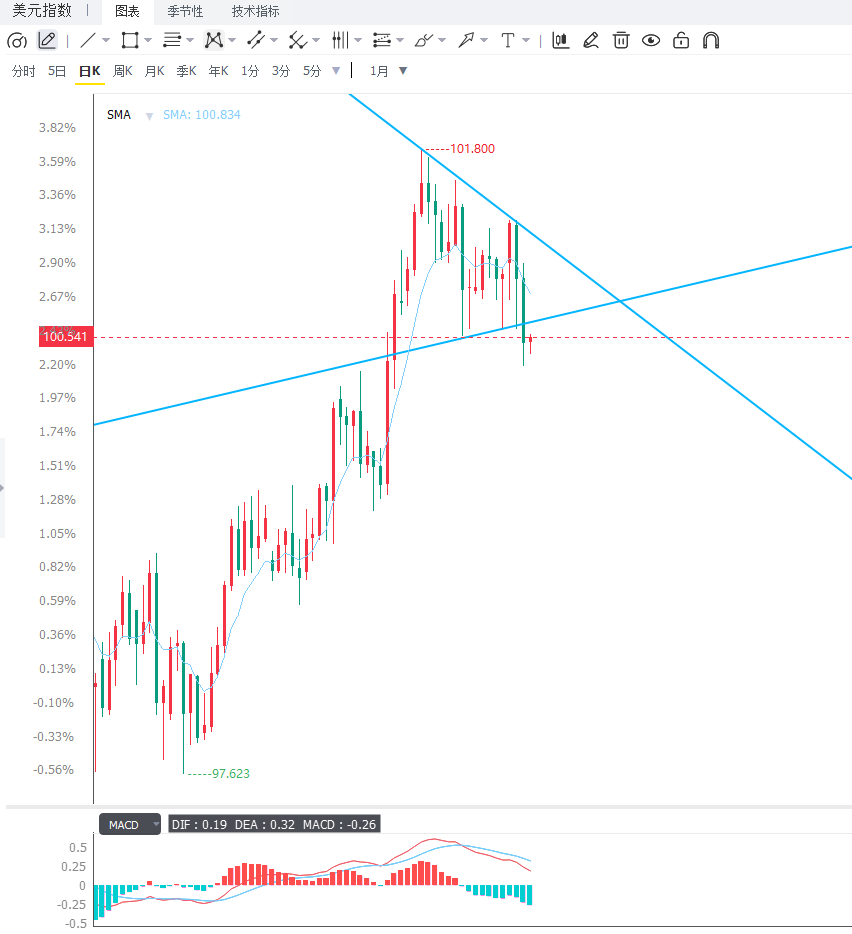
The US dollar index (DXY) remained range-bound in Asian trading on Thursday, hovering around 100.50, near the four-week low reached in the previous session. As the latest US inflation data continued to cool, market expectations for a near-tightening of monetary policy by the Federal Reserve were further reduced, putting overall pressure on the dollar. However, escalating geopolitical tensions in the Middle East continued to provide some safe-haven support for the dollar.  Data released by the U.S. Bureau of Labor Statistics showed that the U.S. Producer Price Index (PPI) fell 0.3% month-on-month in June, significantly lower than the revised 0.6% increase in the previous month; the year-on-year growth rate fell to 5.5% , also lower than market expectations. The previously released U.S. Consumer Price Index (CPI) for June also showed further easing of inflationary pressures. The cooling of these two key inflation indicators significantly reduced market expectations for further interest rate hikes by the Federal Reserve. Following the release of the inflation data, investors believed that the likelihood of the Federal Reserve maintaining interest rates at its July policy meeting had increased further, putting some pressure on the dollar. The market believes that if U.S. inflation continues to improve in the coming months, the Federal Reserve will have more room to maintain a wait-and-see approach, thereby weakening the dollar's interest rate advantage. However, dollar bears did not further increase their bets due to the renewed escalation of tensions in the Middle East. The U.S. and Iran launched a new round of military operations this week, with both sides launching successive strikes, further escalating regional security risks. Market surveys show that the U.S. again carried out airstrikes on Iranian missile and drone-related facilities, while Iran retaliated against U.S.-related military targets in the region, further exacerbating regional tensions. Furthermore, US President Trump stated that if the situation continues to deteriorate, he would not rule out further action against Iran's critical infrastructure. Meanwhile, shipping security risks near the Strait of Hormuz and the Bab el-Mandeb Strait continue to rise, raising market concerns about potential disruptions to global energy transportation. The Strait of Hormuz handles approximately 20% of global seaborne crude oil transport; any disruption to this transport could push up international energy prices. Rising energy prices could reignite global inflationary pressures, thereby increasing the likelihood that major central banks will maintain higher interest rates. The market currently still expects at least one more 25-basis-point rate hike by the Federal Reserve this year, which is one of the key reasons why the dollar has not experienced a significant decline. In addition, the dollar remains supported by safe-haven demand. Against the backdrop of fluctuating global risk sentiment, capital allocation still favors highly liquid dollar assets, keeping the dollar index in a high-level consolidation pattern rather than entering a one-sided downward trend. Going forward, investors will focus on the latest US macroeconomic data and speeches by Federal Reserve officials, hoping to glean more signals regarding the path of monetary policy. Meanwhile, developments in the Middle East will continue to influence global market risk appetite and significantly impact the dollar's trajectory. From a daily chart perspective, the US dollar index has temporarily stabilized around 100.50 after a continuous decline, currently trading below major moving averages, with the overall trend remaining weak. The MACD indicator continues to be below the zero line, indicating that bearish momentum remains dominant, although the downward momentum has slowed somewhat. The area around 100.20 currently forms the first support zone; if this level is breached, the dollar index may further test 99.80. On the upside, watch for resistance around 101.00 and 101.60; only a retest of above 101.60 could improve the short-term weakness. Looking at the 4-hour chart, the dollar index is maintaining a low-level consolidation, with short-term moving averages gradually flattening and the RSI indicator operating in neutral territory, indicating strong market caution. If subsequent US economic data continues to be weak, the dollar index may break below 100.20 and test the support around 99.80; if geopolitical risks continue to escalate and drive a rebound in safe-haven demand, it may retest the resistance zone of 101.00 to 101.30.
  Editor's Summary: The recent pressure on the US dollar index stems primarily from the continued cooling of US inflation and the market's downward revision of expectations for a short-term Fed rate hike, weakening the dollar's interest rate advantage. However, escalating tensions in the Middle East, pushing up energy prices and global safe-haven demand, limit further downside for the dollar. In the short term, the dollar's performance will continue to be influenced by economic data, inflation changes, and expectations of Fed policy. If US inflation continues to decline, the dollar will face further downward pressure; however, if energy prices continue to rise and reignite inflation expectations, or if global risk sentiment deteriorates further, the dollar is likely to receive support from safe-haven flows and maintain a high-level consolidation pattern.
Data released by the U.S. Bureau of Labor Statistics showed that the U.S. Producer Price Index (PPI) fell 0.3% month-on-month in June, significantly lower than the revised 0.6% increase in the previous month; the year-on-year growth rate fell to 5.5% , also lower than market expectations. The previously released U.S. Consumer Price Index (CPI) for June also showed further easing of inflationary pressures. The cooling of these two key inflation indicators significantly reduced market expectations for further interest rate hikes by the Federal Reserve. Following the release of the inflation data, investors believed that the likelihood of the Federal Reserve maintaining interest rates at its July policy meeting had increased further, putting some pressure on the dollar. The market believes that if U.S. inflation continues to improve in the coming months, the Federal Reserve will have more room to maintain a wait-and-see approach, thereby weakening the dollar's interest rate advantage. However, dollar bears did not further increase their bets due to the renewed escalation of tensions in the Middle East. The U.S. and Iran launched a new round of military operations this week, with both sides launching successive strikes, further escalating regional security risks. Market surveys show that the U.S. again carried out airstrikes on Iranian missile and drone-related facilities, while Iran retaliated against U.S.-related military targets in the region, further exacerbating regional tensions. Furthermore, US President Trump stated that if the situation continues to deteriorate, he would not rule out further action against Iran's critical infrastructure. Meanwhile, shipping security risks near the Strait of Hormuz and the Bab el-Mandeb Strait continue to rise, raising market concerns about potential disruptions to global energy transportation. The Strait of Hormuz handles approximately 20% of global seaborne crude oil transport; any disruption to this transport could push up international energy prices. Rising energy prices could reignite global inflationary pressures, thereby increasing the likelihood that major central banks will maintain higher interest rates. The market currently still expects at least one more 25-basis-point rate hike by the Federal Reserve this year, which is one of the key reasons why the dollar has not experienced a significant decline. In addition, the dollar remains supported by safe-haven demand. Against the backdrop of fluctuating global risk sentiment, capital allocation still favors highly liquid dollar assets, keeping the dollar index in a high-level consolidation pattern rather than entering a one-sided downward trend. Going forward, investors will focus on the latest US macroeconomic data and speeches by Federal Reserve officials, hoping to glean more signals regarding the path of monetary policy. Meanwhile, developments in the Middle East will continue to influence global market risk appetite and significantly impact the dollar's trajectory. From a daily chart perspective, the US dollar index has temporarily stabilized around 100.50 after a continuous decline, currently trading below major moving averages, with the overall trend remaining weak. The MACD indicator continues to be below the zero line, indicating that bearish momentum remains dominant, although the downward momentum has slowed somewhat. The area around 100.20 currently forms the first support zone; if this level is breached, the dollar index may further test 99.80. On the upside, watch for resistance around 101.00 and 101.60; only a retest of above 101.60 could improve the short-term weakness. Looking at the 4-hour chart, the dollar index is maintaining a low-level consolidation, with short-term moving averages gradually flattening and the RSI indicator operating in neutral territory, indicating strong market caution. If subsequent US economic data continues to be weak, the dollar index may break below 100.20 and test the support around 99.80; if geopolitical risks continue to escalate and drive a rebound in safe-haven demand, it may retest the resistance zone of 101.00 to 101.30. Editor's Summary: The recent pressure on the US dollar index stems primarily from the continued cooling of US inflation and the market's downward revision of expectations for a short-term Fed rate hike, weakening the dollar's interest rate advantage. However, escalating tensions in the Middle East, pushing up energy prices and global safe-haven demand, limit further downside for the dollar. In the short term, the dollar's performance will continue to be influenced by economic data, inflation changes, and expectations of Fed policy. If US inflation continues to decline, the dollar will face further downward pressure; however, if energy prices continue to rise and reignite inflation expectations, or if global risk sentiment deteriorates further, the dollar is likely to receive support from safe-haven flows and maintain a high-level consolidation pattern.
- Risk Warning and Disclaimer
- The market involves risk, and trading may not be suitable for all investors. This article is for reference only and does not constitute personal investment advice, nor does it take into account certain users’ specific investment objectives, financial situation, or other needs. Any investment decisions made based on this information are at your own risk.