The decline in gold prices hides a deeper meaning! Divergence between short-term and long-term cycles suggests a turning point is approaching.
2026-07-16 18:36:11
On Thursday (July 16), spot gold continued its correction during the Asian and European sessions, currently trading around 4035. Recent gold prices have fluctuated downwards, but the volatility is extreme, indicating that it is not driven by a single logic. Short-term market fluctuations and medium-to-long-term trends are diverging, determined by five core factors: monetary policy, inflation type, geopolitical and energy factors, opportunity cost of dollar assets, supply and demand, and global fiscal debt. Considering the current US-Iran conflict, the surge in oil prices, and the Federal Reserve's policy environment, the impact of these factors on gold prices can be fully analyzed. 
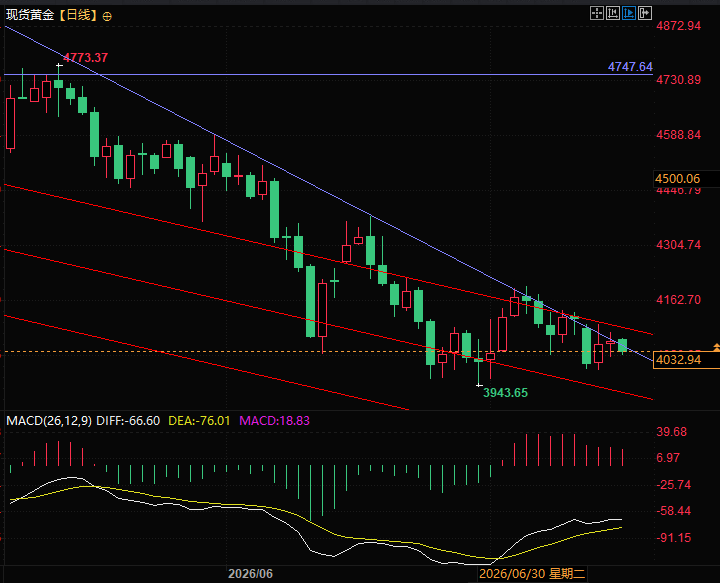 (Spot gold daily chart, source: EasyTrade) At 18:33 Beijing time, spot gold is currently trading at $4033 per ounce.
Federal Reserve monetary policy and real interest rates on US Treasury bonds
Gold is a non-interest-bearing asset; holding gold does not generate fixed interest. The real yield on US Treasury bonds directly determines the opportunity cost of holding gold and is a key factor in short-term price fluctuations. When the Federal Reserve signals interest rate hikes and monetary tightening, the market prices up US Treasury yields, causing funds to flow out of gold and into the US dollar and US Treasury bonds, which offer stable returns, putting downward pressure on gold prices. Conversely, rising expectations of interest rate cuts and falling real yields enhance the value of gold as an investment, giving its price upward momentum. Current market pricing clearly confirms this logic: the Strait of Hormuz blockade pushed up oil prices, the market anticipated a possible Fed rate hike in September or December, and hawkish expectations raised real interest rates, directly limiting the upside potential for gold prices. However, June's US CPI data weakened significantly, with overall CPI declining by 0.4% month-on-month and core CPI remaining flat, significantly lower than market expectations. Fed Chairman Kevin Warsh reiterated his anti-inflation stance in congressional hearings but did not mention interest rate hikes. Williams also stated that inflation may have peaked, and real interest rates may be turning downwards from their current high levels.Geopolitical conflicts and the indirect negative impact on crude oil prices
Escalating geopolitical conflicts do not necessarily equate to a rise in gold prices. When Middle East tensions directly push up oil prices, a complete chain of negative factors for gold prices emerges: escalating US-Iran conflict → disruption of navigation in the Strait of Hormuz, leading to a surge in oil prices → rebound in energy inflation expectations → strengthened expectations of a Fed rate hike → higher real yields on US Treasury bonds → increased cost of holding gold → institutional selling of gold long positions. In this round of market activity, gold was quoted at $4052, a cumulative drop of nearly 8% in the last thirty trading days, with almost no intraday volatility, showing a severe divergence from the surge in oil prices. This transmission logic dominated the market, with short-term geopolitical safe-haven demand completely overshadowed by negative interest rate news.The divergent impacts of two types of inflation on gold prices
The market generally views gold as an inflation hedge, but inflation of different causes has completely opposite effects on gold prices. Supply chain-driven inflation (such as oil supply disruptions and geopolitical blockades): only pushes up the prices of physical commodities, without adding new money supply, and therefore cannot boost gold prices. In the past five trading days, crude oil prices have risen by more than 9%, ship traffic in the Strait of Hormuz has shrunk by 52% compared to the previous period, and the US military has launched four consecutive days of airstrikes against Iran. Crude oil prices have surged due to supply shortages, representing typical energy supply inflation. Gold has almost no positive feedback from this and will instead indirectly put downward pressure on gold prices. Conversely, monetary inflation (fiscal overspending and long-term excessive money supply): the purchasing power of the US dollar continues to dilute, fully releasing gold's value-preserving attributes, which is the core driving force supporting a long-term bull market in gold prices. The total US debt has exceeded $39 trillion, with annual debt interest payments exceeding $1 trillion. The continuously expanding fiscal deficit has long fueled expectations of currency depreciation, laying the foundation for a medium- to long-term upward trend in gold prices.The fiscal debt cycle determines the long-term turning point of gold prices.
The interest rate hike cycle cannot continue indefinitely; the high level of US debt will continue to constrain the Federal Reserve's tightening space. Every 25 basis point increase in the benchmark interest rate adds hundreds of billions of dollars to the annual interest costs on US debt. Once fiscal pressure reaches a critical point, the Federal Reserve will have no choice but to abandon rate hikes and shift to easing, leading to a decline in real yields on US Treasury bonds. Currency depreciation expectations will once again dominate the market, and a long-term bullish trend in gold will resume. Reviewing complete interest rate hike cycles since the 1970s, gold has experienced a sustained upward trend after each round of tightening.The strength of the US dollar and the diversion of safe-haven funds
Gold is priced in US dollars, and a stronger dollar will suppress gold prices. At the same time, during geopolitical crises, the dollar also possesses safe-haven characteristics, diverting funds that would otherwise flow into gold. Recently, the dollar has reached a turning point, but gold prices have not seen a significant increase. With ongoing conflict in the Middle East, market concerns about further deterioration of the regional situation have discouraged traders from aggressively shorting the dollar, providing it with bottom support and further limiting the upside potential for gold.Precious metal supply and demand, central bank gold purchases and the gold-silver ratio
Supply and demand structure determines the long-term price center of gold, and short-term disturbances cannot reverse the long-term allocation logic. The physical supply-demand gap for silver has widened for five consecutive years and will continue into its sixth year in 2026, with a cumulative gap of 762 million ounces. Currently, the gold-silver ratio is 69:1, at a historical high, indicating that silver is significantly undervalued relative to gold, driving the long-term allocation value of the precious metals sector. Central banks worldwide continue to increase their gold reserves, reducing reliance on the US dollar through diversified foreign exchange reserves. This gold-buying pace will not be interrupted by short-term geopolitical fluctuations, providing long-term bottom support for gold prices. Currently, gold has retreated 28% from its January high of $5589, and silver has fallen more than 52% from its high of $121.62. This is merely a temporary correction due to the short-term interest rate cycle; the long-term bullish fundamentals for precious metals remain unchanged.Summary: The current gold price movement driven by multiple factors
In summary, considering all the variables affecting gold prices, the current geopolitical conflict between the US and Iran, supply-side inflation caused by soaring oil prices, hawkish expectations of interest rate hikes from the Federal Reserve, and a strengthening US dollar and US Treasury yields, together constitute a short-term bearish combination suppressing gold prices. Therefore, gold prices have remained range-bound and have not risen in tandem with oil prices. However, the short-term negative impact of interest rates is only a temporary disturbance and cannot change gold's core value as a hedge against currency devaluation and global credit risk. Continued gold purchases by central banks, the expanding global fiscal deficit, and high long-term debt pressures on the US dollar are the underlying logic supporting a long-term bullish trend in gold prices. The flat intraday fluctuations in gold prices directly reflect its asset attributes: short-term price movements are constrained by monetary policy and energy geopolitics and will not fluctuate significantly with sudden events, but in the long term, it will wait for a period of monetary easing to realize its long-term hedging and value preservation value. From a technical perspective, gold prices continue to move along the downtrend line, while being continuously suppressed by the 0.618 Fibonacci retracement level at 4065 and approaching the key support level of 4000. Closely monitor gold price movements in the near term. If gold prices rebound and recover this level, it will likely indicate the start of a rebound. At the same time, if geopolitical headwinds cause gold prices to fall rapidly, we should also pay attention to the formation of a sentiment low. (Spot gold daily chart, source: EasyTrade) At 18:33 Beijing time, spot gold is currently trading at $4033 per ounce.
- Risk Warning and Disclaimer
- The market involves risk, and trading may not be suitable for all investors. This article is for reference only and does not constitute personal investment advice, nor does it take into account certain users’ specific investment objectives, financial situation, or other needs. Any investment decisions made based on this information are at your own risk.