Trump's speech revealed his diplomatic strategy; Middle East geopolitical risks are manageable in the short term.
2026-07-17 17:50:13
Trump delivered a prime-time national televised address, revisiting election security controversies and signaling domestic political maneuvering. His core demands and election strategies are deeply intertwined with subsequent US policy toward Iran and the future of the US-Israel alliance, forming the core thread of current US domestic and foreign policy. Simultaneously, the global political landscape is entering a critical window of dual elections: Israel's 25th parliament was officially dissolved today, with a new general election scheduled for October 27th; the US is about to hold its midterm elections in early November. The high overlap in the timing of these two elections directly impacts the US's core Middle East strategy, particularly its strategic maneuvering toward Iran. 
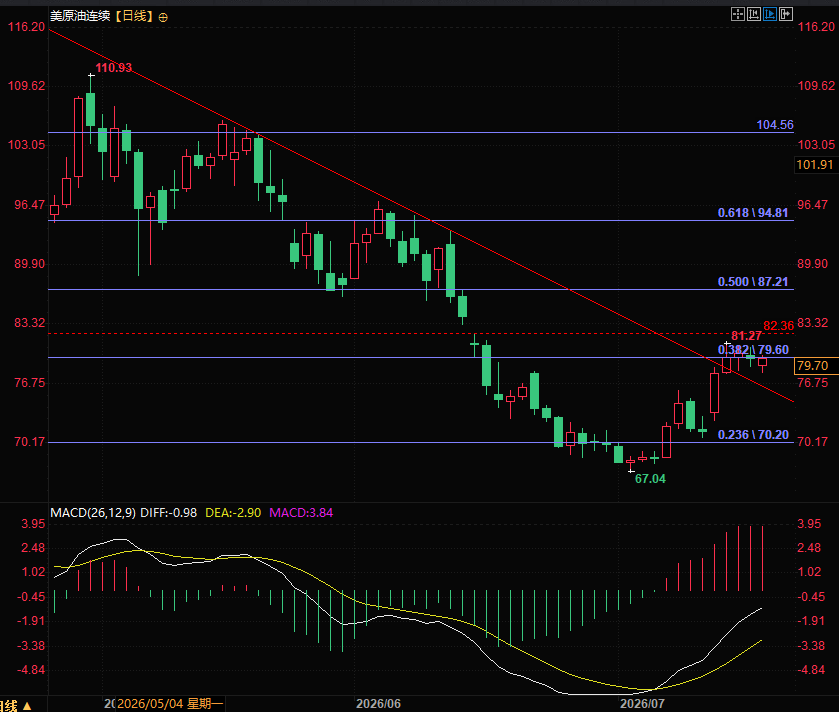 (WTI crude oil futures daily chart, source: EasyTrade) At 17:48 Beijing time, US crude oil is currently trading at $79.72 per barrel.
Trump's election security speech: Midterm election campaigning with no real increase.
Trump's national televised address was widely anticipated as a window into major policy announcements, but its core content offered no substantial new information and was essentially a political rallying cry for the midterm elections. The entire speech revolved around narratives of security vulnerabilities in the US election system, deep-seated government interference, and past election fraud, continuing his core political rhetoric for years without presenting any conclusive evidence to prove systemic, nationwide fraud and manipulation of election results in previous US elections. Major mainstream media outlets and industry analysts subsequently concluded that the entire speech merely reiterated the same controversial logic used by Republican politicians, with the core purpose of inciting sentiment among conservative bases and building momentum for the midterm elections.Core narrative: hyping up deep-seated government intervention and creating a victim narrative of governance.
The core narrative of his speech focused on the internal political maneuvering within the United States. Trump specifically accused deep-seated layers of government within the executive branch of the U.S. government of deliberately concealing loopholes in the election system, blocking crucial intelligence leads, and misleading voters nationwide, thereby continuously undermining his foundation for governance. He claimed that during his daily presidential briefings, a large amount of crucial information concerning election security was deliberately withheld and filtered, and that this intelligence filtering system was a standardized decision-making process within U.S. intelligence agencies, with no empirical evidence to support any deliberate concealment. Simultaneously, he fiercely criticized mainstream media for deliberately avoiding full broadcasts of his speech, creating information bias, and demanded the revocation of broadcasting licenses for relevant media outlets, further exacerbating the polarization between the two parties and in the public sphere.Rehashing old cases: Amplifying the atmosphere of suspicion surrounding the election by leveraging questionable events.
To reinforce his narrative of the election crisis, Trump revived the old Michigan voter registration case from the 2020 election, characterizing the registration irregularities committed by grassroots workers to meet performance targets as a major security incident involving systemic election fraud and bribery. He accused the previous Justice Department of deliberately delaying the investigation and condoning election irregularities. However, the FBI and the Michigan Attorney General's Office had already completed two rounds of independent investigations, clarifying that the fraudulent registration forms never entered the formal review process, did not substantially affect the election results, and there was no actual voter fraud. Even without new evidence, Trump claimed he had instructed federal law enforcement teams to reopen the case and hold relevant public officials accountable, further amplifying the atmosphere of election suspicion.Policy Exploration: Using the Opportunity to Push for Federal Centralization of Election Authority
At the policy level, this speech was a key test by Trump in his push to reform the US electoral system and seize federal control. He publicly called on Congress to pass the "Save America Act," advocating for significantly tightening the threshold for voter identity verification and mandating that voters produce birth certificates, passports, and other proof of ownership. Civil rights organizations warned that these stringent standards would significantly raise the voting threshold for underprivileged voters, effectively depriving some groups of their right to vote. Macro-political analysts pointed out that Trump's core intention was to break the traditional structure of state-level power in US elections, gradually centralizing electoral jurisdiction from the states to the federal government, reconstructing the rules governing elections nationwide, and paving the way for the Republican Party to maintain long-term control over the electoral discourse.Trump's speech aimed to serve the midterm elections and offset negative public opinion pressure.
With only months remaining before the US midterm elections, the political purpose of this speech is extremely clear. The Democratic Party has collectively criticized Trump, arguing that he deliberately created a crisis of confidence, distorted facts, and amplified social suspicion. The core objective, they believe, is to divert negative public opinion surrounding his administration, suppress voter turnout, and consolidate the Republican base by widening social divisions. In a midterm election environment without a presidential candidate, Trump has successfully garnered consensus among conservative voters by highlighting election security issues, offsetting public pressure from a weak economy, and making it a key tool in the Republican midterm campaign.The dual election window between the US and Israel: The Middle East game enters a critical period of change.
The actions taken in the US domestic election are deeply intertwined with the Middle East landscape and the US's core strategies towards Iran and Israel. Currently, the Israeli parliament has been formally dissolved, entering a caretaker transition period before the general election . The plenary session of parliament is indefinitely adjourned, regular legislation is frozen, and only emergency oversight functions remain. Real power in the country's military and political sphere is entirely controlled by the caretaker cabinet led by Netanyahu, which continues to advance its military maneuvering against Hezbollah in Lebanon and Iranian influence. This unique transition period coincides significantly with the US midterm elections and Trump's political maneuvering, constituting a crucial window of opportunity for the US-Israel-Iran trilateral power struggle.The core demands of the United States are: stability, limiting war, and control over Iran, all in service of the overall election.
From the perspective of the Trump team's core interests, the optimal diplomatic strategy at this stage is to maintain Netanyahu's rule, control the scale of the Middle East conflict, and avoid a full-scale war with Iran. This strategy serves entirely in line with the US midterm elections and subsequent presidential campaigns. Domestically, Netanyahu's hardline anti-Iran stance aligns closely with the values of Trump's core voter base—evangelicals, the Republican right wing, and pro-Israel conservatives. Maintaining his rule can solidify Trump's base and prevent the rise of more radical right-wing forces or moderates in Israel, which could lead to a loss of control over US Middle East policy. In terms of foreign strategy, the US is not currently seeking to overthrow the existing Iranian regime or replace its core leadership, a significant departure from the widely accepted hardline narrative. US policymakers clearly anticipate that the cost of militarily overthrowing the Iranian regime would be extremely high, requiring not only massive military spending and troop deployments but also triggering a chain reaction of proxy wars in the Middle East, a blockade of the Strait of Hormuz, and soaring international oil prices, directly impacting domestic inflation and the economy, becoming a major drag on the midterm elections. Therefore, the true objective of the United States is to force hardliners within Iran to make concessions through sanctions, limited military pressure, and diplomatic maneuvering, thereby promoting controlled negotiations on the Iranian nuclear issue, de-escalating tensions in the Middle East, stabilizing oil prices, and creating a stable external economic environment for the midterm elections. However, this optimal strategy has an inherent contradiction: Netanyahu, currently in the election rescue phase, has a strong motivation to escalate the Middle East conflict and expand military strikes against Iran and its proxies in order to reverse his election prospects and resolve the corruption crisis. If Israel unilaterally launches a large-scale military operation, igniting a full-blown US-Iran conflict, it will directly push up global oil prices, exacerbate domestic inflationary pressures in the United States, and negatively impact Trump's midterm election prospects. This also makes the core operational logic of the Trump team at this stage: publicly supporting Israel and consolidating conservative voter bases, while privately strongly restraining Netanyahu and strictly controlling the upper limit of conflict, and making every effort to promote indirect US-Iran negotiations in order to de-escalate the situation before the Israeli general election and the US midterm elections.Summary: Recent geopolitical developments and market expectations
The domestic elections in the US and Israel have definitively set the upper and lower limits for the short-term geopolitical game in the Middle East. Under the intertwined tensions of "election rescue" and "domestic stability maintenance," the geopolitical situation in the near term will likely present a state of "superficial tension, but actual undercurrents of control." This means the US will continue to issue extremely tough public declarations supporting Israel and opposing Iran, while Netanyahu will continue his targeted killings to maintain his hawkish image domestically. Behind the scenes, the US will use funding, weapons supplies, and intelligence leverage to tightly rein in Netanyahu, preventing him from crossing the line and triggering a full-scale war between the US and Iran. Simultaneously, the US and Iran will maintain a tacit understanding through indirect channels to avoid a complete breakdown in relations. The implications for investors: Theoretically, the market can expect some implicit benefits from the "US's control" in the near term. With the probability of a full-blown conflict being firmly suppressed by the domestic political needs of both countries, the extreme risk of a surge in prices for commodities such as crude oil due to geopolitical instability is decreasing. The geopolitical situation is entering a rare period of "high-pressure equilibrium" before the dual elections take place. (WTI crude oil futures daily chart, source: EasyTrade) At 17:48 Beijing time, US crude oil is currently trading at $79.72 per barrel.- Risk Warning and Disclaimer
- The market involves risk, and trading may not be suitable for all investors. This article is for reference only and does not constitute personal investment advice, nor does it take into account certain users’ specific investment objectives, financial situation, or other needs. Any investment decisions made based on this information are at your own risk.