Iran confronts US military, destroying its aircraft; oil prices rise accordingly.
2026-07-17 18:24:13
On Friday (July 17), during the European session, Iran's statement regarding the destruction of a US military aircraft fueled speculation of escalating tensions , causing oil prices to rise briefly. WTI crude oil is currently trading around $79.92, up 2.08%. On July 17, the Iranian Islamic Revolutionary Guard Corps officially issued a statement announcing a strong and reciprocal counterattack against the previous illegal US airstrikes. Through ballistic missiles and drones, the corps launched a two-stage precision strike, successfully destroying multiple US refueling aircraft and fighter jets. This counterattack significantly escalated the intensity of the current conflict. The trigger for this conflict was the US cross-border airstrikes on the evening of July 16. Using a Jordanian military base, the US launched a surprise attack on the area surrounding the port of Bandar Abbas in southern Iran, targeting numerous non-military infrastructure sites including bridges, residential areas, and pumping stations. Simultaneously, airstrikes targeted key transportation hubs such as airports and railway stations, causing casualties and infrastructure damage in multiple locations in Iran, completely shattering the previously fragile ceasefire agreement. Faced with the US military's escalating infrastructure attacks, Iran has adopted an increasingly hardline stance. The Iranian National Security Council has publicly stated that sovereignty, management, and command over the Strait of Hormuz belong entirely to Iran, and no outside party has the right to interfere with the operation of the waterway. This also means that Iran still has ample motivation to counter US pressure by blocking and harassing the waterway. 
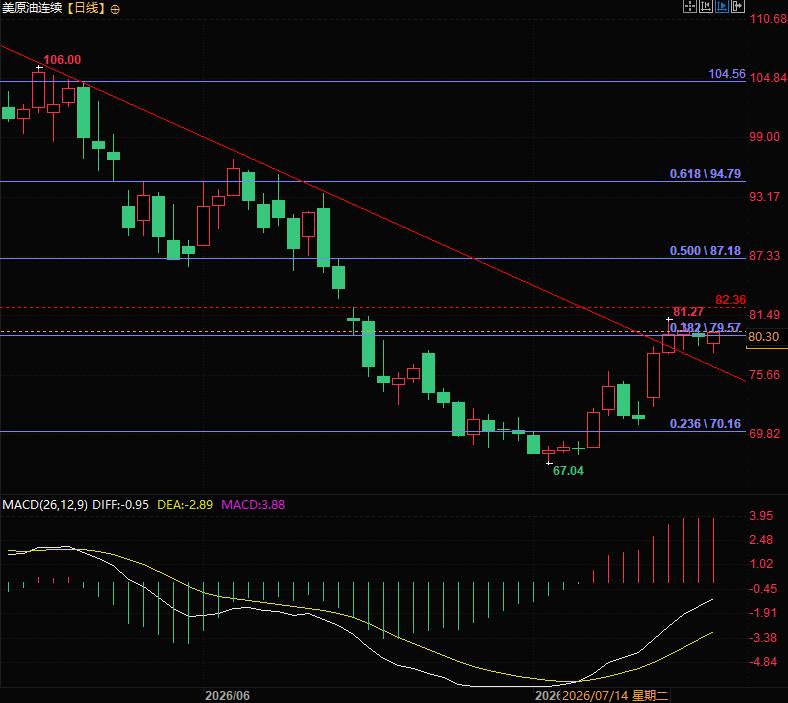 (WTI crude oil futures daily chart, source: EasyTrade) At 18:20 Beijing time, WTI crude oil futures were trading at $80.04 per barrel.
Current status of cross-strait shipping: Capacity has been significantly reduced and is far from returning to normal levels.
The ongoing geopolitical conflicts have completely disrupted shipping in the Strait of Hormuz. Leading commodity institutions, using high-frequency satellite data, have revealed the true shipping capacity of the strait, drastically overturning the market's optimistic expectations of "easing tensions and shipping recovery." Joint research data from several authoritative institutions, including Hartley Partners, Energy Perspective, and Rystad Energy, shows that since the start of the conflict, the strait's traffic volume has remained low, with a persistent capacity gap. Data shows that in the past three weeks, the average daily number of vessels transiting the Strait of Hormuz has remained between 20 and 50, with only two trading days briefly exceeding 80 vessels. In contrast, the normal daily traffic volume is as high as 120 to 140 vessels, meaning the current overall capacity is more than halved compared to normal levels. Even with a brief recovery following the conflict, with vessels slightly increasing to 36 on Tuesday, a new high for recent weekend rebounds, structural deficiencies remain prominent. Furthermore, with the implementation of a new round of US sanctions, industry experts predict that traffic data will weaken again starting Wednesday, effectively halting the shipping recovery trend.The ship's structural design is severely unbalanced, resulting in a unique transshipment pattern for crude oil exports.
From the perspective of the ship type structure that is the core focus of the transaction, the current navigation resources in the Taiwan Strait are extremely skewed, with energy transport vessels bearing the most severe pressure. Currently, only about 30% of the vessels transiting the strait are core crude oil carriers such as Very Large Crude Carriers (VLCCs), Suezmax tankers, and Aframax tankers. The capacity for transporting refined oil products and liquefied petroleum gas (LPG) is extremely scarce: an average of only 4 to 6 refined oil carriers and only 1 LPG carrier transits the strait daily, compared to the pre-conflict average of 5 to 10 vessels per day, indicating a significant contraction in petrochemical energy export capacity. In addition, the number of bulk carriers, container ships, and special-purpose vessels remains low and stable, offering no substantial hedging effect on the energy market. The current shipping situation in the Taiwan Strait exhibits a strong "distorted structure," with the number of outbound vessels consistently exceeding the number of inbound vessels. The core reason is that after Iran effectively blocked the waterway on February 28, a large number of fully loaded oil and gas vessels were stuck in port for a long time. Currently, most outbound vessels are short-haul shuttle tankers, mainly operated by state-owned energy companies, which continue to sail despite geopolitical risks. These vessels transport crude oil through a ship-to-ship transshipment model. The daily volume of very large crude carriers can reach 9 to 10 vessels. They are specifically designed to facilitate the transshipment of crude oil for private fleets that are hedging against risks or suspending operations to observe the situation. This barely maintains the basic foundation of crude oil exports from the Gulf, and the overall transportation system is extremely fragile.Shipping risks across the board have skyrocketed, with no vessels able to evade geopolitical attacks.
The market had previously harbored a wishful thinking that "closing vessel tracking could evade attacks," but recent attacks have completely shattered this illusion, exacerbating the overall shipping security risks in the Persian Gulf. Rystad Energy satellite tracking data shows that on July 7th, a Qatari Q-Flex LNG carrier with its Automatic Identification System (AIS) disabled was attacked, and on July 14th, two UAE-affiliated Very Large Crude Carriers (VLCCs) were attacked in succession. This demonstrates that regardless of whether a vessel conceals its navigation path, no transit vessel can avoid the risk of geopolitical attacks. The frequent attacks have completely shattered market confidence in shipping. Since the attack on the Qatari LNG carrier, the country has completely suspended LNG export capacity, with only one UAE LNG carrier managing to transit. The stability of Gulf oil and gas exports has been completely compromised. Previously, after the US-Iran Memorandum of Understanding was signed on June 17th, the market was generally optimistic about a full recovery in shipping, with a large number of empty vessels flocking to the Persian Gulf to prepare for export. Now, all optimistic expectations have failed, and the escalating conflict has further reduced the possibility of a short-term recovery in shipping.The impact on the industrial chain has been realized, and oil, gas, and chemical products are expected to enjoy a long-term supply premium.
The current geopolitical turmoil in the Taiwan Strait has evolved from short-term emotional speculation into a substantial disruption to the global petrochemical supply chain, directly reshaping the medium- and long-term pricing logic of crude oil, natural gas, and chemical products. Previously routine long-haul LPG and naphtha shipping routes have been largely paralyzed, with shipping volumes drastically reduced and transport schedules completely disrupted, directly impacting the long-term production schedules of major Asian cracking plants. To offset the supply gap in Middle Eastern raw materials, Asian manufacturers have been forced to seek alternative feedstocks from the United States, pushing up global energy procurement costs. From a regional shipping perspective, current market capacity is forced to diverge, with very large crude carriers (VLCCs) prioritizing the stable southern Oman shipping route coordinated by the US, while the northern core shipping route experiences drastic fluctuations and extreme instability, resulting in a significant decrease in shipping efficiency. Furthermore, cross-regional commodity shipping from west to east across the Strait has essentially come to a standstill, intercontinental oil and gas trade channels are blocked, and the global energy supply mismatch problem continues to worsen.Summary and Technical Analysis:
Based on the latest developments and high-frequency shipping data, the US-Iran conflict has entered a triple-worsening phase characterized by mutual military attacks, shipping blockades, and supply chain disruptions. However, these developments are not sudden; the key observation point remains the change in marginal quantities, such as whether the US will comment on the bombing of its military aircraft tonight. If it acknowledges it, it may face fierce retaliation, but the escalating losses could hinder long-term US military operations. From a technical perspective, oil prices are fluctuating in a high range, leaning towards a bullish bias. However, if a breakout fails to occur, it indicates insufficient buying power, which is currently the case. For crude oil trading, current low shipping data, a disrupted energy transportation structure, and escalating military conflict collectively form a bottom support for oil prices. Before a substantial easing of the geopolitical situation and the return of cross-strait shipping capacity to normal, the downside for oil prices is limited, and the risk premium still has room to rise. Going forward, it is crucial to closely monitor the latest US-Iran military actions and changes in daily shipping capacity data. (WTI crude oil futures daily chart, source: EasyTrade) At 18:20 Beijing time, WTI crude oil futures were trading at $80.04 per barrel.
- Risk Warning and Disclaimer
- The market involves risk, and trading may not be suitable for all investors. This article is for reference only and does not constitute personal investment advice, nor does it take into account certain users’ specific investment objectives, financial situation, or other needs. Any investment decisions made based on this information are at your own risk.