Inflation has fallen to 2.8%, so why is the euro still locked at 1.1440?
2026-07-17 18:16:14
On Friday, July 17, the euro traded in a narrow range around 1.1440 against the dollar, rising approximately 0.3% for the week. The dollar index hovered around 100.75, falling about 0.3% for the week. The latest final inflation figures confirmed a marginal easing of price pressures in the Eurozone. However, the energy shock, the interest rate differential between Europe and the US, and the pricing of the European Central Bank's policies all contributed to the exchange rate not undergoing a unilateral revaluation, but rather returning to a range-bound game driven by macroeconomic variables. 
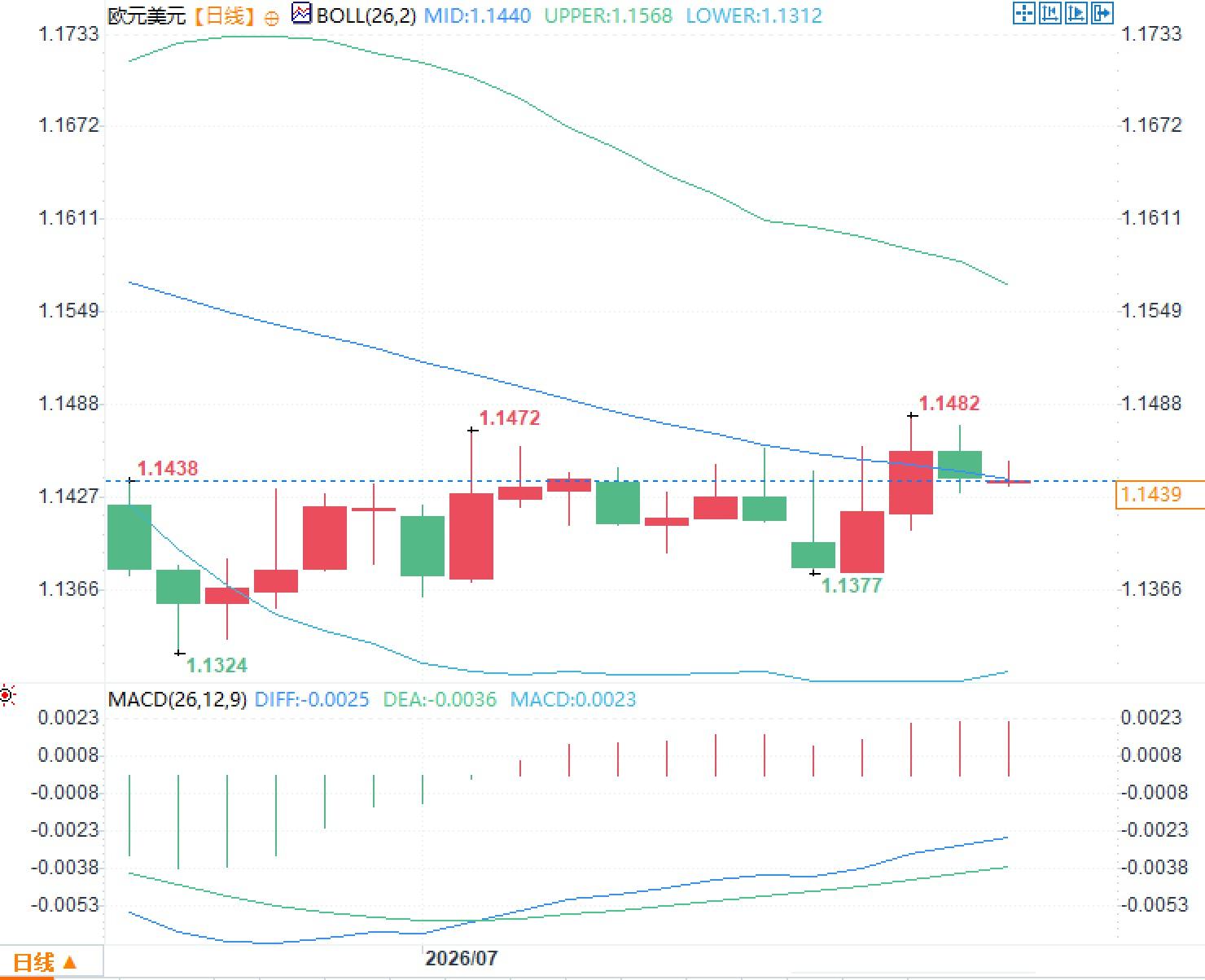 The recent low has risen from 1.1324 to 1.1377, but resistance levels at 1.1472 and 1.1482 have formed, indicating an improved rebound structure, but a failure to break through the previous supply zone. In the MACD indicator, the fast and slow lines remain below the zero line, but the histogram has turned positive, suggesting weakening downward momentum rather than a confirmed medium-term uptrend. Therefore, 1.1377 to 1.1482 constitutes the most immediate trading range. A successful break above 1.1482 would allow the market to retest the upper Bollinger Band; a break below 1.1377 would damage the current rebound structure, potentially leading to a reassessment of 1.1324 and the lower Bollinger Band.
The key to curbing inflation lies not in 2.8%, but in the simultaneous cooling of structural inflation.
The Eurozone's Harmonized Index of Consumer Prices (HICP) rose 2.8% year-on-year in June, down from 3.2% in May and down 0.1% month-on-month. Core inflation, excluding energy, food, alcohol, and tobacco, rose 2.4% year-on-year, down from 2.6% in May. The data was consistent with the preliminary figures, so it did not create a significant information gap, and the exchange rate reaction was limited. What truly impacts policy expectations is the breakdown of the components. Energy price inflation fell from 10.8% year-on-year to 8.5%, and down 1.8% month-on-month; food, alcohol, and tobacco inflation fell from 1.9% to 1.5%, service inflation fell from 3.5% to 3.2%, and non-energy industrial goods inflation fell to 0.7%. Services still contribute about 1.51 percentage points to overall inflation, but its growth rate has begun to ease, indicating that the sticky pressures previously driven by wages, rents, and labor-intensive industries have not worsened further. This data is not simply negative for the euro. The decline in inflation reduces the necessity for further interest rate hikes, but also reduces the risk that the ECB will be forced to adopt aggressive tightening measures, thereby harming growth. The market therefore did not directly trade the easing, but instead assessed whether the 2.8% target could continue to converge toward the 2% target.The European Central Bank has gained room to wait, but energy risk constraints have led to a policy shift.
The European Central Bank (ECB) raised its key interest rate by 25 basis points in June and projected overall inflation to average 3.0% in 2026, 2.3% in 2027, and fall to 2.0% in 2028. The forecast also emphasized that higher energy prices could be passed on to food, goods, and services. This means that while the decline in inflation in June improved the short-term path, it was insufficient to overturn the assessment that overall inflation would remain above target for the year. The core policy contradiction is that although energy inflation has fallen from its high, it still contributes approximately 0.77 percentage points to overall inflation. If the conflict in the Middle East pushes up oil and gas prices again, the negative month-on-month growth in June may only be a temporary phenomenon. The spread of energy costs to core projects through transportation, chemicals, food processing, and corporate pricing typically takes several months. Therefore, the ECB is more likely to observe summer data rather than quickly change its policy stance based on a single month's decline. Market focus will also shift from "whether to continue raising interest rates" to "how long high interest rates will be maintained." As long as service inflation remains above 3%, the policy statement is unlikely to release a clear easing signal; however, if energy prices stabilize and wage growth continues to slow, the threshold for further tightening will rise significantly.The interest rate differential between Europe and the US continues to limit upside potential, and the US dollar also lacks sustained upward momentum.
The Federal Reserve currently maintains its target range for the federal funds rate at 3.50% to 3.75%, while the European Central Bank's deposit facility rate is 2.25%. Based on the midpoint of the range, the short-term policy rate for the US dollar is still approximately 137.5 basis points higher than that for the euro, and this cost difference continues to constrain the euro's upward movement against the dollar in the medium term. However, exchange rate trading is driven by changes in expectations, not static interest rate differentials. Recent US inflation data has been relatively mild, leading the market to lower its pricing of another near-term rate hike by the Fed, thus preventing the dollar from gaining stronger momentum from the existing interest rate differential. Meanwhile, rising energy prices and safe-haven demand limit the dollar's decline, causing the euro to fluctuate between expectations of a narrowing interest rate differential and risk premiums. From a macro pricing perspective, for the euro to achieve more sustainable strength, two conditions need to be met simultaneously: core inflation in Europe must cool steadily without a significant slowdown in growth, and the Fed's policy expectations must continue to move towards neutral. Currently, only the second condition shows some signs of improvement; the first condition remains constrained by energy costs and regional inflation divergence.The technical structure has entered a convergence phase, with 1.1440 becoming the short-term pricing axis.
The daily chart shows the euro/dollar pair currently trading at approximately 1.1440, with the Bollinger Band middle line at 1.1440, the upper band at 1.1568, and the lower band at 1.1312. The price's close proximity to the middle band suggests that this is not a phase of accelerated trend development, but rather a period of rebalancing between bulls and bears based on macroeconomic expectations. The recent low has risen from 1.1324 to 1.1377, but resistance levels at 1.1472 and 1.1482 have formed, indicating an improved rebound structure, but a failure to break through the previous supply zone. In the MACD indicator, the fast and slow lines remain below the zero line, but the histogram has turned positive, suggesting weakening downward momentum rather than a confirmed medium-term uptrend. Therefore, 1.1377 to 1.1482 constitutes the most immediate trading range. A successful break above 1.1482 would allow the market to retest the upper Bollinger Band; a break below 1.1377 would damage the current rebound structure, potentially leading to a reassessment of 1.1324 and the lower Bollinger Band.
- Risk Warning and Disclaimer
- The market involves risk, and trading may not be suitable for all investors. This article is for reference only and does not constitute personal investment advice, nor does it take into account certain users’ specific investment objectives, financial situation, or other needs. Any investment decisions made based on this information are at your own risk.