With a new British prime minister and the Labour Party remaining in power, the pound's gains have run out.
2026-07-17 21:54:12
On July 17th (European and American trading sessions), the British pound retreated against the US dollar, currently down 0.32%. The pound had been strengthening recently, but the change of prime minister has led to a "sell the news" scenario, with the exchange rate now having given back half of its previous gains. The recent political upheaval in the UK saw a leadership change, with Andy Burnham officially elected as the new Labour Party leader and set to take over as Prime Minister next week, succeeding Keir Starmer, who was forced to resign due to setbacks and internal party pressure. As the sixth change of prime minister in the UK in nearly a decade and the seventh leader since the Brexit referendum, this political shift has not triggered market panic. Instead, it has brought a mild, temporary boost to the pound, overcoming the negative impact of past leadership changes on exchange rates. The market is exhibiting a typical "short-term boost, long-term unchanged" pricing characteristic. 
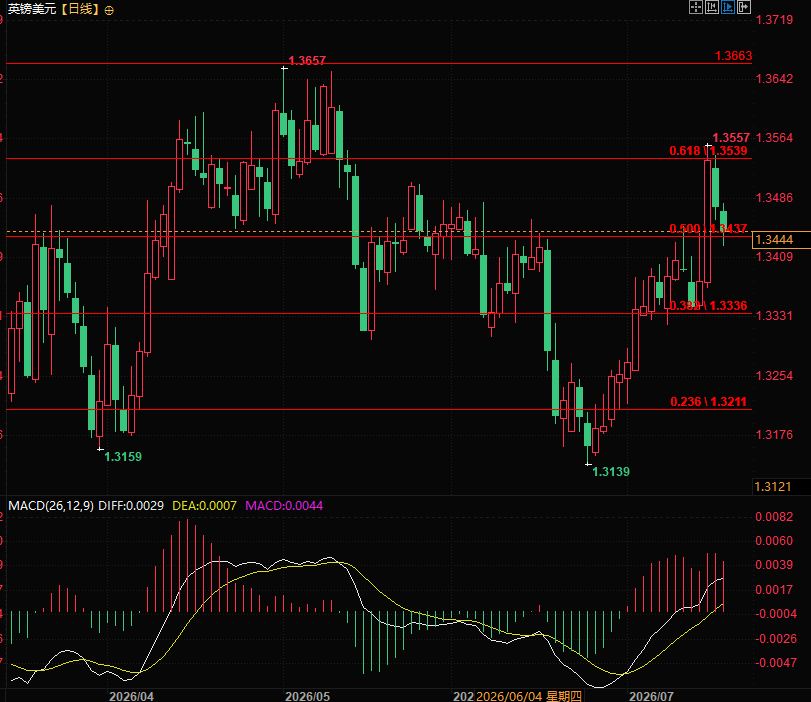 (GBP/USD daily chart, source: FX678) At 21:51 Beijing time, GBP/USD is currently trading at 1.3446/47.
The entire leadership transition proceeded smoothly, significantly reducing political uncertainty.
The Labour Party's leadership transition proceeded smoothly and orderly, laying a crucial foundation for stabilizing market sentiment and supporting the pound. Burnham, the sole candidate, won by a landslide with 379 nominations out of 403 Labour MPs in the House of Commons, clearing all procedural obstacles. Compared to past political upheavals in the UK, characterized by fierce infighting and unpredictable changes, this smooth transition, free from party politics, general election uncertainty, and power struggles, significantly mitigated the political uncertainty that the market feared most. According to UK parliamentary democracy rules, the ruling party can change leaders and prime ministers without a general election. This transition did not require a general election, and the next general election can be postponed until 2029 at the latest, completely avoiding the policy risks associated with a general election.Background to the leadership transition: Starmer's failure to govern and the Labour Party mired in a crisis of public opinion.
The dismal end of the Starmer government is the core backdrop to this leadership transition. Two years ago, the Labour Party won the general election by a landslide. Initially, market confidence was high and public support remained strong. However, subsequent policy missteps and decision-making errors eroded the party's credibility and popular support. Coupled with a crushing defeat in the May local elections and the Labour Party's poll numbers being overtaken by the Reform Party, which champions anti-immigration policies, its foundations crumbled. Ultimately, under pressure from internal party pressure and declining public opinion, the party hastily resigned. Burnham, a key figure within the Labour Party known for his populist approach and exceptional ability to manage public opinion and communicate effectively, possessed a more relaxed and approachable style compared to the rigid and authoritarian Starmer, making him a prime candidate for rebuilding the party's reputation and regaining public support.Burnham's new policy framework: Focusing on grassroots empowerment and people's livelihood and industrial recovery
In his inaugural address, Burnham unveiled his policy framework, with a core focus on "regaining hope for all and achieving high-quality growth across the board." His core reform strategy involves breaking away from London's highly centralized model, decentralizing governance authority, empowering local cities and grassroots communities with autonomous decision-making, revitalizing regional economies, and optimizing public services. Simultaneously, he explicitly addresses long-standing shortcomings in public welfare, focusing on tackling the persistent social problem of unequal distribution of social security benefits for the elderly, the sick, and the disabled. On the economic front, he proposes strengthening state control over core industries, building a modern industrial system, and creating new high-quality jobs, directly addressing the structural problems stemming from Thatcher-era privatization and deindustrialization in the 1980s, such as the hollowing out of the real economy and the stagnation of grassroots development.Key positive factors for the market: Strong policy continuity with no risk of radical policy implementation.
What the market should focus on is that this leadership transition did not involve any substantial policy shifts , which is key to the pound avoiding negative impacts and securing stable support. Burnham's moderate and de-polarizing governing philosophy is highly consistent with the policy slogans of Starmer when he took office in 2024, and no groundbreaking new governance ideas were introduced . The Labour Party's overall economic framework, fiscal tone, and governing approach have maintained a high degree of continuity. Compared to the pound's collapse and market turmoil triggered by the Truss government's aggressive fiscal policies, this leadership transition has no fiscal risks, no policy abrupt changes, and no black swan events in the market. Moreover, the new Chancellor of the Exchequer adheres to a fiscally prudent approach, completely dispelling market concerns about aggressive governance, and the UK political risk premium has significantly decreased.The underlying logic of the market trend: The market is desensitized to frequent leadership changes and only prices in changes in risk.
Looking back at the UK's history of seven prime ministerial changes in the past decade, the market has long been desensitized to the "political transition" event. The frequent changes of power in the past have already led the market to fully price in the chaos of the British political system, so this transition will not trigger panic selling of the pound. The core advantage that distinguishes this transition from previous ones lies in the triple benefits of a smooth transition, policy stability, and risk clearing. This is also the core driving logic behind the recent slight strengthening of the pound. Simply put, the market doesn't care about the "change of prime minister" itself, but only about the uncertainty and policy risks brought about by the transition, and this transition perfectly avoids all potential negative factors.Market Summary and Outlook: Limited Positive Factors, Beware of a Reversal After the Initial Implications Are Implemented
From a trading perspective, the current market movement exhibits clear phased characteristics. The smooth transition, diminished political uncertainty, and zero policy risk provided a mild boost to the pound, resulting in a "sell the fact" pattern. However, from a medium- to long-term perspective, the fundamental weakness of the pound remains unchanged. Long-term structural problems persist, including a sluggish UK economy, geopolitical conflicts increasing the cost of living, pressure on public services, an unbalanced social security system, and uneven regional development. Burnham's new policies have not addressed these core issues and cannot reverse the fundamental weakness. Overall, the recent change of prime minister is a minor, short-term positive for the pound, but it does not alter the medium- to long-term bearish trend. With Burnham officially taking office next week and the transition complete, the market is likely to continue its "sell the fact" pattern, with short-term gains gradually materializing and the pound's appreciation receding. The pound's future performance will primarily be anchored to the strength of the UK economic recovery, inflation trends, and fiscal fundamentals; the marginal impact of the political transition will quickly fade. (GBP/USD daily chart, source: FX678) At 21:51 Beijing time, GBP/USD is currently trading at 1.3446/47.
- Risk Warning and Disclaimer
- The market involves risk, and trading may not be suitable for all investors. This article is for reference only and does not constitute personal investment advice, nor does it take into account certain users’ specific investment objectives, financial situation, or other needs. Any investment decisions made based on this information are at your own risk.