Gold prices held steady while silver prices weakened, with US Treasury yields suppressing the positive impact of inflation data.
2026-07-17 22:04:12
On Friday (July 17), spot gold rose slightly while spot silver declined during the US trading session. Traders weighed this week's cooling inflation data, stronger-than-expected US economic indicators, persistently high US Treasury yields, and renewed geopolitical risks in the Strait of Hormuz. Spot gold traded around $3,989.91 per ounce, up 0.34%; spot silver was quoted around $55.287, down 0.36% on the day.  Gold traded in a range of $3970.20-$4008.70 in early trading. Gold prices rose and then fell back on Thursday, currently still below the $4000 mark, but holding above the intraday low of $3970. Silver traded in a range of $54.65-$56.12 in early trading. Although it held above $54.65, it failed to break through the short-term technical resistance range of $55.60-$57.52. Following the release of the latest key US economic data, the market's overall bullish and bearish positioning provided far less support for precious metals than the initial bullish expectations following the release of the Consumer Price Index (CPI) and Producer Price Index (PPI). In June, the overall US CPI fell 0.4% month-on-month, and the final demand PPI declined 0.3% month-on-month; however, retail sales rose 0.2% month-on-month, initial jobless claims fell to 208,000, and the Philadelphia Fed Manufacturing Index surged to 41.4. A mixed set of data weakened market bets on a July rate cut by the Federal Reserve, but it wasn't enough to convince traders that the Fed had completely shifted to easing. Federal funds rate futures indicate a roughly 90% probability of the Fed keeping rates unchanged at the July 29th meeting; the 10-year Treasury yield was around 4.53%, the 2-year yield was 4.12%, and the US dollar index (DXY) fluctuated narrowly at 100.80. In short, cooling inflation provides a floor for gold, but the resilience of economic activity and high Treasury yields continue to suppress upside potential. The current state of shipping in the Strait of Hormuz can be summarized as: restricted passage, highly tense situation, and prolonged military standoff; the shipping market has not yet returned to normal. The US expanded its strikes against Iranian infrastructure in the Gulf region, targeting ports and transportation facilities; Iran retaliated in kind against facilities belonging to US allies in the region. While the conflict has not yet resulted in a complete blockade of the Strait of Hormuz and there is no authoritative confirmation, the geopolitical risk premium has already been reflected in oil prices: Brent crude is trading around $86, and West Texas Intermediate (WTI) crude is trading around $81.11. This geopolitical conflict has a two-way impact on gold: geopolitical safe-haven demand is beneficial to gold; however, rising oil prices have rekindled market concerns about inflation, supporting higher US Treasury yields and weakening the upward momentum of safe-haven buying in gold. Looking at the overall asset class landscape: oil is strong; US Treasuries received buying support amid Thursday's yield decline; the US dollar is consolidating; and silver is significantly weaker than gold. Traders are currently focusing on three key variables: speeches by Federal Reserve officials, subsequent changes in market interest rate expectations after this week's inflation/retail/employment data, and whether shipping in the Strait of Hormuz will be further disrupted. If gold prices stabilize above $4,000, short-term downward pressure will be significantly alleviated; however, if oil prices surge again, the market will reassess whether energy inflation will offset the positive effects of the decline in June's CPI and PPI. Global commodity markets: WTI crude oil prices strengthened, approaching $80; Brent crude oil was around $86. The US dollar index held steady around 100.80, and the benchmark 10-year US Treasury yield remained around 4.53%. Technical Analysis
 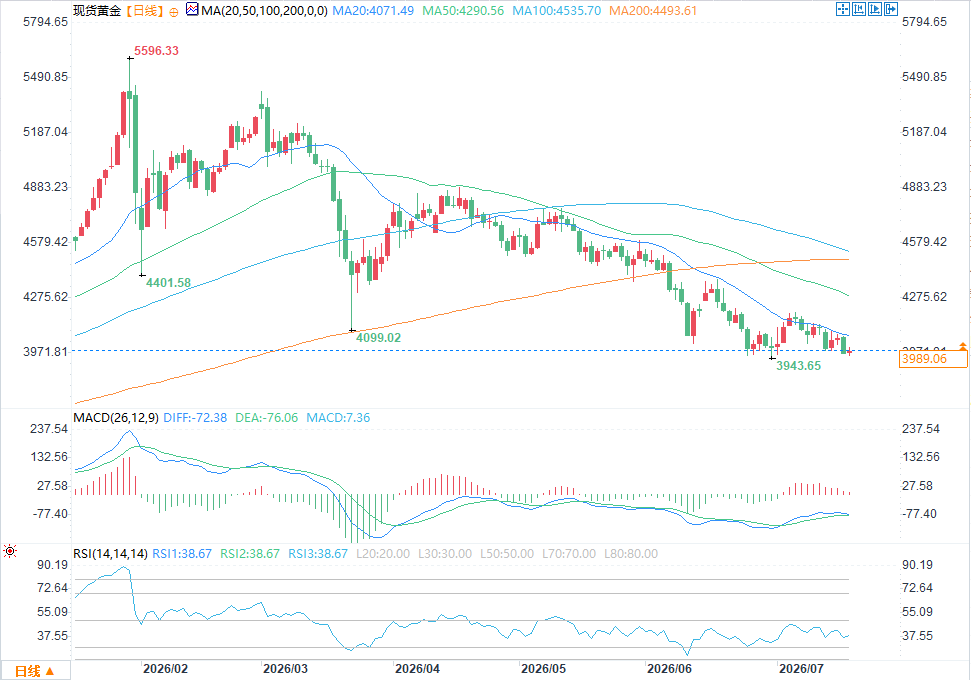 After breaking below a key level on Thursday, gold prices have maintained a short-term technical advantage, with prices remaining below the psychological level of $4,000. The primary upside target for the bulls is to recover the $4,000 level, and if that holds, look towards $4,008.70, with a further target of $4,044. The short-term downside target for the bears is a break below the $3,970.20 support level, with deeper targets at $3,959 and $3,942. First resistance level: $4,000; Second resistance level: $4,008.70. First support level: $3,970.20; Second support level: $3,959.
 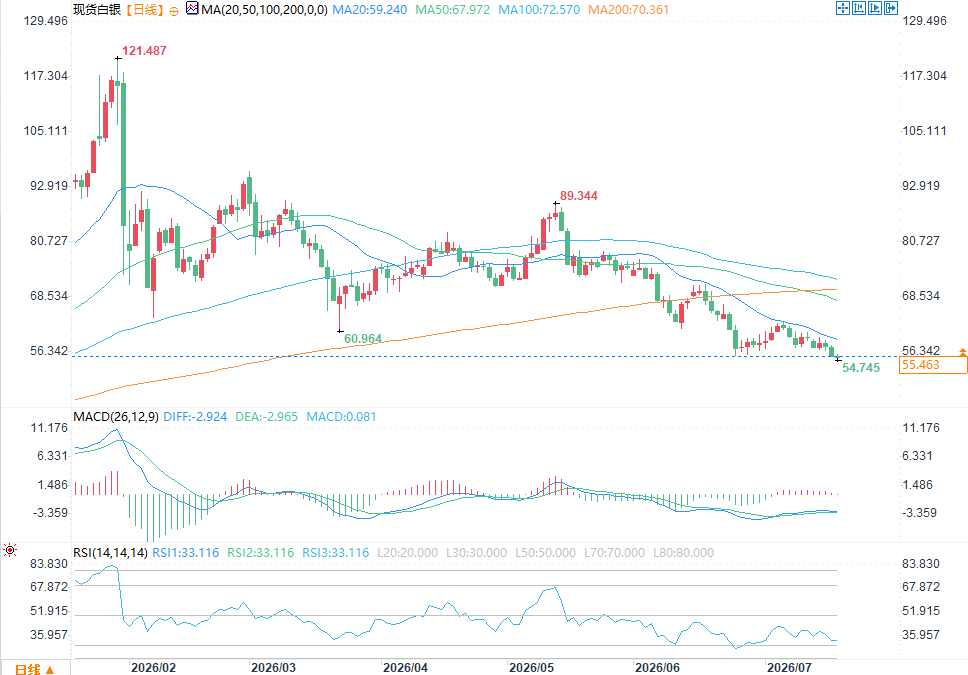 Silver prices continue to trade below $55.60, at the lower edge of the recent breakout range, indicating a short-term bearish technical advantage. The primary upside target for the bulls is a return to above $55.60, followed by $57.13 and then $57.52. The downside target for the bears is a break below $54.65 support, with further downside targets at $53.42 and the psychological level of $50. First resistance level: $55.60; Second resistance level: $57.13. First support level: $54.65; Second support level: $53.42.
Gold traded in a range of $3970.20-$4008.70 in early trading. Gold prices rose and then fell back on Thursday, currently still below the $4000 mark, but holding above the intraday low of $3970. Silver traded in a range of $54.65-$56.12 in early trading. Although it held above $54.65, it failed to break through the short-term technical resistance range of $55.60-$57.52. Following the release of the latest key US economic data, the market's overall bullish and bearish positioning provided far less support for precious metals than the initial bullish expectations following the release of the Consumer Price Index (CPI) and Producer Price Index (PPI). In June, the overall US CPI fell 0.4% month-on-month, and the final demand PPI declined 0.3% month-on-month; however, retail sales rose 0.2% month-on-month, initial jobless claims fell to 208,000, and the Philadelphia Fed Manufacturing Index surged to 41.4. A mixed set of data weakened market bets on a July rate cut by the Federal Reserve, but it wasn't enough to convince traders that the Fed had completely shifted to easing. Federal funds rate futures indicate a roughly 90% probability of the Fed keeping rates unchanged at the July 29th meeting; the 10-year Treasury yield was around 4.53%, the 2-year yield was 4.12%, and the US dollar index (DXY) fluctuated narrowly at 100.80. In short, cooling inflation provides a floor for gold, but the resilience of economic activity and high Treasury yields continue to suppress upside potential. The current state of shipping in the Strait of Hormuz can be summarized as: restricted passage, highly tense situation, and prolonged military standoff; the shipping market has not yet returned to normal. The US expanded its strikes against Iranian infrastructure in the Gulf region, targeting ports and transportation facilities; Iran retaliated in kind against facilities belonging to US allies in the region. While the conflict has not yet resulted in a complete blockade of the Strait of Hormuz and there is no authoritative confirmation, the geopolitical risk premium has already been reflected in oil prices: Brent crude is trading around $86, and West Texas Intermediate (WTI) crude is trading around $81.11. This geopolitical conflict has a two-way impact on gold: geopolitical safe-haven demand is beneficial to gold; however, rising oil prices have rekindled market concerns about inflation, supporting higher US Treasury yields and weakening the upward momentum of safe-haven buying in gold. Looking at the overall asset class landscape: oil is strong; US Treasuries received buying support amid Thursday's yield decline; the US dollar is consolidating; and silver is significantly weaker than gold. Traders are currently focusing on three key variables: speeches by Federal Reserve officials, subsequent changes in market interest rate expectations after this week's inflation/retail/employment data, and whether shipping in the Strait of Hormuz will be further disrupted. If gold prices stabilize above $4,000, short-term downward pressure will be significantly alleviated; however, if oil prices surge again, the market will reassess whether energy inflation will offset the positive effects of the decline in June's CPI and PPI. Global commodity markets: WTI crude oil prices strengthened, approaching $80; Brent crude oil was around $86. The US dollar index held steady around 100.80, and the benchmark 10-year US Treasury yield remained around 4.53%. Technical Analysis After breaking below a key level on Thursday, gold prices have maintained a short-term technical advantage, with prices remaining below the psychological level of $4,000. The primary upside target for the bulls is to recover the $4,000 level, and if that holds, look towards $4,008.70, with a further target of $4,044. The short-term downside target for the bears is a break below the $3,970.20 support level, with deeper targets at $3,959 and $3,942. First resistance level: $4,000; Second resistance level: $4,008.70. First support level: $3,970.20; Second support level: $3,959. Silver prices continue to trade below $55.60, at the lower edge of the recent breakout range, indicating a short-term bearish technical advantage. The primary upside target for the bulls is a return to above $55.60, followed by $57.13 and then $57.52. The downside target for the bears is a break below $54.65 support, with further downside targets at $53.42 and the psychological level of $50. First resistance level: $55.60; Second resistance level: $57.13. First support level: $54.65; Second support level: $53.42.
- Risk Warning and Disclaimer
- The market involves risk, and trading may not be suitable for all investors. This article is for reference only and does not constitute personal investment advice, nor does it take into account certain users’ specific investment objectives, financial situation, or other needs. Any investment decisions made based on this information are at your own risk.