The US launched its ninth consecutive night of airstrikes against Iran, escalating the conflict across the board, and causing Brent crude oil prices to break through $90.
2026-07-20 09:34:13
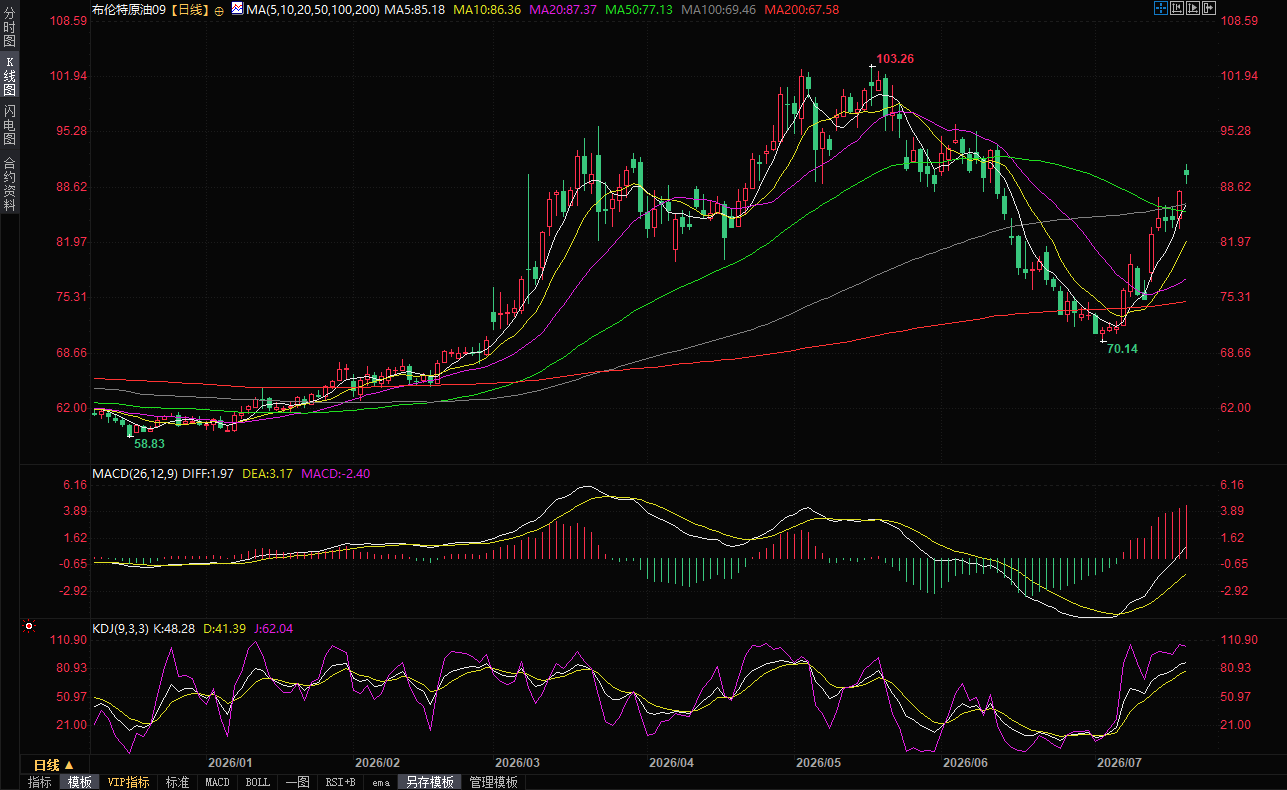
Since July 11, the US military strikes against Iran have continued for nine nights, with the conflict spreading from military targets to civilian infrastructure. Iran retaliated with missiles and effectively blocked the Strait of Hormuz, cutting off a global energy artery. With the US death toll rising to 17 and international oil prices surging over 15% last week, this conflict is evolving from a localized confrontation into a storm affecting the global economy. The ceasefire agreement is now defunct, and its next move is worrying. On Monday (July 20), international oil prices continued their upward trend, with US crude oil rising over 3% to $84.60 per barrel and Brent crude oil rising 3.7% to $91.42 per barrel. 
I. Escalating Conflict: US Ninth Night of Airstrikes on Iran
At 7:00 PM local time on July 19 (7:00 AM Beijing time on July 20), the U.S. Central Command launched a new round of airstrikes against Iran, marking the ninth consecutive night of U.S. military action against Iran since July 11. In a statement, the U.S. Central Command stated that the airstrikes aimed to "continue to weaken Iran's military capabilities to attack merchant ships and civilian sailors transiting the Strait of Hormuz." According to previous information released by the U.S. Central Command, in multiple rounds of airstrikes, the U.S. military has struck numerous military targets along the Iranian coast, including military surveillance facilities, air defense facilities, command centers, maritime combat facilities, and missile and drone storage sites. Meanwhile, the U.S. Navy continues its naval blockade of Iran. As of July 19, the U.S. military had forced six merchant ships to change course and rendered one ship unable to navigate. After arriving at Joint Base Andrews aboard Air Force One, U.S. President Trump told the media that the U.S. military was conducting a "fierce bombing" campaign against Iran to avenge the three U.S. military personnel killed in the Middle East. Trump stated, "Iran has been hit extremely hard, and its military is almost completely destroyed. They have some missiles, some drones, and a little manufacturing capacity left, but very little. We control the Strait, and they can't control anything now."II. Iran's strong retaliation: missiles launched from Lorestan province
In response to the continued US airstrikes, Iran swiftly reacted. According to the Islamic Republic News Agency (IRNA) on July 20, Iran launched a new round of missile launches from Lorestan province in western Iran that day, targeting "enemy targets." Iran announced on July 19 that the recent US airstrikes had resulted in at least 50 deaths and 517 injuries. A source within the Iranian Islamic Revolutionary Guard Corps Navy revealed that traffic in the Strait of Hormuz has dropped to zero, with no ships currently passing through the strait, and any attempt to cross will be met with Iranian retaliation. The source stated that as long as the US continues its "hostile and provocative actions," the Strait of Hormuz will remain closed, and Iran will not issue passage permits to any vessels. Regionally, Iran's retaliatory actions have affected several countries. Kuwait, Bahrain, and Jordan all reported that their air defense systems intercepted a new wave of missiles and drones from Iran. The Jordanian Armed Forces issued a statement on July 19 saying that Jordanian air defense systems intercepted and shot down three missiles from Iran. Israel Defense Forces Chief of Staff Zamir stated that the IDF is closely monitoring the situation in Iran, maintaining a "high state of alert," and is prepared to resume combat operations immediately.III. Casualty figures continue to rise: U.S. military deaths rise to 17
As the conflict continues to escalate, casualty figures on both sides are rising. On July 19, the US military stated that a US soldier in Iraq was killed by an Iranian drone strike. Just on July 18, the US military confirmed that two US soldiers were killed on July 17 in Jordan by Iranian ballistic missiles and drones, several others were injured, and one US soldier was missing. US Department of Defense data shows that since the conflict began in late February, 17 US soldiers have been killed and more than 430 wounded. This number has risen from the previous 16. Iran has also suffered heavy losses. Iranian officials stated that 12 Iranians died in the past day, bringing the death toll in the latest round of fighting to at least 50. US airstrikes have also affected Iranian civilian infrastructure—officials in several Iranian provinces reported that bridges, railways, airports, communication towers, desalination plants, and other civilian facilities were attacked by US airstrikes. The Hormozgan province along the Strait of Hormuz was particularly hard hit, with six bridges destroyed and 116 communication towers damaged. A U.S. airstrike on a desalination plant in Hormozgan province has completely disrupted the drinking water supply for about 10,000 residents in 20 surrounding villages.IV. Global Market Volatility: Oil Prices Soar, Gold Prices Under Pressure
The escalating conflict between the US and Iran has had a severe impact on global financial markets. In early Asian trading on July 20th, international oil prices surged. By 9:20 AM, WTI crude oil futures prices had risen by over 3% to $84.60 per barrel, while Brent crude oil futures prices had risen by over 3% to $91.42 per barrel. Both oil prices reached new highs since June 11th. Currently, the gains have narrowed slightly, with WTI crude oil trading around $83.52 per barrel and Brent crude oil around $90.24 per barrel. In the previous week, international oil prices had already risen by more than 15%. Market analysts pointed out that the disruption to navigation in the Strait of Hormuz, one of the world's most important energy transport routes, has directly triggered deep concerns about potential disruptions to oil supply. The precious metals market, however, showed the opposite trend. On Monday, spot gold fell as much as 0.8% to $3,982.237 per ounce. The continued rise in oil prices exacerbated inflation concerns and increased expectations of a Federal Reserve rate hike, putting pressure on gold prices. However, bargain hunting provided support for gold prices, and spot gold once rebounded to around $4,017 per ounce before falling back to around $4,002.20 per ounce.V. The ceasefire agreement has completely collapsed; where will the conflict go?
On July 18, the US and Iran launched a new wave of offensives, with Iran announcing it would cease fulfilling its obligations under the ceasefire memorandum, citing "US violation of the ceasefire agreement." Bloomberg pointed out that the week-long mutual attacks between the US and Iran have no longer been limited to strictly military targets, but have also affected bridges, ports, and other public facilities, indicating that the fragile ceasefire agreement signed last month has little hope of being restored. US Energy Secretary Wright stated on July 19 that US military action against Iran will continue until President Trump achieves his military objectives. In an interview, Wright stated that the Trump administration's goal is to prevent Iran from acquiring nuclear weapons and weaken its ability to threaten neighboring countries and global business activities, "therefore, this mission will continue until the mission is accomplished." Analysts believe that with the complete collapse of the ceasefire agreement, the escalating mutual attacks, and the de facto closure of the Strait of Hormuz, the US-Iran conflict is unlikely to show signs of easing in the short term. Global energy markets, shipping security, and regional stability all face severe challenges.Editor's Summary
The US launched its ninth consecutive night of airstrikes against Iran, marking a new phase in the US-Iran military conflict. While the immediate trigger was Iran's attack on US bases in Jordan, resulting in US casualties, the deeper context lies in the long-standing power struggle between the two sides over control of the Strait of Hormuz, the Iranian nuclear issue, and dominance in the Middle East. Currently, the US's "continuous weakening" strategy and Iran's "blockade of the Strait" retaliation have created a vicious cycle. Traffic in the Strait of Hormuz has plummeted to zero, and Brent crude oil prices have broken through $90 per barrel, highlighting the substantial impact of this conflict on the global energy supply chain. The US Energy Secretary stated that the military action "will continue until the mission is completed," while Iran responded by ceasing to comply with the ceasefire agreement, indicating that neither side has shown any willingness to back down. With the US death toll rising to 17 and Iranian casualties exceeding 500, the risk of further escalation is increasing, and uncertainty in global markets will continue to intensify.Frequently Asked Questions
Q: Why has the US launched continuous airstrikes against Iran? What was the immediate trigger? A: The immediate trigger for the US's continuous airstrikes against Iran was Iran's attack on US targets in the Middle East. On July 17, Iran launched ballistic missile and drone attacks on US bases in Jordan, resulting in the deaths of two US soldiers, one missing, and multiple injuries. Additionally, a US soldier in Iraq was killed by an Iranian drone. The US claims its airstrikes are aimed at "continuously weakening Iran's military capability to attack merchant ships and civilian sailors transiting the Strait of Hormuz." Deeper reasons include the US's attempt to prevent Iran from acquiring nuclear weapons, weaken Iran's control over the Strait of Hormuz, and the long-standing power struggle between the two sides over dominance in the Middle East. Q: What is the current casualty situation on both sides? A: According to the latest data, since the conflict began at the end of February, the number of US military deaths has risen to 17, with more than 430 injured. On the Iranian side, the recent US airstrikes have resulted in at least 50 deaths and 517 injuries. In addition, the US airstrikes also caused extensive damage to Iranian civilian infrastructure, including the destruction of six bridges, damage to 116 communication towers, and an attack on a desalination plant that disrupted the drinking water supply for approximately 10,000 residents. Q: What is the current status of the Strait of Hormuz? What impact will this have on the global energy market? A: On July 19, a source from the Iranian Islamic Revolutionary Guard Corps Navy stated that traffic in the Strait of Hormuz has dropped to zero, and no ships are currently passing through the strait. Iran has stated that the strait will remain closed as long as the US continues its "hostile and provocative actions." As a result, international oil prices surged on July 20, with Brent crude breaking through $91 per barrel and WTI crude reaching $84 per barrel, both new highs since June 11. Last week, international oil prices rose by more than 15% cumulatively. The Strait of Hormuz is one of the world's most important energy transport routes, with approximately 30% of global seaborne oil trade passing through it; its closure poses a serious threat to the global energy supply chain. Q: Why did the ceasefire agreement between the US and Iran break down? A: The US and Iran signed a temporary ceasefire agreement in June, but it has never been effectively implemented. Since July 11, the US military has continued its military strikes against Iran. On July 18, Iran announced it would cease fulfilling its ceasefire memorandum, citing "US violation of the ceasefire agreement." Analysts point out that the week-long mutual attacks have no longer been limited to military targets, but have also affected bridges, ports, and other public facilities, making the restoration of the ceasefire agreement almost hopeless. US Energy Secretary Wright stated on July 19 that US military operations would continue until the objectives of the military operations were achieved. Q: How might this conflict evolve? What impact will it have on the regional situation? A: Judging from the current situation, the conflict is unlikely to ease in the short term. The US has clearly stated that its military operations "will continue until the mission is completed," while Iran has responded by blocking the Strait of Hormuz and continuing missile retaliations. The conflict has expanded from a bilateral confrontation between the US and Iran to involve multiple countries, including Kuwait, Bahrain, Jordan, and Israel. Analysts warn that the risk of further escalation of the conflict is rising exponentially. If the conflict continues to escalate, it will not only severely impact global energy markets and shipping security, but could also trigger broader regional military confrontation. At 09:30 Beijing time, Brent crude oil futures for September delivery were trading at $90.37 per barrel.- Risk Warning and Disclaimer
- The market involves risk, and trading may not be suitable for all investors. This article is for reference only and does not constitute personal investment advice, nor does it take into account certain users’ specific investment objectives, financial situation, or other needs. Any investment decisions made based on this information are at your own risk.