The US dollar index remains strong and volatile; continued attention should be paid to signals from the Federal Reserve's policy.
2026-07-20 13:44:13
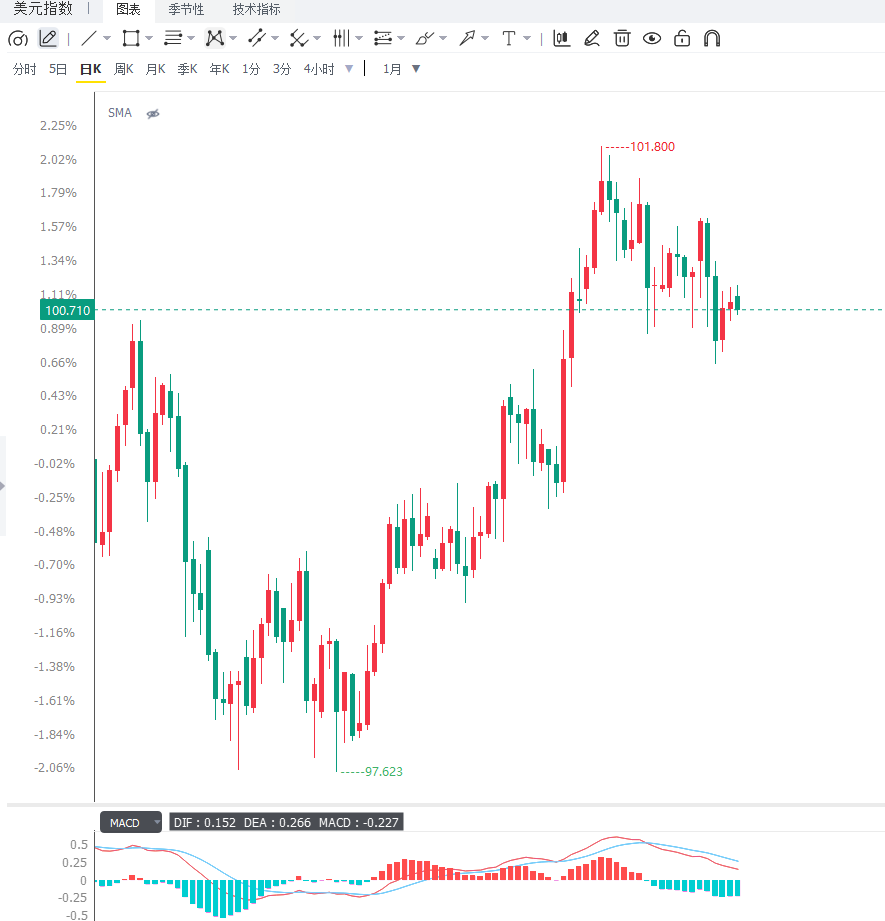
The US dollar index (DXY) rose slightly in early Asian trading on Monday before consolidating, currently trading around the 100.70 area with limited intraday movement. Despite the lack of a clear short-term price breakout, the dollar remains supported by safe-haven demand and expectations of Federal Reserve policy, leading the market to believe that the dollar's short-term trend will remain relatively strong.  A key factor driving the recent strengthening of the US dollar is the continued escalation of tensions between the US and Iran. Recent reports indicate that the US has launched operations against Iranian targets for the ninth consecutive night, following confirmation of another US service member's death in operations in Iraq. The US stated that these actions were in response to recent casualties. Simultaneously, Iran retaliated by launching ballistic missiles and one-way attack drones into Bahrain, Jordan, Kuwait, and Iraq. Market concerns suggest the current situation could escalate further, increasing uncertainty about the duration of the regional conflict. Amidst rising risk aversion, the US dollar, as the world's primary safe-haven asset, has received financial support. Investors are re-pricing geopolitical risk premiums, maintaining the dollar's advantage relative to other major currencies. This is especially true when global financial markets experience increased volatility, with funds often flowing to more liquid dollar assets. On the other hand, significant fluctuations in the energy market have also strengthened the dollar's support. Recent increases in international crude oil prices to their highest level since June 12th are primarily due to increased shipping risks in the Strait of Hormuz and related port restrictions, raising concerns about potential disruptions to Middle Eastern oil supplies. Rising oil prices have reignited global inflation expectations. If energy costs continue to rise, it could force major central banks to maintain a more cautious monetary policy. For the Federal Reserve, rising inflation risks could reduce market expectations for rapid interest rate cuts and support a strong dollar. The market still anticipates the possibility of further interest rate adjustments by the Fed, with some investors continuing to bet on a tightening policy environment. This expectation further strengthens the dollar's short-term advantage and limits a significant pullback in the dollar index. However, the dollar's future performance will depend on US economic data and speeches by Fed officials. With a lack of major US economic data releases at the beginning of this week, market focus will shift to the latest statements from Federal Open Market Committee (FOMC) members regarding inflation, interest rates, and the economic outlook. Furthermore, global risk events remain a significant variable affecting the dollar. If the situation in the Middle East escalates further, demand for the dollar as a safe haven may continue to increase; however, if risk sentiment eases rapidly, the dollar's short-term gains may be suppressed. From a daily chart perspective, the dollar index has maintained a slightly bullish trend recently, and after the price stabilized above the 100 level, bullish momentum has recovered somewhat. The index is currently trading around 100.80. Key resistance levels to watch are the 101.20-101.50 area; a break above this level could lead to a test of the 102.00 psychological level. Support is initially seen at the 100.00 area, a recent key level for both bulls and bears; a break below this level could lead to a pullback to test the 99.50 area. Technically, the MACD is gradually strengthening, and short-term moving averages are providing support, indicating a short-term bullish bias. However, profit-taking pressure should be monitored at higher levels. On the 4-hour chart, the US dollar index maintains an upward trend, trading near short-term moving averages, with buying pressure still holding a slight advantage. The RSI indicator is in a neutral-to-strong zone, suggesting that upward momentum has not yet been excessive. A break above the 101.20 resistance level could open up further upside potential; a break below 100.50 could trigger a correction, potentially testing support around 100.00. The 4-hour chart currently favors a bullish bias, with market direction largely dependent on geopolitical risks and expectations surrounding Federal Reserve policy.
  Editor's Summary: The US dollar index is currently supported by safe-haven demand, expectations of Federal Reserve policy changes, and inflation concerns stemming from rising energy prices. Escalating tensions in the Middle East increase the probability of declining market risk appetite, allowing the dollar to maintain its traditional safe-haven advantage. In the short term, the dollar still has upward momentum, but the extent of its continued rise depends on whether risk events escalate further. If regional tensions persist, the dollar may continue to attract capital inflows; if market risk sentiment improves while US economic data weakens, the dollar may face a technical correction. Going forward, investors should pay close attention to speeches by Federal Reserve officials, changes in energy prices, and developments in global risk events. The US dollar index may maintain a high-level, slightly bullish trend in the short term.
A key factor driving the recent strengthening of the US dollar is the continued escalation of tensions between the US and Iran. Recent reports indicate that the US has launched operations against Iranian targets for the ninth consecutive night, following confirmation of another US service member's death in operations in Iraq. The US stated that these actions were in response to recent casualties. Simultaneously, Iran retaliated by launching ballistic missiles and one-way attack drones into Bahrain, Jordan, Kuwait, and Iraq. Market concerns suggest the current situation could escalate further, increasing uncertainty about the duration of the regional conflict. Amidst rising risk aversion, the US dollar, as the world's primary safe-haven asset, has received financial support. Investors are re-pricing geopolitical risk premiums, maintaining the dollar's advantage relative to other major currencies. This is especially true when global financial markets experience increased volatility, with funds often flowing to more liquid dollar assets. On the other hand, significant fluctuations in the energy market have also strengthened the dollar's support. Recent increases in international crude oil prices to their highest level since June 12th are primarily due to increased shipping risks in the Strait of Hormuz and related port restrictions, raising concerns about potential disruptions to Middle Eastern oil supplies. Rising oil prices have reignited global inflation expectations. If energy costs continue to rise, it could force major central banks to maintain a more cautious monetary policy. For the Federal Reserve, rising inflation risks could reduce market expectations for rapid interest rate cuts and support a strong dollar. The market still anticipates the possibility of further interest rate adjustments by the Fed, with some investors continuing to bet on a tightening policy environment. This expectation further strengthens the dollar's short-term advantage and limits a significant pullback in the dollar index. However, the dollar's future performance will depend on US economic data and speeches by Fed officials. With a lack of major US economic data releases at the beginning of this week, market focus will shift to the latest statements from Federal Open Market Committee (FOMC) members regarding inflation, interest rates, and the economic outlook. Furthermore, global risk events remain a significant variable affecting the dollar. If the situation in the Middle East escalates further, demand for the dollar as a safe haven may continue to increase; however, if risk sentiment eases rapidly, the dollar's short-term gains may be suppressed. From a daily chart perspective, the dollar index has maintained a slightly bullish trend recently, and after the price stabilized above the 100 level, bullish momentum has recovered somewhat. The index is currently trading around 100.80. Key resistance levels to watch are the 101.20-101.50 area; a break above this level could lead to a test of the 102.00 psychological level. Support is initially seen at the 100.00 area, a recent key level for both bulls and bears; a break below this level could lead to a pullback to test the 99.50 area. Technically, the MACD is gradually strengthening, and short-term moving averages are providing support, indicating a short-term bullish bias. However, profit-taking pressure should be monitored at higher levels. On the 4-hour chart, the US dollar index maintains an upward trend, trading near short-term moving averages, with buying pressure still holding a slight advantage. The RSI indicator is in a neutral-to-strong zone, suggesting that upward momentum has not yet been excessive. A break above the 101.20 resistance level could open up further upside potential; a break below 100.50 could trigger a correction, potentially testing support around 100.00. The 4-hour chart currently favors a bullish bias, with market direction largely dependent on geopolitical risks and expectations surrounding Federal Reserve policy. Editor's Summary: The US dollar index is currently supported by safe-haven demand, expectations of Federal Reserve policy changes, and inflation concerns stemming from rising energy prices. Escalating tensions in the Middle East increase the probability of declining market risk appetite, allowing the dollar to maintain its traditional safe-haven advantage. In the short term, the dollar still has upward momentum, but the extent of its continued rise depends on whether risk events escalate further. If regional tensions persist, the dollar may continue to attract capital inflows; if market risk sentiment improves while US economic data weakens, the dollar may face a technical correction. Going forward, investors should pay close attention to speeches by Federal Reserve officials, changes in energy prices, and developments in global risk events. The US dollar index may maintain a high-level, slightly bullish trend in the short term.
- Risk Warning and Disclaimer
- The market involves risk, and trading may not be suitable for all investors. This article is for reference only and does not constitute personal investment advice, nor does it take into account certain users’ specific investment objectives, financial situation, or other needs. Any investment decisions made based on this information are at your own risk.