The market believes that the easing of geopolitical tensions is limited, and oil prices will not fall despite the negative impact.
2026-07-21 17:42:13
On Tuesday (July 21), international oil prices fluctuated rapidly during the Asian and European sessions. The Revolutionary Guard claimed to have struck US military targets in Jordan and Bahrain. Subsequently, news circulated that Iran had proposed a 10-day ceasefire, with the US demanding a partial agreement on passage through the Strait of Hormuz first. Oil prices then surged to 0.7% before quickly falling back to -1%, currently trading around 83, up 0.69%. The geopolitical struggle over the Strait of Hormuz continues to intensify. The US has launched its tenth consecutive night of airstrikes against Iranian territory, and Iran has retaliated strongly, precisely targeting commercial oil tankers in the key shipping lanes, further escalating the geopolitical confrontation. Early Tuesday morning, Iran attacked a merchant ship in the Strait of Hormuz, forcing all crew members to abandon ship. Simultaneously, the US continued to escalate its airstrikes against Iranian military targets. The two sides are engaged in an extreme struggle over this energy choke point, which carries one-fifth of the world's oil and natural gas trade, with the battle for control of the shipping lanes reaching a fever pitch, continuously injecting geopolitical premiums into the oil market. From a trading perspective, the US military's intensive airstrikes over ten consecutive nights failed to achieve a strategic deterrent effect and did not force Iran to relax its control over the Strait of Hormuz. The shortcomings of the US's reliance solely on air strikes in this game have been thoroughly exposed. As the conflict continues to escalate, the tail risk of a full-scale US-Iran war has intensified again, and risk aversion continues to dominate energy market prices.  In an attempt to de-escalate the situation, Iran's Interior Minister traveled to Pakistan, the mediator at the heart of the conflict, for emergency consultations. However, there are currently no signs of substantive negotiations, and the probability of a short-term ceasefire or de-escalation is extremely low, making a rapid reversal of the tense geopolitical situation unlikely. The temporary ceasefire agreement reached last month has been completely invalidated, and maritime trade in the Strait of Hormuz has essentially come to a standstill. Furthermore, the confrontation is no longer limited to purely military targets; both sides have begun targeting civilian infrastructure vital to the lives of civilians, further escalating the intensity and scope of the conflict and increasing overall uncertainty. The US State Department has simultaneously updated its overseas risk warnings, explicitly stating the possibility of global retaliation from Iran and its proxies, and highlighting the potential for attacks on US overseas assets, bases, and personnel, indicating a continued spread of geopolitical risks. The US military has also suffered substantial casualties in this round of conflict: an attack on a US base in Jordan resulted in the deaths of two soldiers and one missing, and on Saturday, another US soldier died during operations to handle a downed Iranian drone in Iraq. Trump issued a strong statement on Monday, clearly stating that any Iranian casualties would be met with retaliatory measures of several times the amount, effectively extinguishing any expectations of de-escalation. Trump was scheduled to welcome the remains of fallen soldiers home on Tuesday evening, but the emotional impact could still escalate, potentially jeopardizing geopolitical conflicts.
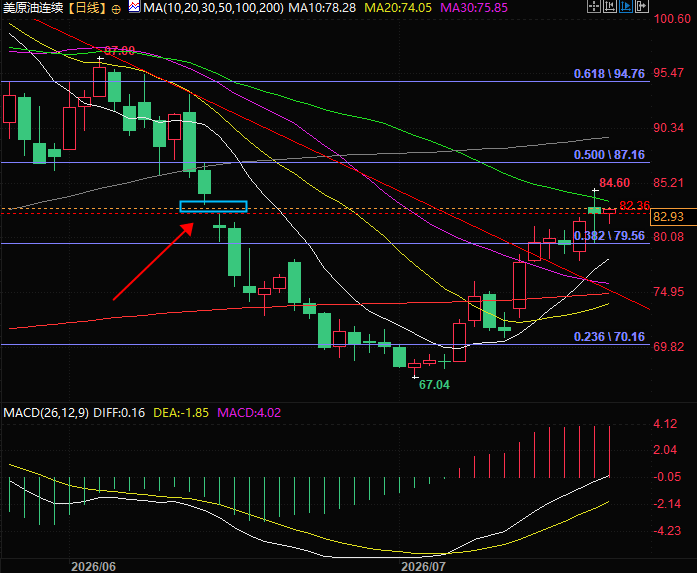 (WTI futures contract daily chart, source: EasyTrade) At 17:38 Beijing time, the WTI futures contract was trading at $82.93 per barrel.
In an attempt to de-escalate the situation, Iran's Interior Minister traveled to Pakistan, the mediator at the heart of the conflict, for emergency consultations. However, there are currently no signs of substantive negotiations, and the probability of a short-term ceasefire or de-escalation is extremely low, making a rapid reversal of the tense geopolitical situation unlikely. The temporary ceasefire agreement reached last month has been completely invalidated, and maritime trade in the Strait of Hormuz has essentially come to a standstill. Furthermore, the confrontation is no longer limited to purely military targets; both sides have begun targeting civilian infrastructure vital to the lives of civilians, further escalating the intensity and scope of the conflict and increasing overall uncertainty. The US State Department has simultaneously updated its overseas risk warnings, explicitly stating the possibility of global retaliation from Iran and its proxies, and highlighting the potential for attacks on US overseas assets, bases, and personnel, indicating a continued spread of geopolitical risks. The US military has also suffered substantial casualties in this round of conflict: an attack on a US base in Jordan resulted in the deaths of two soldiers and one missing, and on Saturday, another US soldier died during operations to handle a downed Iranian drone in Iraq. Trump issued a strong statement on Monday, clearly stating that any Iranian casualties would be met with retaliatory measures of several times the amount, effectively extinguishing any expectations of de-escalation. Trump was scheduled to welcome the remains of fallen soldiers home on Tuesday evening, but the emotional impact could still escalate, potentially jeopardizing geopolitical conflicts.Military competition is spreading across the board, and the risk of paralyzing shipping across the Taiwan Strait continues to soar.
This round of US airstrikes precisely targeted key Iranian targets, including military command centers, naval combat equipment, missile and drone launch sites, and air defense systems. The release of footage of the bombings further amplified the US's military pressure posture. The US government has explicitly stated that it will maintain a high state of readiness throughout the operation, continue to hold Iran accountable for its attacks on civilian merchant ships in the Strait of Hormuz, and resolutely defend the freedom of navigation in the waterway. There are currently no signs of retreat in this military standoff. The ongoing military confrontation has led to a near-total paralysis of shipping in the Strait of Hormuz, with risk aversion completely suppressing market liquidity. Data from British maritime agencies shows that the attack on an oil tanker in Omani waters early Tuesday morning directly triggered the crew to abandon ship, further escalating the risk to navigation in the Strait. The Iranian Revolutionary Guard has officially claimed responsibility for the attack and confirmed two other ship strikes launched in the Strait on Monday, actively escalating the disruption to the waterway. The previously promoted US-led detour route around Oman has become completely ineffective; currently, there are no safe navigation paths around the Strait of Hormuz, and the energy transport system is under immense pressure. Iran's retaliatory strikes continue to expand, comprehensively covering the US's Middle Eastern allies. The Jordanian military confirmed that Iran launched five attack drones into its territory. Although all were intercepted by Jordan's air defense system, this incident signifies that regional offensive and defensive confrontation has fully unfolded. The Middle East geopolitical conflict is no longer limited to the US and Iran; a multilateral game is taking shape, further amplifying uncertainty in the global energy market. Since the US resumed airstrikes against Iran on July 7, the number of US military casualties has approached 100. A spokesperson for the US Department of Defense publicly denied rumors that the casualty data was concealed, stating that over 90% of the injured suffered only mild concussions and the vast majority have returned to duty, attempting to calm market sentiment and downplay the severity of the conflict. However, the official military casualty database has not yet updated the latest damage data for this round, and the information asymmetry continues to exacerbate the divergence between bullish and bearish views in the market, leaving room for further upward pricing of geopolitical risks.Risks from both shipping lanes are converging, and the global energy supply chain is facing a double shock.
The most significant incremental variable in this round of geopolitical risk lies in the fact that the conflict has spread from the Strait of Hormuz alone to the world's second core energy shipping route, creating a dual-route risk resonance pattern. Affected by Saudi airstrikes on its international airport, the Houthi rebels in Yemen, supported by Iran, officially announced a maritime embargo against Saudi Arabia on Monday, planning to block the Bab el-Mandeb Strait, a vital energy choke point on par with the Strait of Hormuz, completely disrupting the previous market pattern of pressure on a single shipping route. Previously, after the Strait of Hormuz became congested and paralyzed, Saudi Arabia relied on overland oil pipelines to export crude oil via the Red Sea, becoming an important safe-haven supplementary channel for global crude oil supply. However, the Houthi rebels possess sophisticated capabilities to disrupt shipping lanes; during the previous Israeli-Palestinian conflict, they attacked over 100 vessels. With this blockade in place, Saudi Arabia's alternative export route will be cut off, and the global maritime crude oil supply chain will face a comprehensive shock. The Saudi military responded strongly, stating it would do everything possible to ensure navigational order in the shipping lanes and condemning the Houthi actions as violations of international law and acts of piracy. The standoff further exacerbates shipping risks and provides strong support for oil prices. On July 20, local time, the Saudi-led coalition issued a statement saying that it is taking all necessary military actions and stringent measures to ensure the safety of shipping in the Bab el-Mandeb Strait, and will take resolute and forceful measures against any threats to shipping safety in accordance with international law and the United Nations Convention on the Law of the Sea. The statement denied the Houthi accusations of a blockade of Yemeni ports and airports. The Saudi Ministry of Foreign Affairs stated that in the first half of 2026, more than 300 merchant ships had entered several ports in Yemen, including Hodeidah, and that the Houthis were responsible for the damage to Yemeni civil aviation infrastructure, the closure of the international airport, and flight disruptions.Expectations for diplomatic détente are weak, and the long-term war of attrition has become entrenched.
Despite market expectations of marginal diplomatic easing, a substantial de-escalation is extremely difficult. Recently, Pakistan has proactively increased its mediation efforts, pushing hard to repair the broken temporary ceasefire agreement. Iran's Interior Minister also arrived in Pakistan on Monday for two days of high-level diplomatic consultations, briefly restoring market risk appetite. However, US Secretary of State Rubio clearly stated that the US will not close the door to negotiations, but will only accept consultations with substantial results, rejecting formalistic mediation. He also acknowledged that there is currently no pragmatic faction leading the negotiations within Iran, and the conditions for a substantial reconciliation are not yet mature. Looking at the attrition data from both sides, a protracted war of attrition has become firmly established. Iranian officials disclosed that multiple rounds of US airstrikes have resulted in 50 deaths and 517 injuries in Iran; since the outbreak of the conflict on February 28, 17 US soldiers have been killed. Both sides have paid a heavy price, and the bottom line in the game continues to rise. It is unlikely that the confrontation can be quickly ended through diplomatic means in the short term, and the geopolitical premium will remain anchored to high oil prices for a long time.The interconnectedness of oil and gas prices exacerbates supply anxieties and strengthens the bullish logic for energy prices.
Current energy market risks have become interconnected in both crude oil and natural gas, further fueling overall energy inflation expectations. Goldman Sachs, a top investment bank, recently raised its European natural gas price forecast in a research report, increasing its Q3 and Q4 TTF natural gas price predictions from €41 and €40/MWh to €60 and €53/MWh respectively. The report also warns of an increased risk of a cold snap in Europe this winter, with TTF prices potentially reaching an extreme high of €65/MWh. The widening supply-demand gap in European natural gas, coupled with the potential impact of a winter cold snap, will indirectly drive up demand for crude oil substitution, creating a synchronized rise in oil and gas prices. Meanwhile, the Strait of Hormuz, a key global shipping route for natural gas, will see its shipping paralysis directly restrict cross-border gas supply, further amplifying the European supply-demand gap. With multiple positive factors converging, the tight supply-demand balance in the crude oil market is unlikely to reverse. The combined effects of geopolitical risks, supply contraction, and energy substitution make it difficult to shake the current high and strong oil price trend in the short term.Trading Summary and Market Outlook
In summary, the core trading logic of the current crude oil market revolves around the ongoing US-Iran standoff, the combined risks of the two shipping lanes, and the tight balance between energy supply and demand. Short-term diplomatic easing can only bring temporary sentiment recovery and cannot change the core fundamentals of a long-term geopolitical stalemate and limited energy supply. Oil prices remain high due to a strong geopolitical premium. The key focus going forward will be on the navigation status of the Strait of Hormuz and the Bab el-Mandeb Strait, as well as the confrontational movements between the US and Iran and the Houthi rebels. If the shipping lanes are completely blocked or the conflict escalates again, oil prices will experience another sharp surge. Conversely, if diplomatic efforts yield unexpected results, a recovery in market risk appetite may lead to a short-term technical correction, but this will not change the overall bullish medium- to long-term trend. Technical analysis shows that WTI oil prices are in a directional phase, with the daily chart leaning bullish. After yesterday's gap-up reversal, prices corrected to fill the gap. Despite the negative impact of the US-Iran peace talks, prices did not show significant weakness. However, intraday charts showed two sharp drops, indicating potential weakness. Currently, prices are awaiting correction, with support between 81-81.5. If WTI oil prices approach this price range, it would signify further weakness. Resistance is near the previous gap at 83.5 and the 50-day moving average. (WTI futures contract daily chart, source: EasyTrade) At 17:38 Beijing time, the WTI futures contract was trading at $82.93 per barrel.
- Risk Warning and Disclaimer
- The market involves risk, and trading may not be suitable for all investors. This article is for reference only and does not constitute personal investment advice, nor does it take into account certain users’ specific investment objectives, financial situation, or other needs. Any investment decisions made based on this information are at your own risk.