Will gold prices rebound in the short term as the US and Iran resume their peace talks narrative?
2026-07-20 18:18:16
On Monday (July 20), during the Asian and European sessions, gold prices rebounded after initially falling along with Asian equity markets, before recovering slightly to close near 4020, up 0.10%. On July 20 local time, Iranian Foreign Ministry spokesman Baghae stated at a press conference that war and diplomacy are both means of defending national interests, and the channels for negotiation have not been completely closed. He mentioned that the Iranian diplomatic team will not abandon its duties due to potential risks in negotiations, and the military will not abandon its national defense mission due to the opponent's superior equipment. In response to a question about whether there is still room for negotiation between the US and Iran, Baghae replied that all Iranian diplomatic and military decisions are centered on national interests, and the two methods are not mutually exclusive. This also means that the channels for dialogue between the two sides have not been completely blocked, which slightly boosted gold prices. With the Middle East situation remaining tense, the US-Iran standoff escalating, and frequent attacks on shipping in the Strait of Hormuz and local oil and gas facilities, geopolitical risks should have driven up safe-haven buying of gold. However, this round of market movements has seen the opposite trend, with gold prices remaining weak and volatile. This week, prices have been under pressure around the $4,000 mark, and last week saw a continuous decline. Manav Modi, senior commodities analyst at Motila Oswal Financial, analyzes that repeated geopolitical turmoil is disrupting market risk appetite, and under the pressure of multiple macroeconomic headwinds, it is difficult for gold to stage a rebound. 
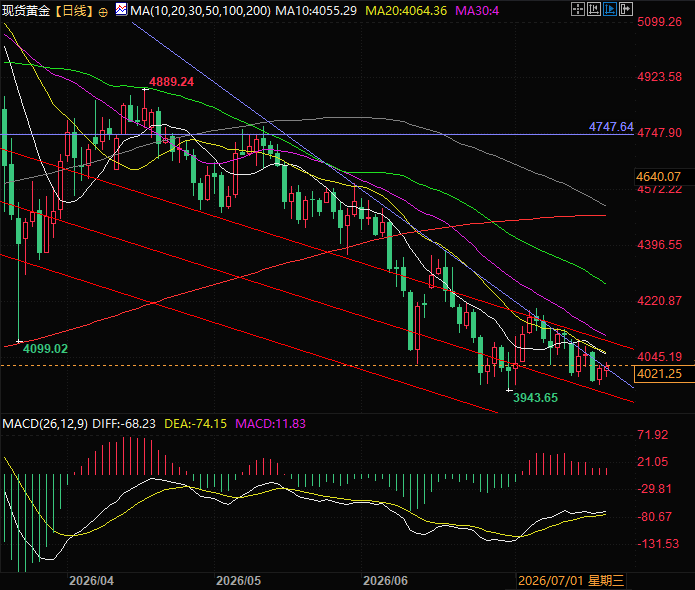 (Spot gold daily chart, source: EasyTrade) At 18:12 Beijing time, spot gold is currently trading at $4020 per ounce.
A strong US dollar and high global interest rates are the core factors suppressing gold prices.
The recent sharp decline in gold prices is fundamentally driven by the dual negative factors of a stronger US dollar and a global tightening monetary environment. The US dollar index has continued to rebound, and since gold is priced in US dollars, the cost for overseas funds to buy gold has increased accordingly, directly discouraging external physical and speculative buying. More importantly, gold is a non-interest-bearing asset, and its allocation value has significantly diminished against the backdrop of global anti-inflation policies. In the past, when inflation was high, funds would flow into gold to hedge against currency devaluation and preserve purchasing power, but the market logic has reversed by 2026. Global energy conflicts have pushed up oil prices, exacerbating concerns about a rebound in inflation. Central banks around the world have made curbing prices their primary policy objective, leading to a consensus expectation of long-term high interest rates in the market. Compared to risk-free bonds such as US Treasury bonds, which can continuously increase yields, gold cannot generate interest or dividends, so funds naturally continue to flow out of the precious metals market. As long as global central banks maintain tight policies to suppress inflation, the upside potential for gold's fundamentals will remain limited.The logic of geopolitical conflict has reversed, turning safe-haven demand into a negative factor for gold prices.
The current Middle East crisis has not been beneficial to gold. The core reason is that the continued rise in oil prices will reignite energy inflation, slowing the current pace of global inflation decline and forcing major central banks such as the Federal Reserve to extend the high-interest-rate cycle. A confluence of positive news for the US dollar has led to a simultaneous strengthening of the dollar and US Treasury yields, further diminishing the attractiveness of gold. Even with the escalating conflict in the Middle East, geopolitical safe-haven demand cannot provide effective support for gold prices. In fact, escalating conflict will amplify market expectations for high interest rates, exacerbating downward pressure on gold prices. However, recent US consumer inflation, producer inflation, and retail sales data show signs of economic weakness. Whether this trend will continue requires further data verification. The market is currently more concerned about the risk of an inflation rebound due to high oil prices. Traders continue to bet on the Federal Reserve maintaining high interest rates. Several high-ranking Federal Reserve officials have recently released hawkish signals, but this also increases the possibility that inflation has peaked. Chairman Kevin Warsh, Governor Christopher Waller, and New York Fed President John Williams have all stated that policymakers' primary goal remains controlling inflation risks. They will only consider initiating interest rate cuts after seeing reliable data showing a sustained cooling of prices, but inflation may have already reached its peak. Domestically, the People's Bank of China maintained the loan prime rate unchanged as expected, keeping domestic liquidity stable and having a limited impact on international gold prices.Key indicators to watch for the market outlook
Short-term gold price movements are primarily anchored to three variables: oil prices, US Treasury yields, and the US dollar index. Escalating geopolitical conflicts will only exacerbate volatility across the entire asset market and are unlikely to reverse the overall trend for gold. Investors should closely monitor the preliminary PMI readings for manufacturing and services sectors of major global economies, the European Central Bank's interest rate decision, and the latest developments in the Middle East to identify short-term turning points in gold prices. Technically, spot gold remains under pressure from the descending trendline (blue) and the lower boundary of the descending channel (red), with overall moving averages in a bearish alignment. However, despite the recent sharp decline in equity markets, gold prices have performed relatively well in the last two trading days, suggesting a potential near-term reversal. (Spot gold daily chart, source: EasyTrade) At 18:12 Beijing time, spot gold is currently trading at $4020 per ounce.
- Risk Warning and Disclaimer
- The market involves risk, and trading may not be suitable for all investors. This article is for reference only and does not constitute personal investment advice, nor does it take into account certain users’ specific investment objectives, financial situation, or other needs. Any investment decisions made based on this information are at your own risk.